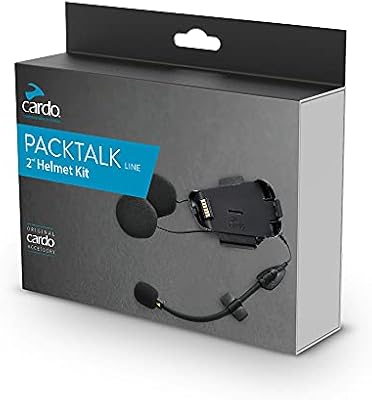
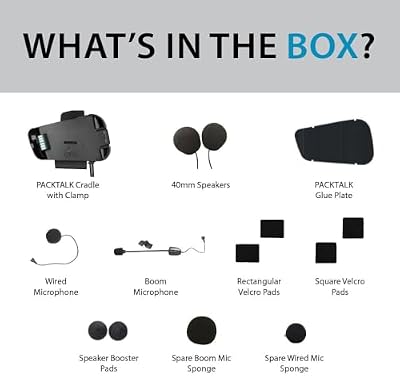
A second helmet should not need a second communicator, and Cardo agrees in principle. The PACKTALK audio and microphone 2nd helmet kit exists to move one headset unit between two helmets: it carries the boom microphone, the mounting hardware, and a 3.5mm jack for speakers you already own or supply separately.
The catch sits in the listing itself. Its title says PACKTALK, and the kit's own fit line excludes every current Packtalk model: the Edge, the Pro, the Neo, and the Edge ORV. One buyer in the record says they ordered on a title that named the Pro and found the not-compatible line printed in the box, which makes the model check the first thing to do, not the last.
This review covers what the kit actually contains, the fit line and the buyer who hit it, the thin written record under a large rating pool, and the pairing that emerges across Cardo's accessory shelf: the mic half sold here, and the speaker half sold separately at nearly the same price.
The short version. The Cardo PACKTALK 2nd helmet kit is mic, mount hardware and a speaker jack, sold so that one older PACKTALK or SmartPack unit can live on two helmets. It is the cheap way to do that, but only for owners of the older units, because the fit line rules out the entire current Packtalk range by name.
On our intercom comparison table it prices in the pricier third of everything we track, and the table prices this accessory per rider like a full headset when it contains neither a unit nor speakers. Check your unit's model before ordering, not the title on the box.
One communicator, two helmets, and what the box leaves out
The kit listed at 99.95 and read In Stock with a buy box on the day we checked. The contents are the audio and microphone kit and nothing else, as the Included Components row puts it.
The first bullet explains the design: it allows you to mount your PACKTALK or SmartPack headset to another helmet, so the expensive part stays with one helmet while the second helmet gets a boom microphone and the mounting hardware. The third bullet is the one to read twice: the kit does not include speakers, and any speaker you want has to plug into its 3.5mm jack.
The second bullet adds a use case the rest of the listing never mentions again: a hard boom microphone aimed at half helmets. Half-helmet riders get a dedicated claim here and nothing else, because no text in the owner record reports using the kit on one.
Against the alternatives, the money math is simple. A second full unit costs several hundred dollars, and the matched 2-pack boxes we have priced this season run from about 400 to about 720 on our table. This kit costs 99.95 and reuses hardware you already own, which is a different trade: it keeps one unit doing both helmets rather than fielding a matched pair that can talk to each other on the road.
The title and the fit line disagree
The listing argues with itself in the first screen, and the disagreement is the whole buying decision.
The title says PACKTALK. The highlight line underneath says Not Compatible With Packtalk Edge, Pro, Neo and Edge ORV Models, which excludes every Packtalk model Cardo currently sells. The kit serves the older PACKTALK and SmartPack units named in the first bullet, and nothing newer.
The owner record shows what happens when that line goes unread. One buyer reports that the listing title named the Pro, and that the box said the Pro was not supported, and asks whether that was a mistake or on purpose. That text carries no confirmed-purchase badge, but it describes the exact trap the listing sets: a title naming the flagship range over hardware the flagship range can't use.
The check that avoids this takes a minute. If the helmet carries a PACKTALK Edge, Pro, Neo or Edge ORV, this kit will not serve it, and our PACKTALK Edge review and PACKTALK Pro review cover units that need different extra hardware. If it's an older PACKTALK or a SmartPack, the kit exists for it.
A big rating pool over a quiet record
The average sits at 4.7 from 1,845 ratings, and the histogram is heavy at the top with 83 percent five-star. The written record underneath is thin: the ten most recent texts span about nineteen months, and most are one line long.
The useful ones still say something. The newest text, from October 2026, frames the kit as a way to replace the speakers and microphone in an existing setup without buying a whole new communicator.
A June 2025 text gives the clearest statement of the use case, calling it a great buy for anyone who wants the same Cardo unit on multiple helmets, while noting the instructions were sufficient but could have been formatted better. Two more describe easy installs and a clean fit.
What the record never supplies is the detail a careful buyer wants. Nobody reports pairing the kit with specific speakers, nobody names which PACKTALK model they own, nobody reports using the hard boom on a half helmet, and nobody reports owning one long enough to describe wear. The 1,845 ratings back the idea, but they don't settle the details.
Template rows and the one spec that matters
The spec table carries the usual listing-template noise. Power Source reads Battery Powered and the rows count one lithium ion battery required, on a kit that contains no battery at all.
Connectivity Technology reads Wireless, though the kit's entire job is a wired 3.5mm connection. Recommended Uses For Product reads Speech and Video Conference, an office-headset row that wandered onto motorcycle hardware. The 2 ohm impedance row prints identically on the 45mm audio set page next door, so the two accessory listings visibly share a spec template.
One row is real. Polar Pattern reads Unidirectional, and that is the actual design of a boom microphone: it picks up sound arriving from the direction it points and attenuates sound from the sides and behind (Wikipedia). Pointed at the mouth from a boom position, a unidirectional mic favors the voice over wind and road noise arriving from everywhere else, which is why the hard-boom design exists.
The other half costs about the same
Cardo has split the second helmet into two accessory boxes, and the mirror-image pricing is hard to miss. This kit sells the microphone and mount hardware without speakers. The 45mm audio set next door sells JBL speakers without a microphone, at 98.95 against this kit's 99.95, and our 45mm audio set review covers that box and its own split record.
Bought together, the two halves cost 198.90, which is about half what a single premium Cardo unit costs and far less than a second premium unit. That combined build makes sense for one specific rider: the owner of an older PACKTALK or SmartPack who rides two bikes or shares a bike, wants full audio on both helmets, and does not need the two helmets to talk to each other on the move.
Riders who want two complete units that work alone should price the 2-pack boxes instead, and our PACKTALK Slim dual pack review is one place to start.
Common questions about the Packtalk 2nd helmet kit
Does it work with a Packtalk Edge or Pro?
No. The listing's own fit line excludes the Edge, the Pro, the Neo and the Edge ORV by name, and the kit serves the older PACKTALK and SmartPack units only. One owner reports ordering on a title that named the Pro and finding the exclusion in the box, so the generation check comes before the order.
Does the kit include speakers?
No. The third bullet states it plainly: the kit does not include speakers, and any speaker plugs into its 3.5mm jack. Cardo sells the speaker half separately as the 45mm audio set.
Can one communicator really serve two helmets?
That is the design intent, and the record agrees with it. The first bullet describes mounting the headset to another helmet, and an owner in the record calls it a great product for using the same Cardo unit on multiple helmets. The trade is that the two helmets share one unit, so only the helmet wearing the electronics can talk.
Is the hard boom only for half helmets?
The listing presents it that way, as a hard boom audio kit for half helmets. No owner text reports the half-helmet use, so the claim rests on the bullet alone, though a boom pointed at the mouth is the standard answer wherever helmet shape rules out a flat pad.