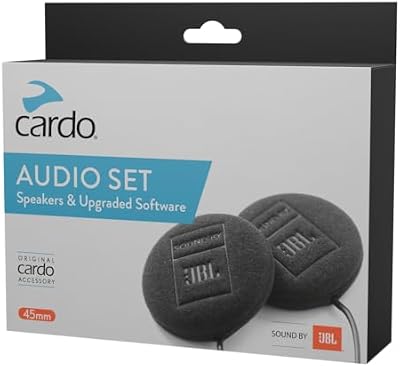
A headset that pairs fine and takes calls fine but sounds thin through the helmet is a common place to end up, and the usual fix is not a new unit. Cardo sells the 45mm audio set for exactly this moment. It's a pair of larger JBL-branded speakers that drop into a helmet in place of the smaller drivers shipped with its FREECOM, PACKTALK and Spirit systems.
The choice is harder than a part swap should be, because the owner record splits down the middle.
Several recent buyers describe night-and-day upgrades and describe testing the new speakers back to back against the old ones. Others, including one on the very same helmet model, report hearing no change at all. Both camps are recent, both include confirmed purchases, and the difference between them appears to come down to where the speaker ends up inside the helmet once it closes.
This review walks the split record, the alignment reading that reconciles it, the spec table that contradicts itself on everything from noise control to battery life, and the one durability account the listing carries. It also sits the price against the alternative that matters. The same money buys an entire entry-level headset from a budget brand.
The short version. The Cardo 45mm audio set is a speaker upgrade and nothing else: two 45mm JBL-branded drivers on wire-stem mounts, no microphone, no unit, no battery. The record is genuinely split, and the reading that reconciles it is placement, which one owner states outright and the physics supports.
On our intercom comparison table the set prices in the pricier third of everything we track, and it is worth remembering that the table prices this accessory per rider like a full headset when it really serves one helmet's ears.
A rider with a working Cardo unit and thin sound is the right buyer. Anyone starting from zero should price a whole budget headset first, because several cost less than these two speakers do.
What the money buys, and what it does not
The set listed at 98.95 and read In Stock with a buy box on the day we checked.
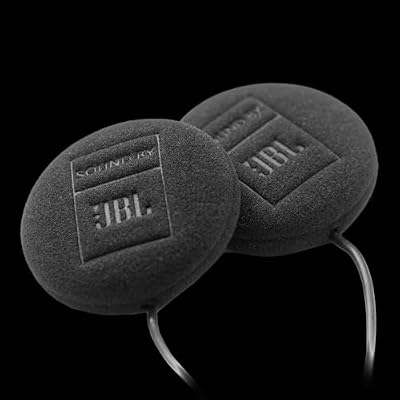
The box is a pair of 45mm speakers with foam-covered circular pads and thin wire stems for mounting, 3.87 ounces of total weight. The spec table names JBL as the audio technology partner and a dynamic driver as the type, with a 20Hz to 20,000Hz frequency range and a 2 ohm impedance. Nothing else ships: there's no boom microphone in the contents, no clamp, and no battery.
One thing about this listing stands out before any spec does. It carries no feature bullets at all, which is unusual on a page with 2,278 ratings behind it. Cardo has left the whole pitch to one highlight line, Compatible With FREECOM, PACKTALK and Spirit Series, and to the spec table. That line is generous in one direction: a separate row reads Most helmet communicators, so the set isn't locked to Cardo units, though it's optimized for the FREECOM and PACKTALK range.
A record that splits, and the reading that reconciles it
The average sits at 4.4, and the ten most recent texts tell two different stories about this speaker set.
Four of the ten describe upgrades with comparisons behind them. One owner who moved from a Spirit HD reports a big step up and says they ran back-to-back tests against the stock 40mm speakers with the JBL sound profiles on and off.
Another describes a huge upgrade over the 40mm speakers that come with the PACKTALK and FREECOM 2x, reporting a side-by-side test and better call quality, and notes the set fits a Shoei RF-1400. A third calls the difference night and day. A fourth calls it a huge upgrade on a 2022 Freecom 4.
Two others pan the set outright. One writes that it made no change at all on a Spirit HD and calls the originals exactly the same. That text lands within two weeks of the Spirit HD praise above. The other, written in Spanish, calls the sound very poor for the money. A third critical text compares across brands: this owner reports the speakers were no better or louder than the stock Fodsports set they already had.
The reading that reconciles all of this comes from the owner who did the controlled tests, and it is about placement. They suggest that buyers reporting no difference have the speakers sitting out of line with their ears.
The physics gives that reading some backing. A loudspeaker driver produces bass efficiently only when its rear wave is baffled away from its front wave (Wikipedia), and a helmet offers no enclosure at all. The padding and the spot against the ear carry the job a speaker cabinet would do. A driver sitting a finger's width off the ear canal loses the very frequencies the upgrade exists to add.
The spec table argues with itself
Whoever filled this listing in ran one template past another, and the rows contradict each other on the basics.
Noise Control reads None, and the row beside it reads active noise cancellation. Connectivity Technology reads Wired, and the hardware interface is a 3.5mm plug, yet the same table carries a Bluetooth 5 row and an app-control row for a set of passive speakers with nothing to pair.
Battery Average Life reads 1 hour on a set that contains no battery, an audio latency row promises 100 milliseconds, and a retractable-cable row describes wiring the photographs show as plain leads.
The driver size rows disagree with the title. Speaker Size reads 45 millimeters, matching the name, and Speaker Diameter reads 3.6 inches, which is 9 centimeters and roughly double the driver the set ships. Treat the 45mm figure as the real one and the diameter row as template spill from a larger listing.
The row that matters most for a motorcycle part is blunt: Water Resistance Level reads Not Water Resistant. The headset units this set feeds carry IP-rated shells, but the speakers themselves sit inside the helmet unprotected, and Cardo's own table declines to claim any water protection for them.
The durability question and its single account
One text in the recent record speaks to how long these last, and it is the only one.
The owner reports going through three sets over the years, each lasting about a year before cutting out, one of them only six months, and says Cardo declined to cover them under warranty. That text carries no confirmed-purchase badge, so it is one account rather than a pattern, but it is also the only longevity data point the record offers.
Nobody with a confirmed purchase reports owning a set long enough to describe aging. The warranty row reads Manufacturer Warranty with no term attached, so the listing itself gives nothing firmer than the usual one-year expectation that covers most gear in this price class. A buyer should treat a year as the planning figure and treat anything longer as a bonus.
Who these are for, and who should buy a whole unit instead
The right buyer owns a working FREECOM, PACKTALK or Spirit unit whose stock 40mm speakers are the weak link. They're willing to take the time to seat the new drivers square to the ear canal, and they want better music and call volume without replacing a unit that already does its job.
The record's positive side is full of exactly that buyer. The fit note in the record names the Shoei RF-1400 as a helmet the set works in.
The wrong buyer is anyone starting their first system. Several Fodsports units in our table cost less than this speaker pair does, the cheapest of them at 57.59, and one of those is the T1 Pro we covered at 69.99 with a full microphone and unit included. Spending 98.95 on speakers alone only makes sense when a unit worth upgrading is already on the helmet.
There's also a third path worth knowing about. Cardo sells the microphone half of a second helmet separately, and the 2nd helmet kit carries the boom mic and mount hardware while leaving the speakers to you. Our PACKTALK 2nd helmet kit review covers that box, which sits within a dollar of this one in price and is its mirror image in contents.
Owners of newer Cardo hardware are on different rungs entirely: the Bold kit review and the Pro/Edge kit review cover the kit boxes built for those generations.
Common questions about the Cardo 45mm audio set
Do these speakers work with non-Cardo headsets?
The listing is generous here. The highlight row names the FREECOM, PACKTALK and Spirit series, and a separate row reads Most helmet communicators, so the set is a 3.5mm-connector part, not a locked one. The record itself only documents Cardo units, and one owner reports no gain over a stock Fodsports set, so the safe reading is that a fit is likely and a gain is not.
Why do some owners hear no difference?
Placement is the reading the record itself proposes. The owner who ran controlled tests against the stock 40mm drivers suggests the no-difference reports come from speakers sitting out of line with the ear, and the critical texts give no placement detail at all. Take the time to center each driver over the ear canal before judging the upgrade.
How long do they last?
One unconfirmed account describes three sets lasting about a year each before cutting out, and no confirmed-purchase text reports long-term ownership. The warranty row gives no term. Plan on a year and treat more as a bonus.
Are they waterproof?
No. The listing's own water resistance row reads Not Water Resistant. The headset units the set feeds carry IP-rated shells, but the speakers sit inside the helmet with no protection claim of their own, so riders in wet climates should dry the helmet interior rather than assume the speakers shrug off rain.