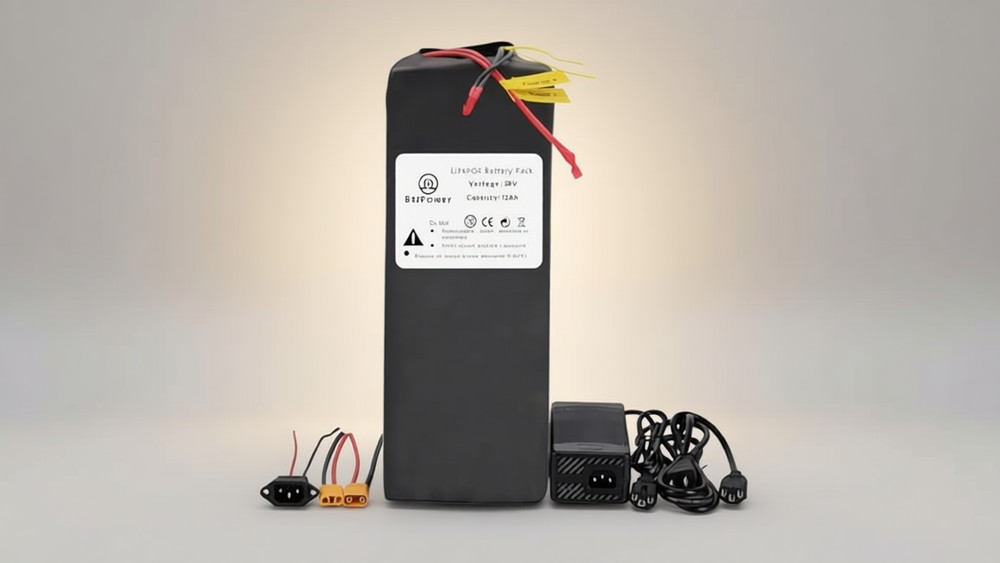
When considering a battery for your e-bike, there is nothing quite like a LiFePO4 battery. There is certainly nothing quite like it in terms of having no worries about the battery chemistry itself. But the differences between worry-free and totally worry-free can sometimes be the entire story of the BtrPower 36V 12Ah, and that story involves trading energy density for thermal stability. In the context of a 36V commuter, that trade means trading stored miles for comfort about charging the thing indoors in your hallway.
The Chemistry, Honestly
LiFePO4 (lithium iron phosphate) is by definition the most thermally stable lithium chemistry currently used in consumer applications. In addition to being inherently gentler in its failure mode compared to the NMC and NCA cells found in most ebike packs, its thermal breakdown characteristics make it relatively difficult for cells to enter thermal runaway, and overheating failures are relatively rare. When cells do fail, they are also relatively unlikely to generate enough heat to continue down a path leading to fire. That is why LiFePO4 is so well respected among ebikers who store their batteries indoors or charge overnight.
We need to be honest since some sellers over-promise. LiFePO4 cannot be called incombustible, nor physically unable to experience thermal runaway. Every lithium pack can fail given enough physical abuse (such as being pierced) or electrical abuse (such as charging with a bad charger). What LiFePO4 provides is a significantly larger margin of error, and when storing a lithium pack indoors, margin is literally what you pay for.
The cost is energy density. LiFePO4 stores less energy per pound, so this pack delivers 432 watt-hours in a brick that a lithium-ion pack would match at a lower weight. For a 36V commuter, 432Wh is still more than enough energy, and the longer cycle life of LiFePO4 recovers value on the other end.
Specifications and Value
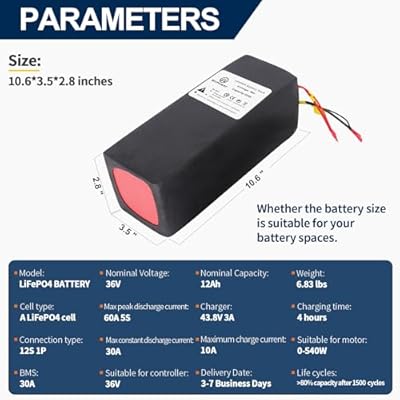
The core specifications of this battery include 36V nominal voltage, 12 amp-hours of capacity, and therefore 432 watt-hours of total stored energy. The cell configuration is 12 cells in series (12S) with a single parallel string (1P). The 30A battery management system (BMS) monitors and controls overcharge, over-discharge, and short circuit conditions. The battery ships with a bundled 3A charger, which charges faster than the 2A chargers supplied with many low-cost ebike batteries.
Dimensions and Physical Specifications
This battery measures 10.6 x 3.5 x 2.8 inches, a simple rectangular shape with no native mounting system. You will need to supply your own mounting solution: frame bags, brackets designed for ebikes, or cases from previously purchased ebike batteries. Measure your potential mounting location carefully before ordering, as the rectangular shape fits some frames perfectly and others poorly.
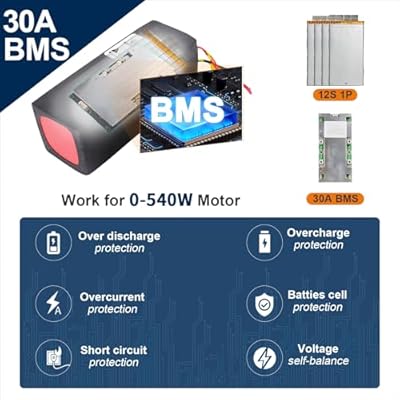
It takes approximately 4 to 5 hours to fully charge the battery using the bundled 3A charger. When fully charged, the battery sits at 43.8 volts. Each individual LiFePO4 cell rests at approximately 3.35 volts, which is normal for this chemistry and one reason this chemistry ages slowly.
Motor Range and BMS
While theoretically capable of providing up to 1080 watts on a 36V system (30 amps x 36 volts = 1080 watts), BtrPower conservatively limits compatible motors to a maximum of 540 watts, creating a significant safety margin. Since most commercially available ebike hub motors operate in the 250W and 350W ranges, this covers virtually all applicable motors. At higher power levels than that, you are beyond what this product was designed for.
Our comparison chart details several products designed for the 48V and 52V voltage classes, which are beyond this pack's design parameters.
BtrPower rates this pack for more than 1500 cycles to 80% capacity. The improved durability of LiFePO4 versus similar chemistries is one of its primary advantages, allowing roughly twice as many charge and discharge cycles as typical lithium-ion packs. Riding once per day, you should exceed four years of useful service. Few commuter battery packs at this price point offer equivalent longevity.
Compatibility and Form Factor
If you are considering this battery, here is how you know it will work on your ebike:
- your controller must be rated for 36 volts.
- your controller must be limited to delivering no more than 30 amps.
- your motor must deliver no more than 540 watts of output power.
- your mounting area must measure at least 10.6 x 3.5 x 2.8 inches.
Your controller and motor must both connect to the battery using connectors compatible with the ones BtrPower provides, or with an adapter.
Real-World Mileage Expectations
Using a 250W motor with moderate pedal assistance on fairly flat terrain, expect anywhere from 30 to 45 miles per charge. With more throttle input on a 350W motor over varied terrain, mileage falls to roughly 20 to 30 miles per charge. These estimates shift with rider weight, wind resistance, tire pressure, and ambient temperature.
Compared apples-to-apples within the 36V battery class, the 12Ah capacity of this pack falls squarely in the middle of the ~11 to ~15Ah range typical of the class. Commuters covering fewer than 20 miles round trip generally finish the day with reserve to spare.
What Do Other Buyers Think?
The listing is new, so its own reviews are just beginning to accumulate, currently averaging about 4.0 stars with relatively few reviews available. The manufacturer is not new:the Btrpower through Amazon for a long time and has accumulated hundreds of reviews across its product lines. Support runs through Amazon's customer messaging platform, with a 12-month warranty and a 30-day return window.
Who Should Consider This Battery?
The buyer who commutes daily on a 36V ebike, charges indoors or overnight, and wants the highest degree of thermal stability and durability available in an ebike battery chemistry at a reasonable price. This product is not for high-power applications, not for buyers wanting a native shark or hailong mount, and it only works in a 36V system. If that description matches your riding, check the the unit on Amazon for current pricing, and browse our other battery reviews if your bike runs a different voltage.
Frequently Asked Questions
What Makes LiFePO4 Safer Than Lithium-ion?
Thermal stability. While neither LiFePO4 nor lithium-ion is entirely incapable of experiencing thermal runaway, the thermal stability inherent in LiFePO4 greatly reduces the likelihood that physical damage or improper charging leads to excessive heat or ignition.
How Long Does It Take to Charge Using the Bundled Charger?
Approximately four to five hours from empty on the included 3A charger, with automatic cutoff at full. Most commuters are not starting from empty, so real charge times run shorter.
Does This Battery Work with My Ebike?
Yes, if your ebike runs a 36V system, your controller delivers no more than 30 amps, your motor produces no more than 540 watts, and your mounting area fits the 10.6 x 3.5 x 2.8 inch pack. Verify each requirement before ordering.
How Long Can I Ride Before Replacing the Battery?
The manufacturer rates this battery for over 1500 cycles to 80 percent capacity, roughly four years of daily charging. Standard lithium-ion packs typically manage 500 to 1000 cycles.
Can I Use This on My 48V or 52V Ebike?
No. Voltage must match, always. A 36V pack on a 48V controller underpowers the system, and the reverse pairing damages components. This pack is for 36V systems only.
What Is the Warranty?
Twelve months, with a 30-day return window through Amazon and support handled via Amazon order messaging. Test the pack thoroughly within the return window.