You found a BtrPower 48V 16Ah LiFePO4 pack in an old build sheet, or a secondhand listing, and went looking for it on Amazon. There's nothing there anymore. The page returns nothing, the successor listing BtrPower pointed buyers toward is gone too, and what you are left holding is a model name that is still worth understanding.
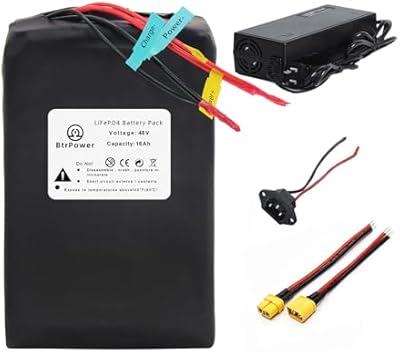
Here's the wrinkle that makes it worth a careful look. BtrPower sold this exact capacity in two different cases. The first was a 7.5 by 5.1 by 4.7 inch box.
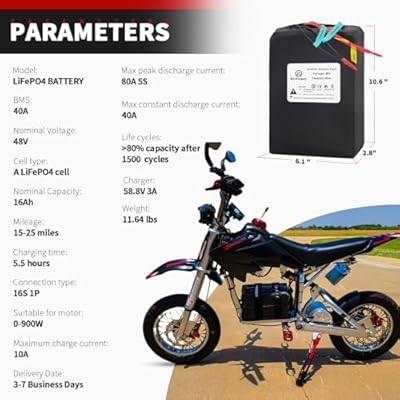
When it sold out, the replacement shipped as a 10.6 by 6.1 by 2.8 inch slab, flat and wide, with the same cells and the same 40A BMS inside. Same name, nothing about the fit carried over.
The recorded spec sheet still answers most of what a buyer would ask: the voltage arithmetic explains why a "48V" pack reads 52 volts on a meter, 768 watt-hours sets the range, and the case dimensions decide whether any replacement actually fits.
My read of the recorded facts is that this was a competently specced pack at a fair price, and the flat case was the entire point of it. If your frame has a shallow battery recess, a 48V 16Ah LiFePO4 pack in a flat profile is still the thing to shop for, because the case shape matters more than the name printed on it.
A pack that shipped in two different cases
BtrPower's own listing admitted the change, which is the only reason we know about it. The original version measured 7.5 by 5.1 by 4.7 inches and sold out. The version that replaced it measured 10.6 by 6.1 by 2.8 inches, trading depth for length and width, and the listing kept the cells and the watt-hours unchanged through the swap.
That kind of silent change is common in the budget battery market, and it usually goes undocumented.
A buyer who owned the box version and ordered a spare two years later would receive a slab that mounts nothing like the first one. With the listing now dead, you can't even ask the seller which shape you'd get, so any secondhand or old-stock pack sold under this name could be either version.
Measure your mounting recess before you order a pack carrying the BtrPower 16Ah name. The two recorded cases share no dimension at all, and neither a rail mount nor a strap mount tolerates a 3-inch error in depth.
What the spec sheet recorded
The numbers below come from the listing as we recorded it, and they check against each other, which is not something every budget listing manages.
- Capacity: 16Ah, sold as 768 watt-hours (48 times 16, the listing's own label math)
- Chemistry: LiFePO4, 16S1P configuration
- BMS: 40A
- Motor compatibility: 250W to 900W
- Cycle life claim: 1500 or more cycles to 80 percent capacity
- Full-charge voltage range: 53.6V to 58.4V
- Warranty recorded at the time: three-month money-back or replacement, twelve-month warranty with a forty-eight hour response promise
The listing carried a 4.9 star rating when we captured it, with no review count recorded anywhere in our data. I'd treat that number as a bare signal and nothing more, because there's no pool behind it that anyone can inspect now.
The BMS margin
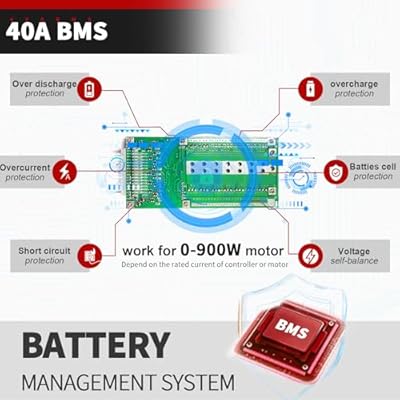
A 900W motor on a 48V system draws a steady 18.75 amps, and the recorded BMS is rated at 40A. That's more than two to one of headroom, which is the right side of generous. Hard hill climbs and full-throttle starts push the draw above the continuous figure for a few seconds at a time, and a 40A board absorbs that without getting near its limit.
The old listing's 25Ah sibling had drawn complaints about real output falling short of the label, and the 40A rating on this pack reads like BtrPower's answer to that record.
Charging time, as math
The listing never printed a charger amperage, so the honest figures are math rather than spec.
At 3A, 16Ah takes about 5.3 hours from empty. At 2A it's closer to 8 hours. If you're buying a replacement pack, check what charger ships with it before you plan an overnight routine around a number the original listing never gave anyone.
Why a 48V LiFePO4 pack reads 52 volts
Sixteen cells in series at 3.2 volts nominal is 51.2 volts, which is why a LiFePO4 pack labeled 48V sits in the 52V class on a voltmeter. The recorded charge range closes the same decode: 16 times 3.65V is 58.4V at full charge, and 16 times 3.35V is 53.6V, the figure the pack settles toward after you unplug it. Both recorded numbers land right where the chemistry says they should.
The charger mismatch matters more than the label. A 16S LiFePO4 pack needs a 58.4V-class charger, while the common 54.6V charger that ships with 13S lithium-ion packs is wrong for it in both voltage and charge style. If you're replacing this pack, a LiFePO4 charger for a 16S pack has to match, and mixing the two chemistries on one charger is the kind of mistake that doesn't announce itself until the cells are damaged.
LiFePO4 chemistry trades energy density for lifespan and thermal stability. Wikipedia's lithium iron phosphate article records specific energy between 0.095 and 0.172 kWh per kilogram for the chemistry and cycle durability of 2,500 to 9,000 cycles, which is the class this pack was built on rather than a figure anyone measured on this particular one.
Range from 768 watt-hours
The em3ev 48V 20Ah guide, verified live this month, puts a 960Wh pack at 30 to 40 miles on throttle alone and 50 to 65 miles at low pedal assist.
This pack holds 768Wh, which is 0.8 of that anchor row, so the same burn rates scale to roughly 24 to 32 miles on throttle and 40 to 52 miles with light pedaling. That scaling is math, not a road test, and a hilly commute or a heavy throttle hand takes it down from there.
Against the motor range, the pack is balanced rather than generous. A 250W commuter motor sips slowly enough that 40 to 52 assisted miles is a realistic weekly figure between charges. A 900W build drinks fast enough that the throttle-only floor of 24 miles is the number to plan around.
Compare the pack against everything we track in the battery comparison table, where 768Wh at its recorded price sat in the cheapest third by cost per watt-hour.
Matching a replacement now that the listing is gone
The listing can't answer questions anymore, so the matching job falls on the buyer. Work down this list in order, because the first item eliminates more candidates than the rest combined.
- Chemistry class. A 16S LiFePO4 pack and a 13S lithium-ion pack are not interchangeable, and the charger gap noted above is the reason. Decide which class your controller and charger actually support.
- Case dimensions. The recorded slab was 10.6 by 6.1 by 2.8 inches, the recorded box was 7.5 by 5.1 by 4.7. Measure the space, not the old pack's story.
- BMS amps. The recorded 40A covered a 900W motor with room to spare. Whatever you buy should carry a BMS at least that far above your controller's draw.
- Connector. Match the discharge plug your controller uses, or budget for an adapter.
On the cycle-life claim, the recorded 1500-cycle figure was conservative for the chemistry class, sitting under the bottom of Wikipedia's 2,500-cycle band. It was also a promise backed by a twelve-month warranty from a seller who no longer sells it, so what it's worth today is a spec-consistency check rather than a promise anyone can hold.
If capacity matters more to your riding than the flat case did, the same line's 48V 18Ah LiFePO4 sibling carried 864Wh, and our 48V 25Ah LiFePO4 review covers where the range chase ends up. Both were rebuilt from their own listings and make better value anchors than a dead listing can. On the smaller side of the brand, the 36V 12Ah LiFePO4 rebuild decodes the variant ladder that listing hid behind.
FAQ: the 16S nominal label, the two case shapes and the dead-listing cycle claim
Was this a 48V or a 52V battery? Both labels applied to the same cells. The pack is 16S LiFePO4, which is 51.2V nominal, and sellers in this market label that class as either 48V or 52V depending on the buyer they're targeting. The recorded voltage range of 53.6V to 58.4V is the giveaway that it's a 16S chemistry pack either way, whichever sticker the seller used.
What changed between the two versions of this pack? Only the case. The original 7.5 by 5.1 by 4.7 inch box sold out and was replaced by a 10.6 by 6.1 by 2.8 inch slab with the capacity and chemistry unchanged. Because the listing is dead, there's no way to know which shape a given secondhand pack is without measuring it.
Can it run a 900W motor? The recorded spec allowed 250W to 900W, and the math supports the top of that band: 900W on a 48V system is about 18.75A continuous against a 40A BMS. Short peaks during climbs and hard starts add to that, and the recorded BMS had the margin to absorb them.
How long does a full charge take? No charger spec was ever recorded, so the honest answer is math: about 5.3 hours at 3A or about 8 hours at 2A from empty. Check the charger that ships with any replacement pack rather than assuming either figure.
Is the 1500-cycle claim still worth anything? As engineering context, yes. As a promise, no. The figure was conservative for LiFePO4, which Wikipedia records at 2,500 to 9,000 cycles, but the twelve-month warranty behind it belonged to a listing that no longer exists. Treat the claim as a reason the pack was designed well, not as coverage you hold.