Three listings from the same brand sold the same 1040 watt-hours at three prices, and this pack took the middle seat.
The plain VISET 20Ah rung captured at 269, this VISET LI version at 289, and a scooter-labeled twin at 299, each with a 40A board and a USB port in the box. I priced the family per watt-hour because the listings never did, and the middle rung doesn't come out well.
On paper the title advertised motors from 200 to 2000 watts, and the top of that range only just holds. A 2000W motor at 52V draws about 38.5A against the 40A ceiling, which leaves about 1.5A in reserve. At 1500W a motor draws roughly 29A, at 1000W about 19A, and the 200W floor pulls under 5A.
What the record kept is thin. The rating froze at 4.8 with no count attached and no text was ever captured, and the listing has since left Amazon, so none of it can grow. Below, you'll find the ladder arithmetic, the range bands, the charging floor, and the questions a successor hunter should carry.
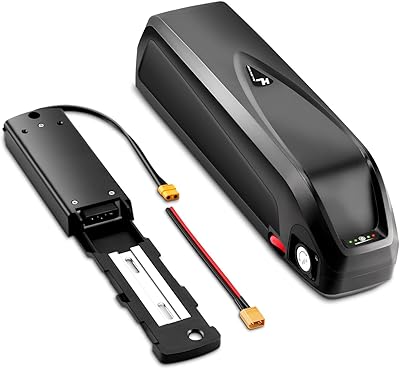
What a 40A board covers, and where it thins out
The recorded title advertised motors from 200 to 2000 watts on a 40A battery management system, and the arithmetic only just holds at the top.
Forty amps at 52 volts is 2080W of continuous output, and a 2000W motor draws about 38.5A at this voltage, so the claim survives with about 1.5A in reserve. That is the thinnest margin this family printed. The plain VISET rung claimed only 1500W and kept about 11A spare on the same board.
Below the top of the range the picture is comfortable. A 1500W motor draws roughly 29A, a 1000W motor about 19A, and the 200W floor pulls under 5A, which the board covers without warming up.
For a build in the 750W to 1500W band, this pack has real headroom. It is only the last 500W of the claim that runs the board close to its ceiling.
The S count the record never settled
A 52V pack's full-charge voltage tells you its cell layout. Fourteen cell groups times 4.2 volts is 58.8V, the standard 14S termination, while 13S tops at 54.6V, and both layouts are sold as 52V. The em3ev 52V buyer guide walks through the difference.
Our old article mentioned 58.8V, but that was a generic statement about 52V systems, not a recorded spec of this pack, so the layout question is now unanswerable. The listing is gone. On any successor listing, the charger's printed voltage settles it in one glance.
Three rungs, one capacity, one brand
Here is what our captured data says about the family, because the listings never said it. The plain VISET 20Ah captured at 269 for 1040Wh, which is 0.26 per watt-hour. This VISET LI version captured at 289, or 0.28.
The scooter-labeled twin captured at 299, or 0.29, with a bracket mount and key lock recorded on its page. Twenty dollars above the plain rung bought nothing our record can name, and the twin above that added a mount.
The ladder's top rung priced best of all. The VISET 30Ah captured at 359 for 1560Wh, which is 0.23 per watt-hour, so the bigger pack carried 50 percent more energy for about a third more money.
Ladders usually get worse per watt-hour as they climb, so a family that inverts that is worth a second look. The VISET 52V 30Ah review covers that rung.
On our own table of 324 packs, this one sits in the below-average band on price per watt-hour, and I won't dress that up.
The exact position renders live in the specs box on the comparison table. The plain rung's review and the scooter twin's review carry the same concession, and the old advice still stands because it was always the right advice. Pick between these rungs on current price and the mount you need.
LED light, USB port and a base stand
Three features rode along on the recorded listing. The LED power light shows remaining charge without waking the whole bike, which matters on bikes whose display hides pack voltage.
The USB port charges a phone or a GPS unit straight from the pack, and the draw is trivial against 1040Wh, so a touring rider loses nothing worth counting. The base stand holds the pack upright indoors for storage and charging. It is not a mount, and the bike still needs its own bracket or rack interface, which the listing never recorded.
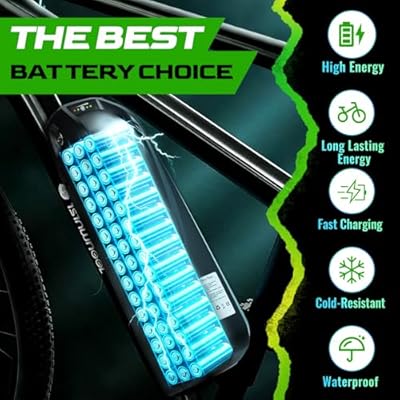
Range and charging at 1040Wh
Fifty-two volts times 20 amp-hours is 1040Wh, just over the 0.96 kWh anchor in the em3ev 48V battery guide, which puts that anchor at 30 to 40 miles on throttle alone and 50 to 65 with a light pedal assist.
Scaled to this capacity, expect roughly 32 to 43 miles on the throttle and 54 to 70 with a light leg. Our old article printed 30 to 50 miles, a band built on nothing in particular, and it is replaced here. Hills, cold and high assist pull the real number toward the bottom.
The charging floor
Charging has a floor and nothing else. At a common 2A rate, 20 amp-hours takes 10 hours from empty, and the record never names the included charger's amperage.
The old article's 7-hour estimate assumed a 3A charger that no capture ever recorded, so it is dropped rather than repeated. Plan on the 10-hour floor unless a successor listing prints a real figure.
No weight was ever recorded either, so the density check every rebuild runs is impossible here. The expectation can still be stated. Complete packs usually land between 0.18 and 0.21 kWh per kilogram, and 1.04 kWh at that band implies roughly 5.0 to 5.8 kg.
What the frozen record leaves
The capture caught a 4.8 rating with no count attached, and no review text was ever recorded for this ASIN. A star figure without a count could be three buyers or three hundred, and the listing's removal means the record can never grow. Read it as a frozen snapshot, not an owner consensus.
What the record does leave is a coherent feature set, a board whose claim holds at the top but only just, and a family whose pricing told the real story.
A rider hunting a replacement can carry four questions: the S count behind the full-charge voltage, the charger's amperage, the discharge connector, and a weight to test against the density band. Compare what is live right now with those questions written down. Our review archive covers packs across every voltage.
Frequently asked questions
Is the LI in VISET LI a different chemistry?
No. The old article recorded it as a product-line designation inside the same catalog, and every VISET pack in this family is a lithium-ion build. The suffix tells you which listing you are on, not what cells sit inside.
How does this differ from the plain VISET 52V 20Ah?
The recorded specs are identical, down to the 40A board, the USB port, the LED light and the base stand. The old article guessed at differences in dimensions and connector type and never settled them. The price gap at capture was 20, and our data adds the only honest difference it can: the ladder position.
Can it run a 2000W motor?
Barely. A 2000W motor draws about 38.5A against the 40A ceiling, which leaves about 1.5A in reserve.
A 1500W motor is the comfortable top of this pack's range. Browse live 52V 20Ah listings if you are building bigger than that.
How long does a full charge take?
The floor is 10 hours at a 2A rate. The included charger's amperage was never recorded, so the old 7-hour figure is dropped here. Whatever successor listing you find, read the charger's label before you believe a charge-time claim.