A rider with a 36V bike and a tired pack has fewer high-capacity options than the 48V crowd, and the biggest phosphate shell BtrPower sells at that voltage deserves a look before you settle for something smaller.
This BtrPower 36V 25Ah battery holds 900 watt-hours in a universal block, feeds motors up to 1000W through a 50A board, and charges on a 5A brick, all at a price per watt-hour that lands close to the middle of everything we track.
I went through the listing, the gallery cards and both written reviews, and the arithmetic holds up better than the record does. Every power figure on the page agrees with every other one, which is rare in this market. The catch is that almost nobody has actually ridden this pack on a bike, and the one detailed owner account describes something else entirely.
Here is what the page proves, what it leaves unproven, and where each figure came from.
Two verified reviews, and neither one mentions a road
The rating reads 4.6 out of 5 from 6 global ratings, with a histogram of 62 percent five-star and 38 percent four-star and nothing below. Those percentages do not divide cleanly into 6 ratings, so I quote them as printed. Two written texts sit behind the average, and both carry a purchase badge.
The top-voted text, from August 2026, reads in full: It's the best battery I've ever owned. Seven words, no bike, no mileage, no detail of any kind, and it carries the text record's only helpful vote.
The second text goes back to April 2023 and it is the only one with substance.
The buyer used this pack as a 36V supply for a fuse block on a side-by-side vehicle, feeding an in-line fuse on the positive side to protect the circuit, and reports it worked great. That is a real, useful account of this battery doing a job. It is also not an e-bike account, and it sits more than two years behind the recent rating growth.
So the claims that matter to a bike buyer, the 25+ miles without pedaling and the 1000W motor support, have no owner evidence behind them at all. Amazon's own filing agrees with the record's drift: the listing places 5,383rd in Household Batteries rather than among bike components.
The weight card closes, if it belongs to this pack
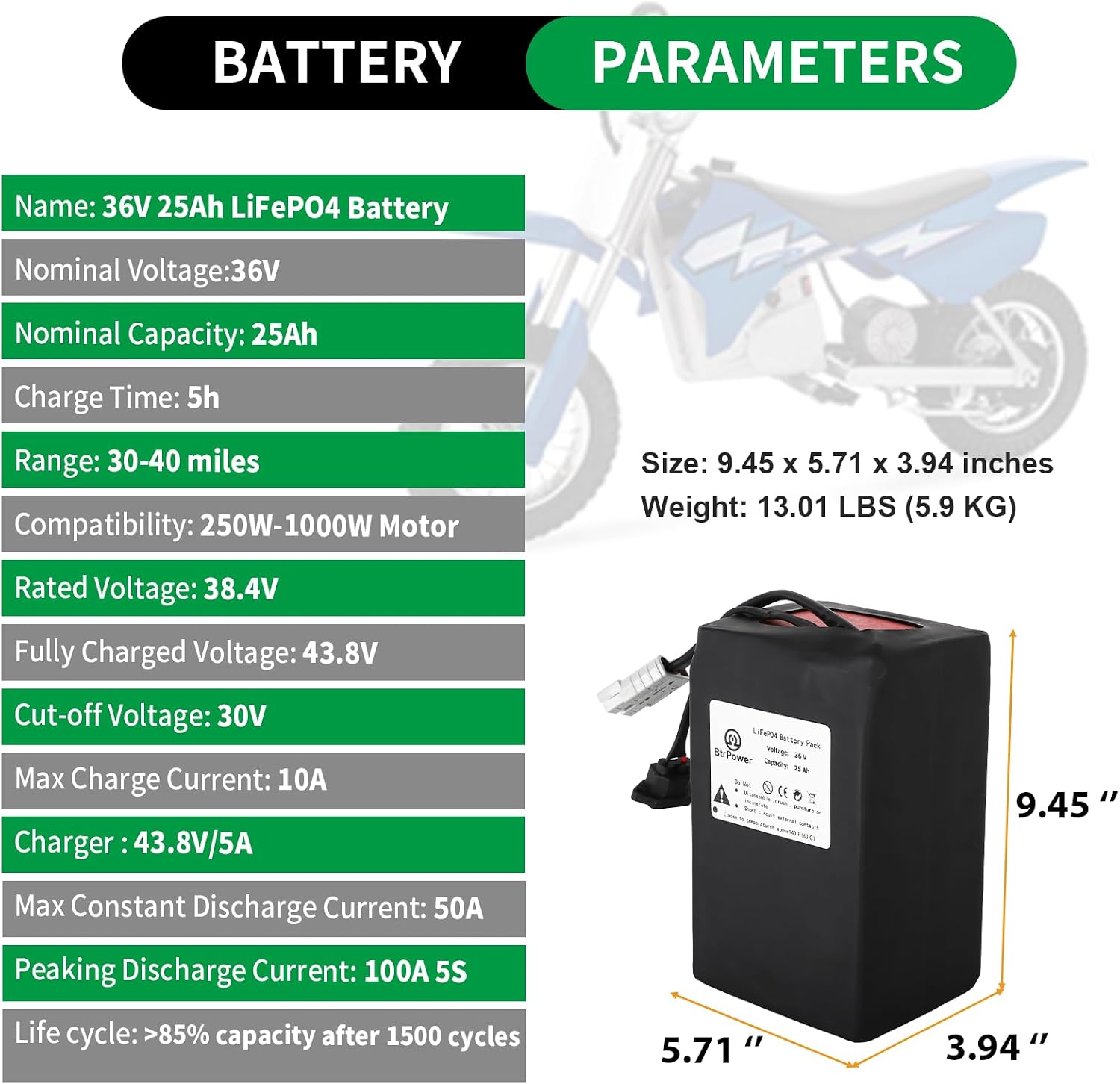
The specification table prints no weight anywhere. The number lives on a gallery card instead: 13.01 pounds, about 5.9 kilograms, next to the printed size of 9.45 by 5.71 by 3.94 inches.
Phosphate chemistry runs heavier per watt-hour than generic lithium-ion, and Wikipedia's lithium iron phosphate page puts the chemistry's specific energy low enough that the bare cells of a 900Wh pack need between about 5.2 and 9.5 kilograms before you add a case, a board or a wire.
A printed 5.9 kilograms for the whole assembly only works if the cells sit near the top of that band, which leaves under a kilo for everything else.
That is a tight reading for a phosphate pack, the same class of number that has ended badly on other listings we have checked, so weigh the box on arrival and compare it against the card before the return window closes.
One caveat belongs on the weight itself. The gallery mixes parameter cards from other rungs of the BtrPower ladder, a 48V 20Ah label and a 60V 35Ah card among them, so the weight card may describe a sibling rather than this shell. Treat 5.9 kilograms as the claim to check, not a confirmed figure.
The power math holds from every direction
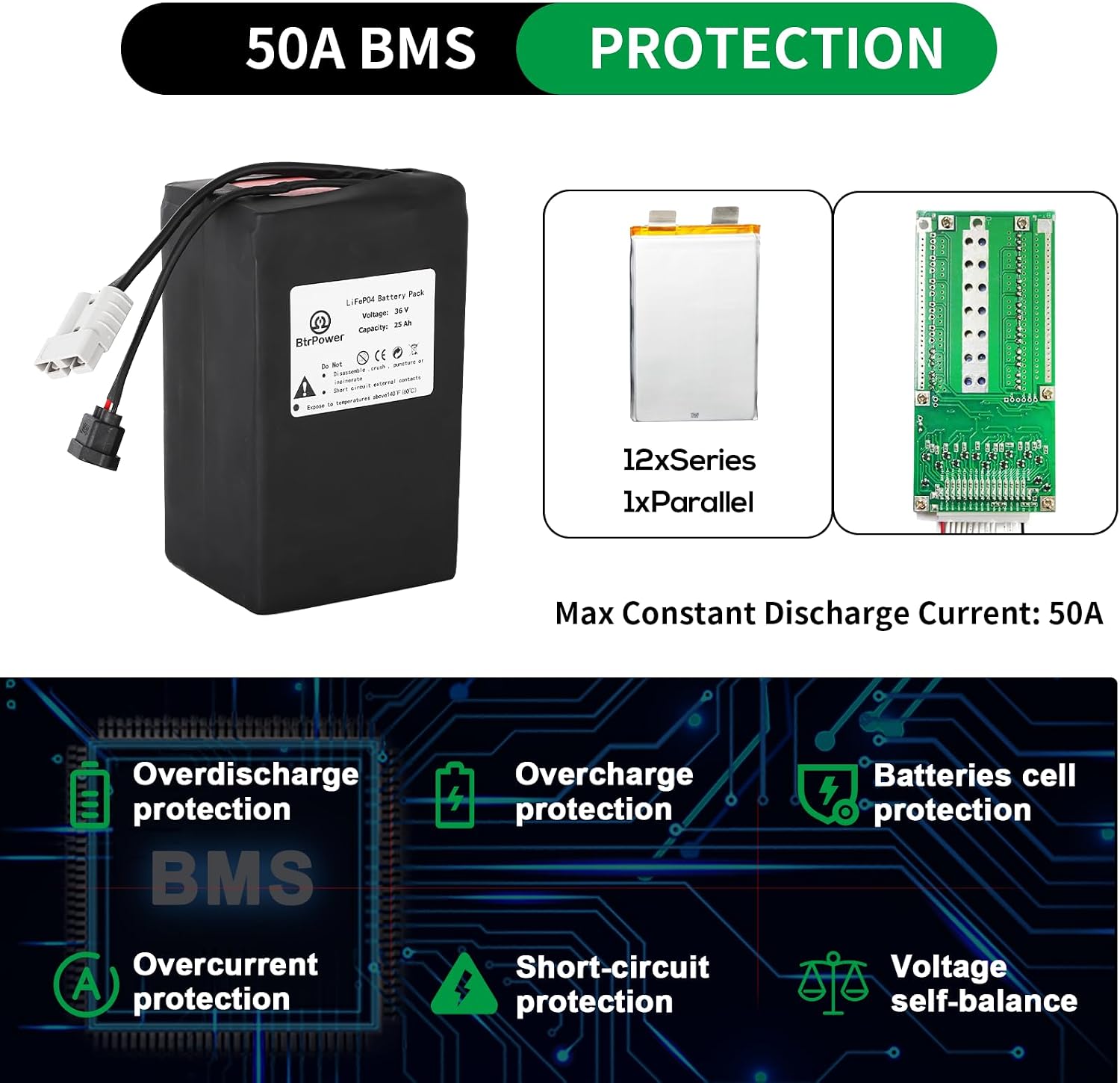
This is the part the listing gets right. The bullet caps the motor at 1000W and the board at 50A maximum constant discharge. A 1000W motor at 36V draws about 27.8A, which sits inside 50A with real headroom for the startup surge.
The equipment bullet repeats the same numbers rather than contradicting them: a 36V controller, a rated controller current at or under 50A, and motors from 250W to 1000W.
The board card's own protection list, overcharge, over-discharge, over-current, short circuit, voltage protection and self-balance, matches a 50A management board doing its job. Listings in this market usually print three ceilings that argue with each other. This one prints one story and the arithmetic agrees with it.
The range claim decodes conservatively too. The bullet promises 25+ miles without pedaling, and 900 watt-hours over that distance works out to 36 watt-hours per mile or less.
Our usual planning figures run 20 to 25 watt-hours per mile with real pedaling and 25 to 30 throttle-heavy on bikes in this power class, so the claim sits at the cautious end of every realistic riding style. If anything, it undersells the pack.
Charging is the fixed cost. The title names a 5A fast charger, and 25 amp-hours at 5A needs at least five hours from empty, longer with the taper every lithium charger runs at the top. Plan on an overnight charge and read the label on the brick that arrives.
What the phosphate card gets right
The gallery carries a comparison card that sells phosphate against generic lithium-ion, and one claim on it is worth taking seriously rather than discounting. The card promises over 1500 charge cycles with capacity holding to 85 percent.
The standard lithium-ion cycle band runs 400 to 1,200 cycles, which would make 1500 look inflated. But the same phosphate page puts lithium iron phosphate's own cycle durability between 2,500 and 9,000 cycles. Against the chemistry's real band, 1500 cycles is a modest promise rather than a marketing stretch, and the 85 percent retention figure is a stricter condition than a bare cycle count.
The listing names no cell model and no test conditions, so the number is still a promise, not a measurement. But it is the honest direction for this chemistry, which is more than the other 1500-cycle claim we have checked this month can say.
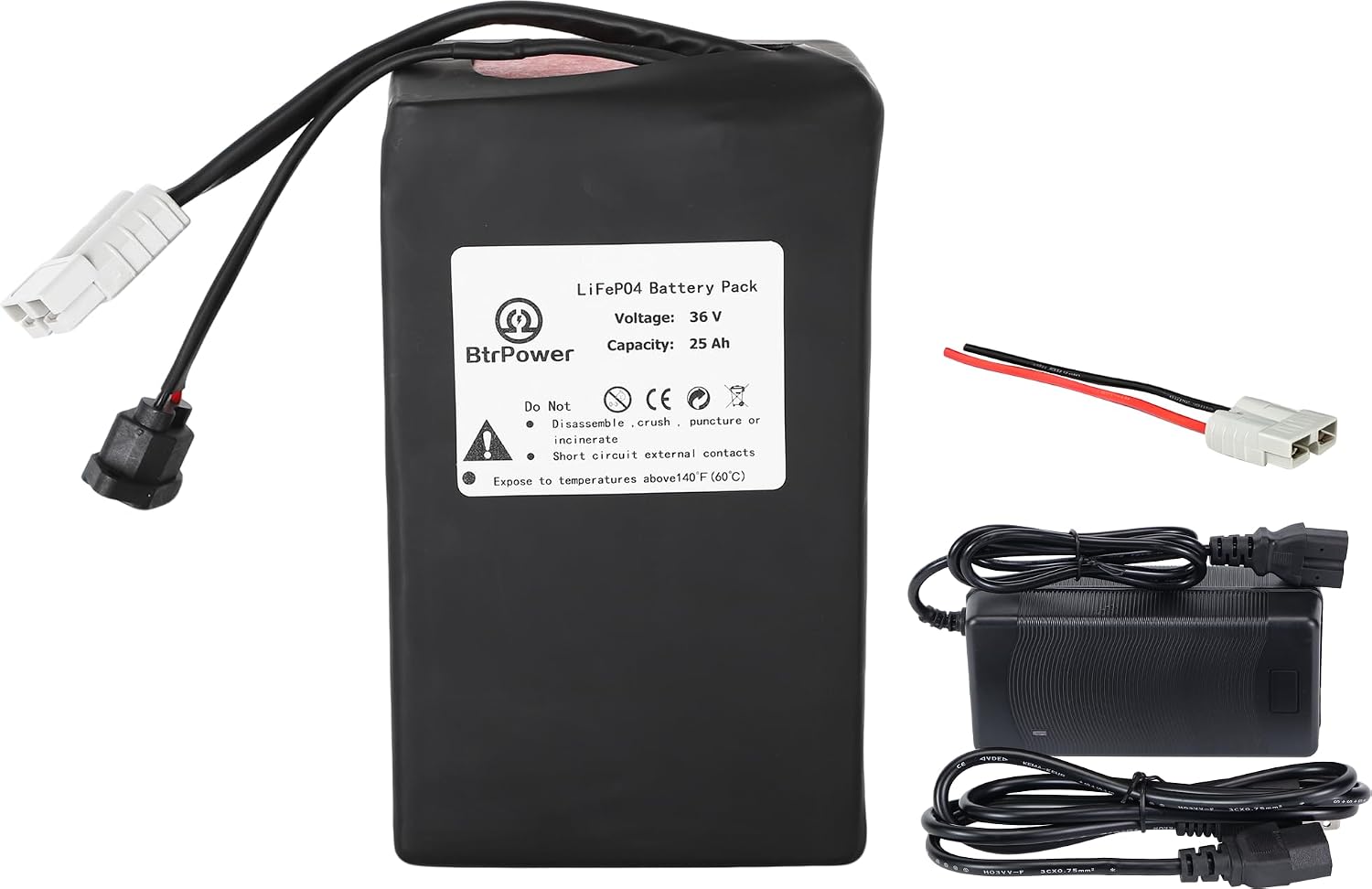
The connector story is concrete as well. The card states the pack ships with both an Anderson connector and a 3-pin connector already wired, so a 36V build with either plug style connects without adapter work. The application card lists bicycles, tricycles, scooters, wheelchairs, motorcycles and four-wheel vehicles, which is an honest picture of a universal block rather than a bike-specific shell.
The warranty reads 3 months of free return and replacement plus 12 months of support.
Buy it for the board, not for the record
The decision this listing forces is unusual, because the specs and the record point in different directions. If you want a 36V pack whose real-world range and fitment other riders have confirmed, this listing cannot offer that, because no text in its record describes either.
If you want a large 36V phosphate supply for a build or a project where the printed numbers are what matter, the numbers here hold up under every check I ran, and the one detailed owner used it for exactly that kind of job.
On value the pack sits close to the middle of the 324 batteries on our price-per-watt-hour table, and the specs box beside this review renders the live comparison as prices move.
Within the BtrPower family the same ladder runs from a 36V 15Ah rung with a 30A board up to a 72V 80Ah shell with a 100A board, and we have reviewed the 48V 20Ah phosphate sibling as well as the bigger 48V 30Ah rung from the same ladder, in its own review and here.
If you order, do three things. Measure your battery case against the printed 9.45 by 5.71 by 3.94 inch block, because the bullet asks you to check the size twice and no bike brand is named anywhere. Weigh the box against the 5.9 kilogram card.
And test a full charge cycle inside the 3-month return window, which on paper is the strongest coverage this listing offers.
Frequently Asked Questions
Will the BtrPower 36V 25Ah fit my bike?
Measure first. The pack is a universal 9.45 by 5.71 by 3.94 inch block with no named bike brands, and the bullet asks you twice to check the size against your battery case. It suits builds and cases rather than a specific model of bike.
How long does the BtrPower 36V 25Ah take to charge?
At the 5A charger named in the title, 25 amp-hours needs at least five hours from empty, and the taper near full adds time. Plan an overnight charge.
Why is this e-bike battery filed under household batteries?
Amazon's rank row places it in Household Batteries, not bike components. The filing matches the record: the only detailed owner text describes using it as a 36V supply for a fuse block on a side-by-side vehicle. It works as a general-purpose 36V pack, and Amazon has noticed.
Is the 1500-cycle claim believable?
It is modest for the chemistry. Generic lithium-ion manages 400 to 1,200 cycles, but lithium iron phosphate's own durability band runs 2,500 to 9,000 cycles, so 1500 with 85 percent retention sits below what the chemistry can do. The listing still names no cell model and no test conditions, so treat it as a promise.
Is the 25-mile range claim realistic?
It is the cautious direction. The claim works out to 36 watt-hours per mile or less, and throttle-heavy riding on a 1000W-class bike usually runs 25 to 30. A careful pedal-assist rider should beat the claim comfortably, and even a full-throttle rider should clear it.