Replacing a proprietary ebike battery usually means replacing hardware you never thought about. A new cradle, new wiring, sometimes a new bracket bolted to the frame. The Jasion EB5 owner who goes shopping for a second pack inherits all of that, unless the replacement happens to match the original exactly.
That is what makes the battery market around this bike hard to shop. Jasion has sold the EB5 for years, the stock pack is a 36V 10Ah unit, and the replacement listings split by model line in ways the listings themselves do not always explain. Buy the wrong one and you own a heavy brick that fits nothing.
This article walks the strongest replacement listing in that market, checks its numbers against its own spec table, and reads the buyer record line by line. The picture that comes out is unusually clear for this category, because the record says the same thing from eleven directions.
The Yose Power 36V 13Ah Jasion EB5 battery sells at 245.79, which works out to about 52 cents per watt-hour. That is among the most expensive positions in our comparison table, and the live figure renders in the specs box below, so you can see exactly where it lands against every pack we track.
What the price buys is compatibility money cannot usually buy at any price. Thirty-three people have rated this pack, ninety-three percent of them at five stars, and the written record is full of owners describing the same event: the pack went into the mount they already had.
A record that splits on fitment, not on the product
The histogram is a strange shape worth reading slowly. Ninety-three percent five stars, seven percent one star, and not a single rating in between. No four-star band, no three, no two.
We counted eleven written texts, and ten of them are purchase-badged. The lone unverified text is also the most technically detailed one in the record, which we come back to below.
Every one-star complaint is a fitment failure. One owner's pack did not fit their bike, returns were refused, and the money for the pack went with it. No text describes a cell fault, a BMS fault or a pack that died early.
When the only anger in a record is about the bike it went onto, the pack itself is doing fine.
There is one odd text that argues with its own rating. A five-star from January 2026 asks for a refund because the battery is small. Take the ninety-three percent with that in mind.
One of those five-star ratings is really a complaint, and the histogram cannot show it.
The one-star is a cautionary tale with a model number in it. Its writer's pack did not fit an EB5 MAX, the listing's returns process did not take it back, and the purchase was lost.
The lesson is not that Yose Power sells a bad pack. It is that "Jasion" is not a fitment spec. The listing title says it fits the Jasion EB5, and it names no other model in the line.
The EB5 MAX is a different bike with a different battery interface, and nothing on this page promises it will fit.
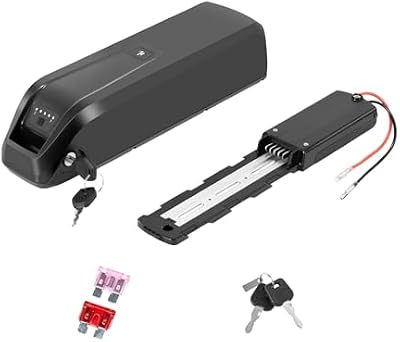
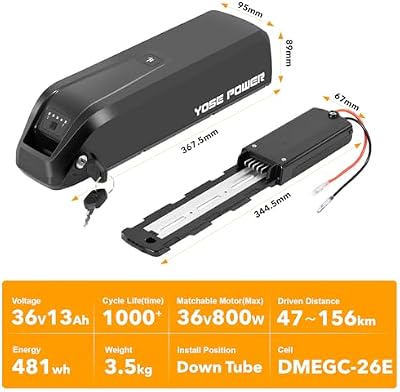
So the buying rule here is stricter than the brand rule. Match the model line first, then the connector, then the case dimensions, which the listing prints as 367.5 by 95 by 89 millimetres. Only then look at capacity and price.
The same record shows the rule working in both directions. One owner reports a perfect fit on an ActBest Race, a bike this listing never mentions, because the pack's interface matched. The fitment list is a floor, not a ceiling, and the connector decides.
What the top-voted text establishes
The most-voted text in the record, from July 2025, is the one that tells you what you are actually buying. Its writer reports that the pack "clicks in like a glove" into the existing cradle on their EB5.
No bracket swap. No rewiring. The original mount stays on the bike.
The same owner describes a plan that tells you how deep the compatibility goes. They mounted the battery bracket on a cargo rack, so two packs can slide out and swap in seconds. That only works when the replacement matches the original's mechanical interface exactly, which is the whole reason this listing exists.
Two details in that text reward attention. The box carried a sticker sheet with a support number and lithium return rules, plus a small instruction booklet. And it carried spare internal fuses.
That fuse detail shows up again in a second owner's text from May 2026, in almost the same words. When two owners independently report the same unexpected part in the box, and the spec table lists a 10-amp charging fuse and a 30-amp discharging fuse, you are looking at a seller that expects the fuse to be the part that fails and ships spares for it.
A third owner reports the same finding in the record's plainest text: the battery was an exact replacement, so they did not have to change out the holder or the wiring.
The charge ceiling that explains the extra range
The longest text in the record is unverified, and it is the one worth reading with a calculator open. Its writer bought an EB5 only as a battery donor for a home build, then measured this pack against the 10Ah stock battery and got about 40 percent more range.
The capacity arithmetic alone does not reach that number. A 10Ah pack at 36 volts holds 360 watt-hours, this one holds 468, and 468 against 360 is 30 percent more.
The owner proposes the missing ten points themselves: the stock pack stops charging at 41.1 volts, this one reaches 41.7, and a 36V pack is ten cells in series with a full charge at 42.0 volts, because each lithium-ion cell tops out at 4.2 volts.
Both packs stop short of full. This one stops less short, and that margin is real range on every ride. It is the rare owner measurement that makes the listing's numbers look understated rather than inflated.
The same record carries a plainer version of the same finding. One owner reports 15 to 20 miles more range than stock, and another, replacing their first battery after two years with the bike, found one charge now covers a trip that used to take two. That owner also compared sellers directly: a pack bought elsewhere arrived with a dead cell, this one arrived with a factory charge.
The numbers argue with themselves in two places
The listing's watt-hour claim is wrong against its own capacity. The bullet says 481 watt-hours, and 36 volts times 13 amp-hours is 468. Thirteen watt-hours is not a rounding error, it is a mistake, and every range plan you make should start from 468.
The BMS row tells a subtler story. This pack carries a 20-amp board, where the other Yose rungs we have reviewed carry 30-amp boards. Twenty amps at 36 volts is a 720-watt continuous ceiling against a motor claim of 0 to 750 watts, so a top-spec 750W motor runs right at the board's limit.
The standard discharge figure matters more for most riders: 10 amps at 36 volts is 360 watts continuous, and hills or headwinds push you onto the max band.
Then there is the charger question. The range bullet promises a full charge in about seven hours, and thirteen amp-hours at a 2-amp charger is 6.5 hours before the taper, so the math only closes with a 2-amp charger.
But the Included Components row lists the battery, keys, a discharge port and a manual, and no charger at all. Confirm what ships in the box before you order, because the listing answers differently in two places.
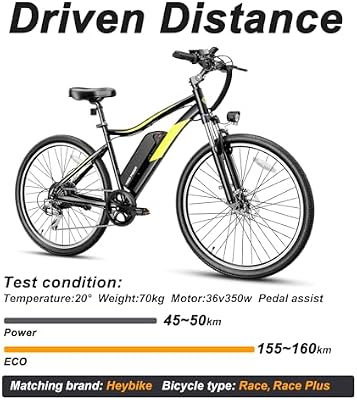
The range claim you can ignore. The bullet promises 47 to 156 kilometres, which is 29 to 97 miles, a band too wide to plan a commute around. Work from 468 watt-hours instead: at 20 to 25 watt-hours per mile of throttle-only riding, that is about 19 to 23 miles, and light pedalling stretches it well past that.
What the listing gets right is the physical spec, and both rows agree with each other for once. The printed case size converts to the same 14.4 by 3.7 by 3.5 inches the details table carries, and both weight rows read 7.7 pounds. On this listing, the measure-first purchase works.
Same cradle or same watts
This pack asks one question, and your bike answers it. If you ride a Jasion EB5 and your original cradle is part of the deal you want to keep, this is the replacement that keeps it, with the strongest owner record in its class and spare fuses in the box.
If you are shopping on price per watt-hour alone, look elsewhere, because at about 52 cents per watt-hour this pack costs more than nearly everything we track. The covered Yose 36V 13Ah silver fish rung and the covered Yose 36V 13Ah down tube rung are cheaper ways into the same capacity, and our Yose 36V 13Ah silver fish review and Yose 36V 13Ah review cover what those records look like. The same brand family also sells a bigger seat-tube rung, covered in our Yose 36V 15Ah review.
And if your bike is an EB5 MAX, neither this pack nor its price is your problem yet, because fitment is. Confirm the model line on the pack you order before the price matters.
Frequently asked questions
Will this fit my Jasion EB5?
The listing names the EB5, the case measures 367.5 by 95 by 89 millimetres, and owners of the basic EB5 describe the pack clicking into the original cradle with no changes. It does not promise the EB5 MAX, and the record contains one owner's lost purchase to prove the line is real. Match your model before anything else.
Is the capacity 468 watt-hours or 481?
It is 468. Thirty-six volts times thirteen amp-hours gives 468 watt-hours, and the bullet's 481 figure does not reconcile with the pack's own capacity row. Plan range from 468, which is about 19 to 23 miles of throttle-only riding and more with light pedalling.
Does the charger come in the box?
The Included Components row lists the battery, keys, a discharge port and a manual, and no charger, while the range bullet promises a seven-hour full charge that only adds up with a 2-amp charger. The listing contradicts itself, so ask the seller. If no charger ships, a 42-volt 2-amp charger for a 36V pack is the matching part.
Is it worth the price next to the other Yose 36V packs?
On raw value, no. At about 52 cents per watt-hour it is one of the most expensive packs we track, and the silver fish and down tube rungs of the same capacity cost less per watt-hour.
What the price buys is the cradle. This is the rung whose owners report keeping their original mount, and no cheaper Yose 36V pack has that record. If the mount is what you are buying, the price is what it costs.