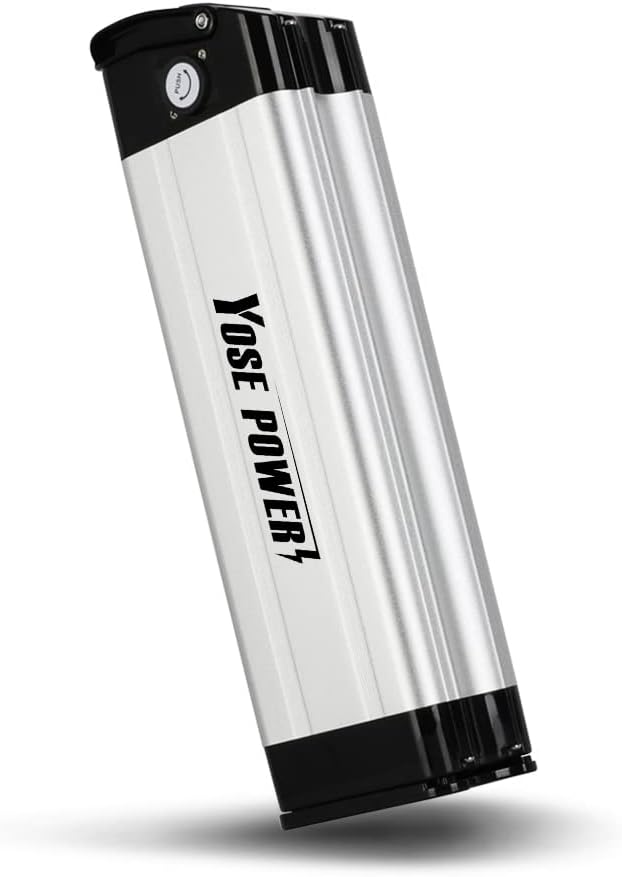
Replacement battery shopping has a step most listings pretend does not exist: figuring out which of the near-identical packs on offer is actually yours. The Yose Power 36V 13Ah silver fish battery sits in a family of four capacities in two colors, and one bullet on its page names all four at once.
The record makes the same point from the other side. Two people have written about this pack and both wrote about selection. One searched until the right variant turned up.
The other ordered what a voice assistant recommended, found it did not fit, and returned it.
So this article is a disambiguation guide with a spec check attached. I ran the card text, the details rows and the arithmetic, and the numbers close more neatly than the family's marketing does. What follows is what to match, what to distrust, and what the page never settles.
Two texts, both about choosing
Six ratings sit behind this pack, and they split into about 3 five-star, 1 four-star and 2 one-star with nothing in the middle. Only two buyers have written anything.
The five-star text, from August 2026, is a selection story in miniature. Its author kept searching until the right one turned up, reports that it works great, and leaves a warning that could headline this article: order the right one. There are, in that owner's words, so many styles.
The one-star text from June 2026 describes the other path. Its author asked a voice assistant what would fit a Caroma scooter and bike, ordered the suggestion, and the pack did not fit. The review aims at the recommendation, not at the battery, and ends in a return.
One owner has found the failure mode of modern replacement shopping: the assistant matched a title, not a mount.
Neither text says a word about charging, range or durability. Four more ratings are wordless. This is a thin record, and what it proves is about the buying process rather than the pack.
Four rungs, two colors, one mount
Yose Power's silver fish line runs 10.4Ah, 13Ah, 15Ah and 17.4Ah, in black and silver variants, and the ladder on this listing's own page names three sibling ASINs. We have covered the 36V 17.4Ah black rung and the 48V 10.4Ah silver rung already.
Voltage first. This rung is 36 volts, and the comparison table filters by voltage so you can pin the family down against your bike's controller. A 36V pack charges to about 42V full, a 48V pack reaches 54.6V, and the two do not interchange.
Then the mount. Silver fish is a standard shape, which is the trap. This case runs 388 by 110 by 75 millimeters, and the details row matches that to the millimeter at 15.28 inches long.
Yose Power also sells downtube packs with a four-pin round port that look nothing like this on the bike even though the brand names match, which is why we keep the 48V 13Ah downtube review separate. Match the cradle length and the discharge connector, then pick the capacity.
The card, the rows, and 13 watt-hours between them
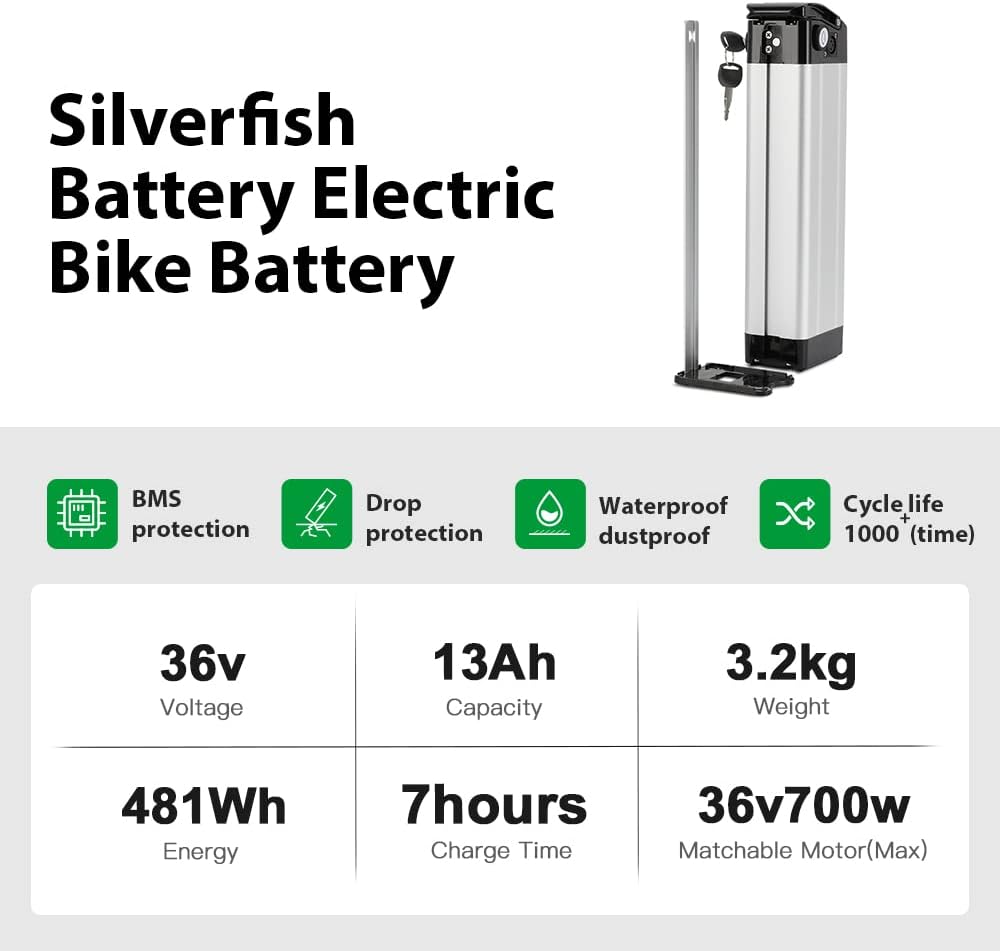
The gallery's spec card prints five numbers in one strip: 36V, 13Ah, 481Wh, 3.2kg, 700W maximum motor. The details table prints its own: 13Ah, 7.7 pounds, 3.5 kilograms of battery weight.
Two of those pairs disagree by a little. The card's 481Wh works out to 13Ah times 37V, a marketing rounding that adds 13 watt-hours over the nominal 36-volt arithmetic of 468Wh.
Use 468 when you plan rides. The card's 3.2kg sits about 300 grams under the 3.5kg row, and the 3.5kg row converts to 7.72 pounds, agreeing with the printed 7.7. Trust the pair that agrees with itself.
The card's 700W motor ceiling is the honest line on the page. Bullet two waves at motors up to 1000W across the family, but this rung's card caps its matchable motor at 700W. If your controller draws more, this isn't your pack.
Divide 468 watt-hours by 3.5 kilograms and the pack works out near 0.13 kWh/kg, a normal figure at pack level once case and board are counted. Commodity lithium-ion cells run denser at the cell level than any full pack manages.
The charger question is where the page contradicts itself in an unusual direction. The details row lists exactly one included item: the battery pack. No charger, no keys, nothing.
The box-list card in the gallery shows five items: battery pack, discharge plug, charger, key, user manual. Bullet four promises the charger fills the pack in 7 hours, which at 13Ah works out to about 1.9 amps of average current, comfortably under the 5-amp ceiling the charge socket card prints. A listing does not usually promise a charge time for a charger it doesn't ship.
The two cards agree with each other and against the spec row, so the likely truth is that the charger ships. Check the box anyway before you buy a separate one, and note that a 2-amp charger, the common stock unit, fills this pack in about 6.5 hours, just under the printed claim.
Range on the card's own test conditions
Yose Power prints a test card for its range figure: 20 degrees, a 70 kilogram rider, a 350W motor, pedal assist. That's the honest footnote most listings omit, and it matches how we compute range across the whole table.
At 468 watt-hours and the usual 20 to 25 watt-hours per mile of pedal-assist riding, this pack is good for roughly 19 to 23 miles. Full throttle raises the burn rate sharply and can halve the figure. A rider lighter than the test's 70 kilograms on flat ground will see more, while a fat-tire bike on low assist will see less, since rolling resistance eats watt-hours before the motor does.
The 17.4Ah sibling carries 626 watt-hours for buyers who need a third more range, and our 36V 17.4Ah review covers what its record shows. For short commutes, this 13Ah rung is the lighter spend.
Frequently asked questions
Which bikes does this rung fit?
The listing names ECOTRIC fat tire folding, Starfish, Dolphin and Peacedove models, and the shape fits any bike with a silver fish cradle of about 388 millimeters and a matching discharge connector. The two written reviews make the same point from opposite ends: measure before you trust a name, because the family spans several mounts and a wrong guess ends in a return.
Is the 481Wh on the card the real capacity?
Plan on 468Wh. The card's figure comes from multiplying 13Ah by 37V, and nominal 36V arithmetic gives 468.
The difference is 13 watt-hours, about half a mile of riding, and the details table's 13Ah is the number both figures share. No owner has published a meter test on this pack yet.
Why does the rating sit below four stars if nobody reports a defect?
Because both written texts are about fitment and recommendations, and two of the six ratings are one-star with only one of them written down. Nobody describes a dead pack, a short capacity or a charging fault. The record's too small to prove reliability and too clean to prove the opposite, which is exactly what a six-rating sample can be.
Match the mount, not the recommendation
This rung suits a 36V rider with a standard silver fish cradle who wants the family's second-smallest capacity and accepts that on price per watt-hour it sits in the pricier third of everything we track, a position the comparison table shows live in its specs box.
The printed numbers hold up better than the marketing around them, the card's 700W ceiling is the one to plan on, and the charger question resolves in the buyer's favor if the box matches the box-list card.
It suits nobody who lets a search engine or an assistant pick the variant. The one return on this record traces to exactly that. Match the mount, match the connector, and the family's shape confusion stops being your problem.