Fat-tire folding ebikes from the small brands burn through their stock batteries fast, and the originals are often 8 to 10 amp-hours, which is a range you plan your day around. The replacement market for those bikes is full of packs that claim to fit everything and fit nothing.
This listing tries to draw the line honestly. It names four frames it fits, and it says outright that the pack cannot replace a Heybike battery. Whether that line holds is exactly what the buyer record tests, because seven owners put this pack on seven different bikes and reported what happened.
This article walks that record, checks the listing's numbers against its own spec table, and reads the install stories closely, because on this pack the install is where every strong opinion in the record comes from.
The Yose Power 36V 15Ah battery sells at 247.00 for 540 watt-hours, which works out to about 46 cents per watt-hour. That still sits among the most expensive positions in our comparison table, though it is cheaper per watt-hour than the Yose DD 36V 13Ah pack we covered the same day. The live figure renders in the specs box below.
A polarized record with no middle at all
Nine people have rated this pack. Sixty percent at five stars, sixteen percent at four, twenty-four percent at one star, and not a single rating at three or two. Nobody looked at this pack and shrugged.
All seven written texts are purchase-badged, which matters here. A polarized record built on unverified template praise would mean nothing, but this one is real owners landing on opposite sides, and the split has a cause we can point at.
Before the split, one warning about the box contents. One owner's pack arrived showing empty, and they nearly wrote it off as dead or a scam before a three-hour charge finally lit the indicator. Packs ship at a partial storage charge for transport safety, so a flat-looking pack on day one is normal, and the first charge is the long one.
The fit line the listing draws, and the record obeys
The bullet names four frames: the FAT20810 fat-tire folding ebike, the Starfish, the Dolphin and the Peacedove. It also states the reverse, in plain words, that this style cannot replace a Heybike battery. Few listings in this market say what they do not fit.
The record splits on exactly that line. An Ecotric fat-tire owner, whose text carries the most helpful votes, reports the pack was perfect with nothing to adjust.
A Swagtron EB6 owner needed minor bracket work, and we come to that below. Both bikes sit near the four named frames in shape and connector.
Outside that circle, the fit fails. Two owners report packs that did not fit their bikes at all, and the angriest of the two says the pack had to be retrofitted and did not slide in as advertised.
The lesson is the one this site keeps repeating: a brand name is not a fitment spec. Match the connector, then the mount, then the case, and only then read the capacity and price.
Two owners put real numbers on what a fit buys. The Swagtron EB6 owner's stock 7.8Ah pack held about 281 watt-hours at 36 volts. This pack holds 540. That is 1.9 times the capacity, and the owner reports it doubled the ride distance, which is what 1.9 times should read like.
The trike owner, on the top-voted text, reports 30 miles ridden and still no recharge needed. At 20 to 25 watt-hours per mile of throttle-only riding, 540 watt-hours is about 22 to 27 miles, so a trike rider pedalling lightly landing past 30 is consistent with the spec, not better than it.
No instructions is a pattern, not an accident
The top-voted text opens with enthusiasm about power, then spends its middle on the install. It came with no instructions. The owner had to disconnect the original battery seat, fit the holder base from the box, and remove a plate at the base of their trike to reach the wires.
The one-star makes the same complaint in nearly the same words. No instructions, does not slide in as advertised, retrofit required.
When the happiest owner and the angriest owner describe the same gap, the gap is real. The install knowledge for this pack lives in the buyer record, not in the box. Plan for a bracket or seat swap even when your bike is on the fitment list, because the pack ships with a holder base that may differ from your original seat.
The returns picture deserves its own sentence. The angriest owner reports that the address supplied for returns was a residence. Whatever the truth of that dispute, it is a practical risk to weigh before ordering from this seller channel.
What the range reports measured, and where the numbers argue
Both reports describe a real power gain too, and the spec table explains why. The pack carries a 30-amp BMS, and 30 amps at 36 volts is a 1080-watt ceiling against a motor claim of 0 to 1000 watts. The honest direction, for once: the board has headroom the title never uses.
The standard discharge figure is 10 amps, or 360 watts continuous, so hills lean on the max band.
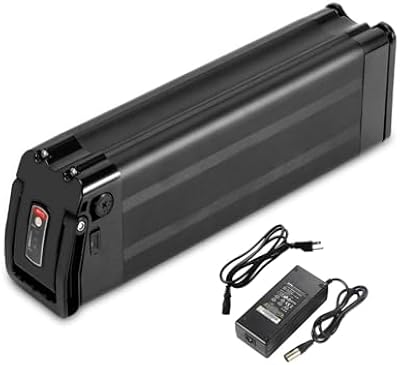
The charger ships in the box, and the model row names it: DPLC084V42Y. The 42-volt output is the correct ceiling for a 36V pack, which is ten cells in series topped at 42.0 volts, because each lithium-ion cell charges to a maximum of 4.2 volts. At a typical 2-amp charge current, fifteen amp-hours takes 7.5 hours before the taper, so plan an overnight charge.
The spec table on this listing is a fight between rows. The model row prints 35V on a 36-volt battery. The output-port bullet says 48V 10A on the same 36-volt pack.
One cell row says lithium metal while another says lithium ion, and no lithium-metal pack ships in this class, so that row is template junk.
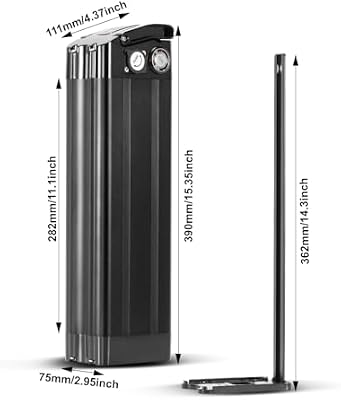
The weight rows disagree too. Battery Weight reads 6 pounds, Item Weight reads 7. And the case dimensions cannot settle on a number: the bullet calls the case 390 millimetres tall, then prints a detail line of 14 inches tall by 3 wide by 4.3 long, while the details table says 4.3 by 3 by 15 inches.
Three case lengths on one page, and only the measure-your-bay routine settles which one arrived.
Two claims come with no evidence either way. The 18-month warranty has a term but no document behind it in the listing, and the 1000-plus cycle claim sits at the top of the 400 to 1,200 cycle band that lithium-ion chemistry generally delivers. Treat both as the listing's word.
What the listing gets right is the electrical spec, which is internally consistent once you ignore the typos. The 2-pin discharge port, the key lock that doubles as the power switch, and the press-twice indicator all appear in one bullet each, and the owner reports confirm each one working as described.
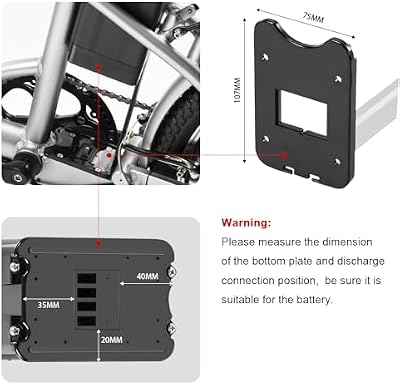
Measure the bay, then argue about the price
The decision this pack forces is the same one its record dramatizes. If your bike is one of the four named frames or a close cousin, and you are ready to swap a bracket or a battery seat with no instructions to help you, this pack delivers a real capacity jump at a price the range reports support.
If your bike is not on the list, the two failed fits in the record are your preview, and no capacity number fixes a pack that will not slide in. The same brand family sells other shells: our Yose 36V 13Ah silver fish review and Yose 36V 13Ah review cover two of them, and the covered 48V 15Ah seat-tube rung sits on this pack's own ladder at higher voltage.
And if you are shopping on price per watt-hour, keep looking, because at about 46 cents per watt-hour this pack still costs more than nearly everything we track. What the price buys is capacity in a shell the small-brand folding bikes actually take, with a buyer record that tells you exactly which bikes those are.
Frequently asked questions
Will this fit my bike?
The listing names four frames: the FAT20810 fat-tire folding ebike, the Starfish, the Dolphin and the Peacedove, and says it cannot replace a Heybike battery. The record adds an Ecotric fat-tire bike and a Swagtron EB6 with minor bracket work, and two bikes it did not fit. Check your connector and mount before the capacity tempts you.
How much range should 540 watt-hours give me?
At 20 to 25 watt-hours per mile of throttle-only riding, about 22 to 27 miles. Light pedalling stretches that well past 30, which is what the trike owner in the record reports. The listing's own range promise is vague, so plan from the capacity instead.
Does the charger come with it?
Yes, and the model row even names it: DPLC084V42Y, a 42-volt charger, which is the correct ceiling for a 36V pack. Plan on roughly 7.5 hours to full at a typical 2-amp current, and expect the pack to arrive showing empty because packs ship at a storage charge.
Is it worth the price?
On raw value, no. At about 46 cents per watt-hour it costs more than nearly every pack we track.
The price buys a 15 amp-hour pack in a seat-tube shell the small folding brands take, plus a buyer record that shows you exactly which bikes it fits and what the install demands. If that is your situation, the price is defensible, and if it is not, nothing in the record will change your mind.