Shopping for a 52V pack in this capacity class means meeting VISET three times. Our capture caught the brand's 30Ah rung at 0.23 per watt-hour, a plain 20Ah listing at 0.26, and this scooter-labeled pack at 0.29. Same voltage, same 1040 watt-hours on paper, three different prices.
The scooter variant captured as the most expensive of the three, and the listing is now gone from Amazon, so what follows is a rebuild from the recorded specs rather than a live review.
The interesting part is what this record kept that its sibling's didn't. A charger printed at 58.8 volts settles the pack as a 14S build, a question the cheaper 20Ah listing left permanently unanswered. It also carried five ratings with written texts, where the sibling's 4.8 floated with no count at all.
Below you'll find the ladder math, the power arithmetic, the charge and range bands, and what five buyers have actually said.
Of the three rungs, this one is the hardest to recommend on value. It carried the same 1040Wh as the brand's plain 20Ah listing while capturing thirty dollars higher, and it gave up 0.06 per watt-hour to the brand's own 30Ah pack.
The hardware story is stronger than the price story: the 40A board covers the claimed 2000W ceiling, the recorded charger settles the cell layout, and current 52V 20Ah listings can still be tested against every check below.
The rung its own brand undercut
Our comparison data tracks 324 packs by price per watt-hour, and this one sits in the pricier third of that table, toward the back of the 52V field. The exact position renders in the specs box on our comparison table. What makes the position worth writing about is the company it kept on the same marketplace.
The brand's 30Ah rung captured at 359 for 1560Wh, which works out to 0.23 per watt-hour. This 20Ah captured at 299 for 1040Wh, or 0.29.
The bigger pack cost about a fifth more money and carried half again the energy. Ladders normally reward you for stepping up, and this one did, steeply. Even stranger, the plain 20Ah listing captured at 269, thirty dollars under this one for a battery with the same voltage, capacity and board rating.
The VISET 52V 20Ah review covers that rung, and the VISET 52V 30Ah review covers the big one. Nothing in the recorded specs explains the thirty-dollar gap. The scooter label, the bracket mount and the key lock rode along on the title, but a lock and a bracket don't cost thirty dollars.
A 40A board with almost nothing in reserve
Forty amps at 52 volts is 2,080W of continuous output, and the title claimed motor support from 200W to 2000W. A 2000W motor draws about 38.5A at this voltage, so the claim sits inside the hardware with about 1.5A to spare. That's a pass, but it's the thinnest pass in this family.
The sibling 20Ah listing claimed 1500W, which draws about 29A and leaves 11A of headroom for hills, headwinds and cold cells. A motor that sizes its controller honestly will rarely sustain a full 2000W draw, but on a long climb the board would run within an amp of its ceiling.
The rest of the claimed range is comfortable. A 1500W motor pulls about 29A, a 1000W motor about 19A, a 750W motor about 14A, and even the 200W floor draws under 4A. Any motor at or under 1500W runs this pack with real margin, which is the honest way to size a build around it.
The charger that settles the cell count
The recorded spec box says the included charger printed 58.8 volts, and that single number answers the question most 52V listings leave open. Fourteen cell groups times 4.2 volts is 58.8V, the standard 14S termination.
A 13S pack tops at 54.6V, and both layouts get sold as 52V, which is why the em3ev 52V buyer guide tells buyers to treat the charger label as the tell. The sibling listing never recorded its charger voltage, so its cell count is unanswerable now that the listing is dead. This one's is settled: 14S, and any replacement charger must print 58.8V to match.
That detail matters more after a death than before it. A buyer hunting a successor pack should ask the seller for the charger's printed voltage in writing, because a 54.6V charger on a 14S pack will never charge it full, and a 58.8V charger on a 13S pack will overcharge it.
Charging, range and the case that carries it
At the recorded 2A rate, 20 amp-hours takes ten hours from empty. The listing's own 10-to-12-hour claim is consistent with that floor plus the slow settling at the top of the charge, so it's one of the few charge estimates we've rebuilt this season that survives its own arithmetic.
Overnight charging covers it, and a buyer who wants faster should buy a 3A or 4A charger at 58.8V, which cuts the floor to between five and seven hours.
Range scales from the em3ev 48V battery guide, whose 0.96 kWh anchor runs 30 to 40 miles on throttle alone and 50 to 65 with a light pedal assist.
At 1040Wh, 1.08 times the anchor, this pack lands at roughly 32 to 43 miles on the throttle and 54 to 70 with a light leg. Hills, cold weather and high assist levels pull the real number toward the bottom of each band.
The manufacturer's cycle claim, 80 percent capacity retained after 800 cycles, sits inside the 400-to-1,200-cycle band that Wikipedia's lithium-ion entry gives for the chemistry. It's a plausible claim rather than a verified one, and the automotive-grade cell language behind it was never backed by a cell brand in any capture.
The bracket most frames can take
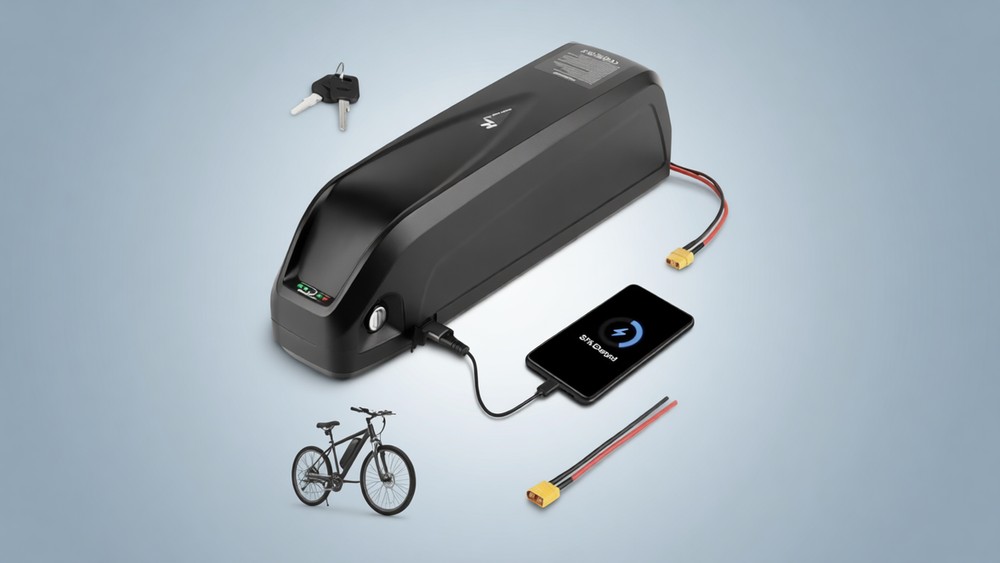
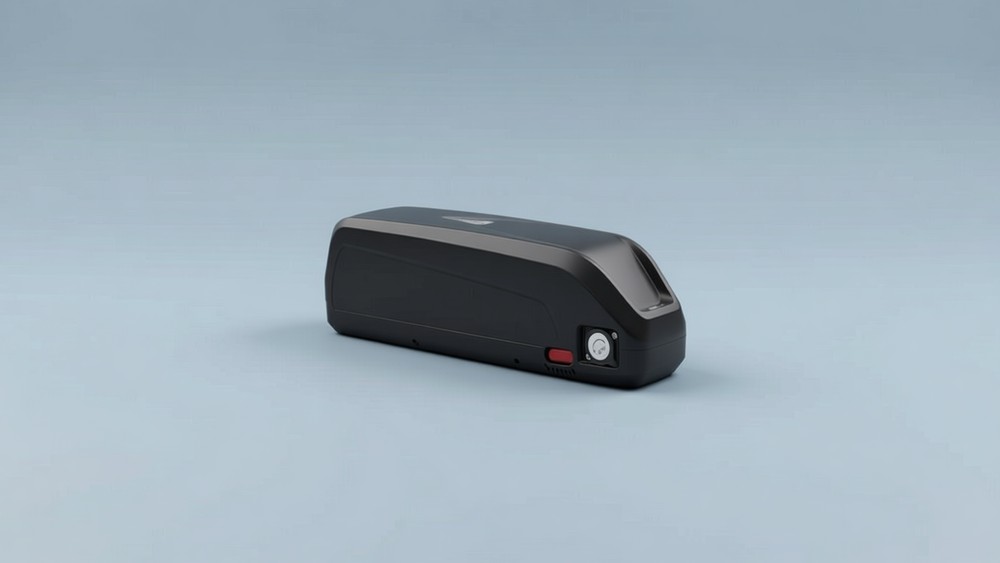
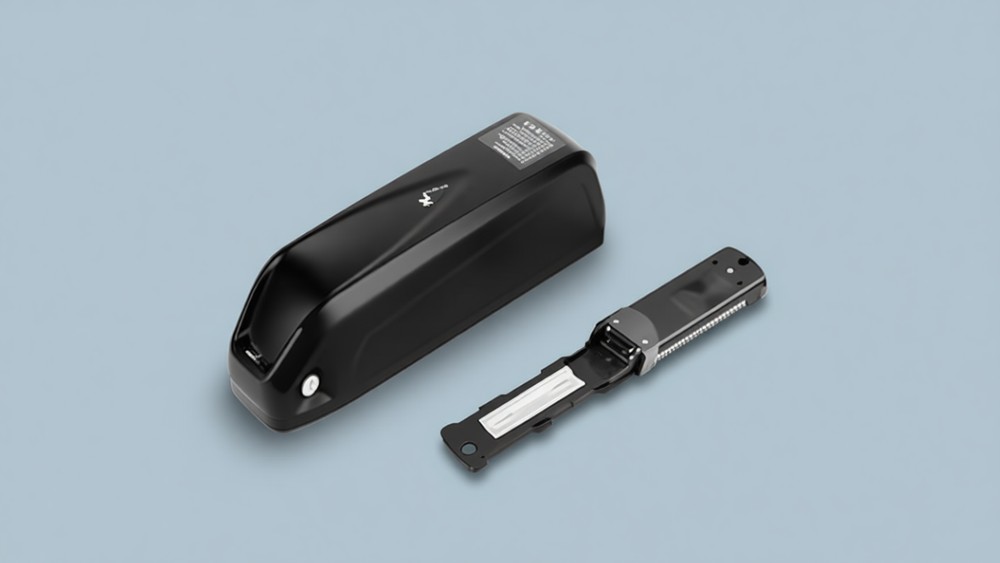
The case measures 14.5 by 3.54 by 5.01 inches, about 4.2 liters, and mounts on a bracket that bolts to the water-bottle screw holes most frames already carry. That's the most compatible mounting position an aftermarket pack can use, and the recorded key lock adds a theft deterrent the plain sibling lacked.
A shock-absorbing holder between case and bracket was part of the recorded feature set, which protects cell connections from road buzz, and the title's USB port and LED indicator round out the convenience list. The USB draw is negligible against 1040Wh, so topping up a phone on a long ride costs nothing worth counting.
What was never recorded
No weight was ever captured, so the density check every rebuild runs is impossible here.
The expectation can still be stated: complete packs usually land between 0.18 and 0.21 kWh per kilogram, and 1040Wh at that band implies roughly 5.0 to 5.8 kg. The discharge connector type was never recorded either, which is the more practical gap, since a connector mismatch is the most common install failure. Ask a successor seller for both figures before ordering.
What five ratings can and cannot say
The February 2026 capture recorded 4.5 stars from five ratings, with three written texts worth passing on.
One owner has called it among the best packs they've used. Another buyer, fitting it as a replacement, confirmed the capacity metered as advertised. A third owner has reported double the range of the pack this one replaced, and picked the build quality out as the first thing they noticed.
Five ratings is a handful, not a consensus, and no star histogram survives to show how the ratings spread.
What the record does show is a consistent picture: buyers who received the pack found the capacity real and the range better than what they'd had before. That's a small sample agreeing with itself, frozen at the moment the listing died. Treat it as a data point with people behind it, not a verdict with statistics behind it.
A rider hunting this class today should carry the checks this listing left behind: the 58.8V charger that proves a 14S layout, a connector type asked for in writing, a weight to test against the density band, and a price to test against the 0.23 rung the brand itself set. Compare what's live right now with those four questions written down.
Our review archive covers packs across every voltage, and the comparison table ranks live listings by price per watt-hour.
Frequently Asked Questions
Was this pack good value?
No, not next to its own siblings. It captured at 0.29 per watt-hour against 0.26 for the brand's plain 20Ah listing and 0.23 for its 30Ah rung, the worst of the three.
Can a 2000W motor really run on it?
On the arithmetic, barely. A 2000W motor draws about 38.5A at 52 volts, and the board is rated 40A continuous, so there's about 1.5A in reserve. Motors at 1500W and under run with real margin.
Was it a 13S or a 14S pack?
14S, settled by the recorded 58.8V charger. Fourteen cell groups times 4.2 volts is 58.8V, where a 13S pack tops at 54.6V. Any replacement charger must print 58.8V.
How long did a full charge take?
Ten hours at the recorded 2A rate, matching the listing's own 10-to-12-hour claim once the full-charge stretch at the end is counted.
What range could a rider expect?
About 32 to 43 miles on throttle alone and 54 to 70 with light pedal assist, scaled from the em3ev anchor at 1040Wh.
Does the bracket fit any bike?
It bolts to standard water-bottle screw holes, which most frames carry. Check that your frame has them and that your controller accepts 52V input before ordering any 52V pack.