The title on this listing promised motor coverage up to 15,000 watts, and the board inside could deliver 2,080. That is more than seven times past the board, and the gap leads this review because nothing else on the spec sheet is controversial. Underneath the fantasy number sits a sensible mid-power pack, and the sensible parts are what a buyer can actually use.
Everything else on the spec sheet reads sensibly too. Its included charger is 58.8V at 4A, which settles the cell layout as 14S and puts the charging floor at five hours from empty, close to where the old claim sat. The housing of this pack carries an IP65 rating, the spec table lists six protections, and the family's bigger 52V rung priced slightly better per watt-hour.
The record is the thinnest kind. One five-star rating, one text about solid build and a spring mount that felt secure, and then the listing left Amazon with the record frozen. Below, the claim math, the charger's settlement of the layout question, the sealing honesty check, and what the price band says.
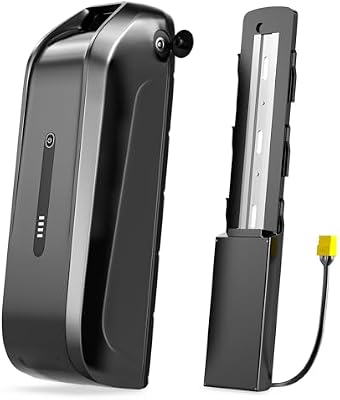
A 15,000W claim meets a 2,080W board
The recorded title said this pack fits motors from 500 to 15,000 watts. Forty amps at 52 volts is 2,080W of continuous output, so the title's top sits more than seven times past the board that would have to feed it.
The gap is not a rounding artifact or a peak-versus-continuous quirk. Boards in this class deliver four-figure power, and five-figure motor ratings belong on packs an order of magnitude bigger than 1040Wh. Held to even the board's own 2,080W ceiling for a sustained draw, this pack would empty in about half an hour.
The honest top of this pack's range is 1,500W. That draws about 29A at 52V and leaves about 11A in reserve, a 1,000W motor draws about 19A, and even the 500W floor of the claim pulls around 10A. Inside the sensible band, this board has real headroom, and that is the part worth buying.
What the charger settles
A 52V pack's full-charge voltage tells you its cell layout. Fourteen cell groups times 4.2 volts is 58.8V, the 14S termination, while 13S tops at 54.6V. The included charger was recorded at 58.8V and 4A, so the layout question that stayed open across the VISET family closes here: this is a 14S pack.
The em3ev 52V buyer guide explains why a charger must match the layout it feeds, and why both layouts still sell as 52V.
IP65 means jets, not submersion
The sealing claim deserves an honest reading, because listings use IP ratings loosely. IP65 per the IP code definitions means the case is dust-tight and survives low-pressure water jets from any angle. It does not mean submersion.
Rain, snow and a hose wash are in scope, pressure washing and deep puddles are not, and that is the correct expectation for a commuter pack in this price band. Browse sealed 52V packs that are live today with that limit in mind.
RANSYRI also printed a temperature range of -20C to +60C. Riders in cold climates get a pack that functions below freezing, with the usual caveat that every lithium-ion chemistry delivers less in deep cold. That is category knowledge, not a defect of this pack.
Where the price lands, and how the family priced around it
Our comparison data tracks 324 packs by price per watt-hour, and this one captured at 0.24, close to the middle of that table.
For 1040Wh at 52V that is genuinely decent value, and the exact position renders in the specs box on the comparison table. The brand's own 30Ah rung captured at 0.23, the same pattern most families show, where the bigger pack prices slightly better per watt-hour. The RANSYRI 52V 30Ah review covers that rung.
Our old article claimed name-brand 52V 20Ah packs cost 35 to 50 percent more than this one. Our data does not track enough name-brand listings to support a percentage like that, so it is dropped here rather than repeated. The honest statement is the band position above, plus the live table, where a buyer can see the whole market on one screen.
The cycle-life claim and the warranty
The spec table claimed automotive-grade cells holding 80 percent capacity past 1,000 cycles. Lithium-ion packs typically manage 400 to 1,200 full cycles per the Wikipedia lithium-ion battery article, so the claim sits at the top of the plausible band.
Nobody audited it, and a claim like that takes years to verify even when a listing survives. The enforceable part of the purchase was the one-year warranty on core components, plus lifetime technical support on the protection module. That was what a buyer actually got, and with the listing gone, the cycle claim stays a claim.
One rating, one text, frozen
The record on this ASIN is as thin as a record gets. One five-star rating and one review text, which said the build felt solid and the spring-mounted pack sat securely on the frame. Our data row carries no rating at all.
The listing has since left Amazon, so the record can never grow, and nothing here should be read as an owner consensus.
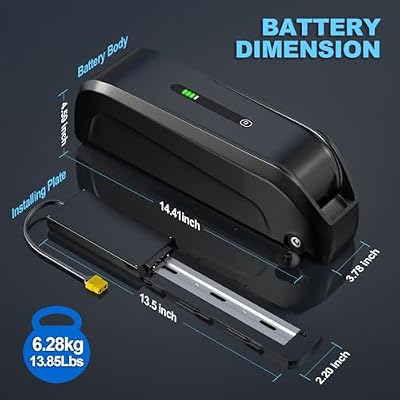
Two practical checks close it out. No weight was ever recorded, though the case at 14.41 by 4.6 by 3.81 inches is about 4.1 liters, and complete packs usually land between 0.18 and 0.21 kWh per kilogram, so 1040Wh should weigh somewhere near 5.0 to 5.8 kg.
The connectors were recorded only as nickel-plated, with no plug type named, so a buyer matching a controller should ask a seller for the exact plug. Compare what is live right now with those two questions written down. Our review archive covers packs across every voltage.
Frequently asked questions
Will it run a 1,500W motor?
Yes, comfortably. A 1,500W motor draws about 29A at 52V against a 40A board, leaving about 11A in reserve. The 15,000W figure in the title should be read as a listing error, since no board in this class feeds five-figure power.
Is it actually waterproof?
IP65 is the honest reading only if you define waterproof as rain, snow and washing. The rating means dust-tight plus low-pressure jets from any angle. Submersion is outside the rating, so deep water stays off the list.
How long does a full charge take?
The recorded charger is 4A, and 20Ah at 4A is five hours from empty, so the old claim of about five hours survives its own floor exactly. Expect a longer tail in practice while the pack's balancer finishes the job.
How far does 1040Wh take you?
Just over the 0.96 kWh anchor in the em3ev 48V guide, which runs 30 to 40 miles on throttle alone and 50 to 65 with a light pedal assist. Scaled up by 8 percent, this pack lands at roughly 32 to 43 on the throttle and 54 to 70 with a light leg. Cold, hills and high assist pull it toward the bottom.
What did the warranty cover?
One year on core components, plus lifetime technical support on the protection module. The cycle-life claim was never covered by anything but the brand's word, and with the listing gone, that question is settled by whatever successor listing inherits the design.