Two numbers on this listing sat about one amp apart, and the gap decides how you should read it. A 30A battery management system at 48 volts delivers 1,440W, and the title claimed support for a 1,500W motor, which draws about 31A. The claim runs about 4 percent past the board, a rounding-level miss compared with the 40 percent overstatements on other packs we rebuilt this season.
Everything else in the record closes cleanly. A 3A charger was recorded on the spec box, so the 7-hour charge figure survives the arithmetic that killed similar estimates elsewhere. The recorded 12.1 pounds works out to about 0.175 kWh per kilogram, just under where complete packs usually land, and it's a weight that closes the physics rather than fighting it. What the record never captured was a single rating, and the listing is gone, so the brand-reliability claims in our old article stay dropped and the numbers below stand on their own.
The 1500W claim against the 30A board
The board is the fact, and the claim is the marketing. Thirty amps at 48 volts is 1,440W continuous, and a 1,500W motor draws about 31A at this voltage, so the title's top claim sits about 4 percent past what the board can sustain. A rider who pushed 1,500W on long climbs would live at or over the ceiling, where a board protects itself by cutting output.
The honest reading is that the claim was rounding, not arithmetic. VEVOR printed a motor range the board nearly covers, and nearly is not coverage. A buyer with a real 1,500W motor should hold out for a 40A board, which the 52V tier commonly carries.
What the board covers comfortably
Below the top of the range there is no argument. A 250W motor draws about 5A, a 750W motor about 16A, and a 1,000W motor about 21A, so every motor a commuter or a typical kit build actually runs fits with real headroom. The comfortable ceiling sits near 1,200W, where the draw reaches about 25A.
This puts the pack one small step from the worst case rebuilt this season: a 15Ah downtube pack whose 2,000W claim ran about 40 percent past its own 30A board, covered in the DaYaoEnne 48V 15Ah review. The shape of the fault is the same, and only the size of the gap differs.
The weight test passes, the title wanders
The spec box recorded 12.1 pounds, about 5.5 kilograms, and 0.96 kWh over that mass lands near 0.175 kWh per kilogram. Complete packs usually run 0.18 to 0.21, so the pack sits just under the band with its case, lock and board accounted for. That is the plausible direction. A pack claiming far more energy per kilogram than the band allows would be the one to distrust.
The recorded dimensions, 14.57 by 4.92 by 3.54 inches, hold about 4.2 liters. Bare 18650 cells for 960Wh need roughly 1.7 liters, so the cells fill about 40 percent of the case and the board, wiring and shell take the rest. That is a normal split for an external box pack.
Reading the kit wording and the discharge socket
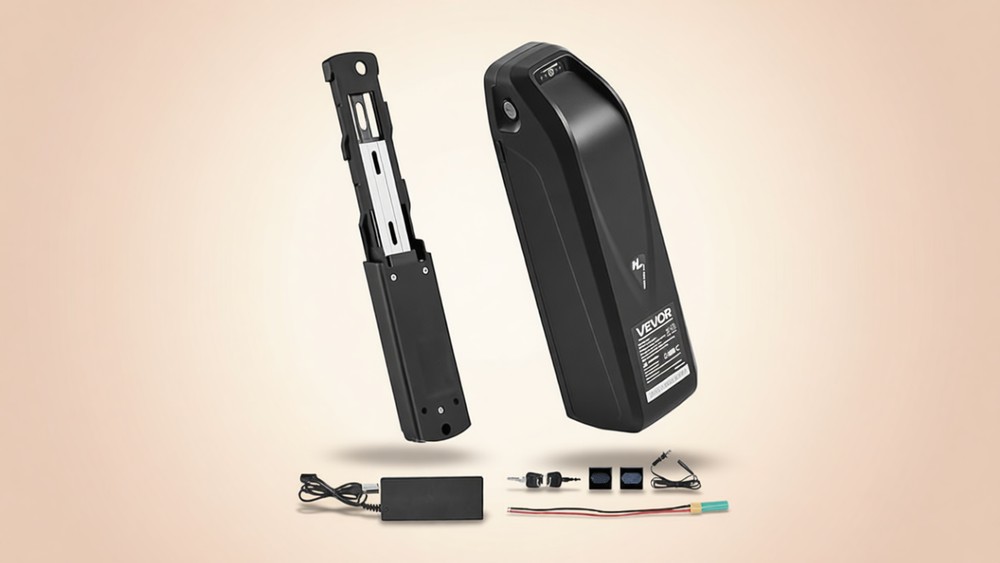
The title calls the pack a 'Detachable Electric Bicycle Replacement Kit with Discharge Socket', which is battery-seller language for two things. Detachable means the pack leaves its mount for indoor charging, and a discharge socket means it feeds the bike through a socketed interface rather than bare leads. The record never settled whether that socket docked into a cradle or fed a mounting plate, so a replacement hunter should match the socket layout, not just the plug, and keep an adapter in mind if the plug side differs. The word 'kit' in a battery title is worth ignoring unless the box contents were listed, and no capture recorded them.

Charging at the recorded 3A
The spec box named the charger: 3A. That single recorded figure is why the charge math closes here when it fails elsewhere. Twenty amp-hours at 3A is about 7 hours from empty, so the old article's 7-hour figure holds, and a 2A charger would stretch the same job to 10 hours.
A folding 20Ah pack rebuilt earlier carried a 5-to-7-hour estimate with no charger amperage ever recorded, and that rebuild dropped the estimate because nothing supported it. The Lolrko 48V 20Ah folding review shows the difference a recorded spec makes. At full charge this pack should sit at 54.6V, which is 13 cell groups times 4.2 volts and the standard 48V termination.

What zero ratings leave
On value the row sits close to the middle of the 324 packs we track by price per watt-hour, and the exact position renders in the specs box on our comparison table. The folding 20Ah rung rebuilt earlier captured the same 960Wh for less per watt-hour, so nobody should mistake this one for a bargain. The brand's own 15.6Ah rung recorded the same per-watt-hour rate for less energy, so the choice between the two VEVOR sizes was never about value.
No rating was ever captured for this pack, and no review text exists in the record. The listing is gone, so that record is frozen at zero forever. The old article leaned on VEVOR's name to fill the gap, with paragraphs about packs that consistently match their specs and a seller that handles service well. Those claims named no verifiable source, and I would rather leave the gap open than fill it with a prior. A brand name is not a record.
What remains is a coherent spec box with one small overclaim, a weight that closes the physics, and a charger amperage that lets the charge math stand. For a replacement hunt in the same capacity class, that is a fair checklist: board amperage against the motor claim, weight against the density band, charger amperage printed, and the mount interface named. Compare live 48V 20Ah listings with those four checks written down.
Our review archive covers packs across every form factor, and the comparison table ranks what is live right now by price per watt-hour.
Frequently Asked Questions
Can it run a 1500W motor?
Only at the edge. The 30A board delivers 1,440W continuous and a 1,500W motor draws about 31A, so sustained full power sits past the ceiling. Motors up to about 1,200W run with real headroom.
Is 12.1 pounds heavy for a 20Ah pack?
No. At about 0.175 kWh per kilogram it sits just under the 0.18 to 0.21 band where complete packs usually land, which is a normal weight for 960Wh in an external box.
How long does a full charge take?
About 7 hours from empty at the recorded 3A. A 2A charger stretches it to 10 hours.
What does the discharge socket wording mean?
It signals a socketed interface between pack and bike rather than bare leads. Whether it docked into a cradle or fed a plate was never recorded, so match the socket layout before ordering any successor.
What range should a rider expect?
The pack's 960Wh matches the em3ev 48V battery guide's anchor exactly, so the guide's own bands apply: 30 to 40 miles on throttle alone, 50 to 65 with light pedal assist.
How long do the cells last?
No cycle-life claim was ever recorded for this pack, so there is nothing to check. Lithium-ion packs generally deliver 400 to 1,200 full cycles before capacity drops hard, per the Wikipedia lithium-ion reference, and depth of discharge and storage habits move a pack within that band more than its label does.
Was VEVOR's reliability reputation real?
There is no record either way. No rating and no review text was ever captured for this pack, and the brand-level claims in the old article named no verifiable source, so they stay dropped.