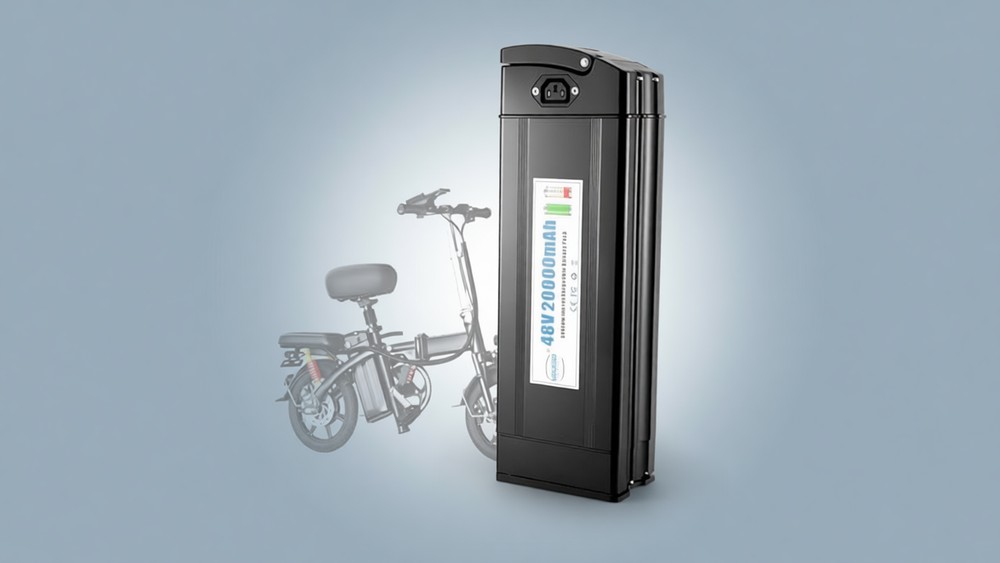
Folding ebikes hide their batteries in the frame, and that makes a replacement pack a measurement problem before it is an electrical one. The LOLRKO 48V 20Ah was built for exactly that job: a 960Wh brick sized to drop into a folding frame's battery cavity, with the wiring leaving from the top.
The original listing carried one of the most honest titles we have recorded, because it warned buyers in plain words that power comes out the top side, not the bottom. That single sentence was the first thing a buyer needed to read.
The listing is now gone from Amazon, so this article rebuilds from our recorded data and the spec box captured in February 2026. It works through what a folding-frame pack has to match, the math behind 960Wh, the cycle claim, and the port placement that made this listing unusual.
On value, the LOLRKO was genuinely good: the captured price put it in the cheapest fifth of the 324 packs we track by price per watt-hour, which is a strong position for a 48V 20Ah pack.
The 30A BMS covers the listing's 250W to 1,000W motor range without strain, and the safety lock was a feature most rivals skipped at this tier. The pack only earns that value if it fits your frame, so the numbers come first. Browse current 48V folding packs on Amazon to compare what is available now.
What a folding-frame pack has to match
Three numbers decide whether a replacement pack works, and the cells are not one of them.
First, the cavity: this pack measures 15 by 5.1 by 3.3 inches, so the frame slot needs to clear all three with room for wiring. Second, the voltage: this is a 48V pack, and running it on a 36V or 52V system damages something expensive. Third, the connector exit, which on this pack is the top face rather than the bottom or side.
Bikes built around a top-exit pack, including some Fiido and Ancheer folders, match all three out of the box. Anything else needs a routing plan before the order goes in. The recorded title spelled out the port placement, which reads like a seller responding to returns from buyers who skipped this check.
The top-exit port and the connector question
Most packs push their wiring out the bottom or the side so cables tuck under and run away from the rider. This one exits from the top face, which changes the routing on every bike it touches. On a frame built for it, the controller wiring already meets the top of the cavity and nothing changes.
On anything else, the cable has to climb over or around the pack, and that is where clearance problems start.
The Shewaihe 48V 13Ah pack made the same design choice on a different form factor, and the same rule applies to both: where the outlet sits is a fitting decision, not a spec detail. Measure where your controller wiring arrives before you buy a top-exit pack.
The plug type itself was never recorded. The listing did not name the connector, so buyers of XT60, Anderson, or proprietary plugs had to ask the seller. With the listing gone, that question now belongs to whatever replacement listing you choose, and it is worth asking before checkout rather than after.
The math behind 960Wh
Forty-eight volts times 20 amp-hours is 960Wh, the standard big-pack tier for 48V riders. Range starts from a tested anchor: the em3ev 48V battery guide puts a 0.96 kWh pack at 30 to 40 miles on throttle alone and 50 to 65 with light pedal assist. This pack holds exactly that energy, so those bands apply directly, and mixed riding with hills and load lands between them.
The 30A BMS sets a 1,440W continuous ceiling at 48 volts. A 250W motor draws about 5 amps and a 1,000W motor about 21, so the full claimed motor range sits comfortably inside the limit. At the full charge voltage of 54.6V, which is 13 cell groups times 4.2 volts, the pack matches every standard 48V charger.
Charging time was never recorded, because the listing never said how many amps its charger pushes. The floor is 20 amp-hours at 2A, or 10 hours from empty. Any claim of a faster full charge depends on a higher-current charger, and the pack's own charging port decides what it accepts.
Weight, cells and the cycle claim
The recorded weight is around 13 pounds, about 5.9 kg. That works out to roughly 0.16 kWh per kilogram, just under the 0.18 to 0.21 band where complete packs of this class usually land. It's a heavy pack for the energy it carries, which is the normal cost of a steel-framed case, a lock mechanism, and a folding-bike form factor built to survive being bolted into a hinge area.
The listing claimed Grade A cells rated for more than 1,000 cycles. Against Wikipedia's lithium-ion cycle-life band of 400 to 1,200 full cycles, that claim sits at the top of the plausible range rather than past it. It's an optimistic number, not an impossible one, and partial cycling stretches real life further.
The Ransyri 36V pack made the same 1,000-cycle claim and it holds for the same reason, while the packs we covered this season that promised 1,500 cycles, like the Q-RQtebat 48V 12Ah, were the ones that failed the check.
The 200A peak caution
One recorded spec deserves a caution. The BMS was described as 30A continuous with a 200A peak, and that peak figure is nearly seven times the continuous rating, which is far above what BMS designs normally publish. Size your build on the continuous 30A rating, because that's the number the hardware must sustain.

A five-rating record, frozen
Our February 2026 capture recorded five ratings averaging 4.0 stars. That is a small pool, and the record leaves room for anything from one strongly critical review to a spread of middling ones. The original review text described at least one buyer whose experience went badly, and the pattern on replacement packs says a fit mismatch is the usual culprit for that kind of score.
The positive side of the record praised the build and the safety lock, and noted the pack arrived well packaged and held charge as expected. With the listing dead, the record can never grow, so 4.0 from five ratings is all this pack will ever show. None of it should be read as a reliability track record, because five ratings cannot carry that weight.

Buying one comes down to three measurements
If you own a folding bike with a frame cavity near 15 by 5.1 by 3.3 inches, a 48V system, and controller wiring that meets the top of the cavity, a pack built to this pattern fits your bike.
The value tier it sat in, the cheapest fifth of what we track, makes it worth looking for a successor with the same shape. The comparison table shows where every pack we track lands on price per watt-hour.
If your bike takes a downtube pack or a rear-rack battery, this form factor will never fit, and the cavity number settles it before anything else matters. Our review archive covers packs across the other form factors.
When you shop for a replacement, compare 48V 20Ah folding packs on Amazon with the three numbers from the first section written down.
Frequently Asked Questions
Will this fit a Fiido or Ancheer folding bike?
Only the models whose battery cavity matches the 15 by 5.1 by 3.3 inch footprint and whose wiring arrives at the top of the cavity. Measure the slot before ordering, because folding frames vary even within one brand.
What connector does this pack use?
The listing never named the plug type. It recorded only that power and charging both exit the top face. Any replacement pack's listing should name its connector, and if it does not, ask before buying.
How long does a full charge take?
The charger's amp rating was never recorded, so only the floor is certain: 20 amp-hours at a 2A charger takes 10 hours from empty. A higher-current charger cuts that by the same share, as long as the pack's port accepts it.
Can I charge it with a 36V charger?
No. A 36V charger terminates near 42V and a 48V pack needs 54.6V. The pack would appear to charge slowly and never reach full. Use a 48V-rated charger only.
Is the safety lock useful?
It keeps the pack from working loose in a frame that flexes, and it slows a casual thief on a parked bike. It is not high security, and the buyers who mentioned it in the record counted it as a plus.