Some listings argue with themselves, and the DaYaoEnne 48V 15Ah did it in one title. It claimed motor support up to 2000W, and it also recorded a 30A battery management system, and those two numbers cannot both be true. Thirty amps at 48 volts tops out at 1,440W, and a 2000W motor needs about 42A, roughly 40 percent more than the board can deliver.
The listing is gone from Amazon now, so the claim stands unretracted and unbuyable. This article rebuilds from our February 2026 recorded data: the spec box, the row in our comparison data, and the title itself, which is the most honest evidence the listing ever left. It works through the power math, the certification badge the title printed, the fit question for a downtube pack, and where the value landed.
On value it sat well. The captured price put it in the cheaper third of the 324 packs we track by price per watt-hour. A good price on a pack whose headline claim fails its own arithmetic deserves a closer look, so the math comes first.
What the pack's own numbers allow
The recorded BMS is 30A continuous, and that is the number the hardware must sustain, so 1,440W is the real ceiling. The title's 200W floor draws about 5A and sits deep inside it. A 750W motor draws about 16A, and a 1,000W motor about 21A, so every motor a commuter or a typical conversion actually runs fits with room to spare.
Where the 2000W claim actually lands
Only the top of the range fails. A rider with a 1,500W motor sits right at the ceiling with nothing in reserve, and a 2,000W motor exceeds the board outright.
The claim was not a rounding error or a generous peak figure printed as continuous. It was about 40 percent past the hardware, and the pack's own spec box carried the number that proves it.
That pattern has company. The Q-RQtebat 48V 12Ah review covers a pack whose 1,500-cycle claim failed against its own recorded charger voltage, a different number with the same shape: a listing whose strongest selling point was the one its own data contradicted.
The UL badge printed in the title
The title ended in two parenthetical claims: a 5-pin variant code and the words UL Certificated. Certification to a UL standard for light-electric-vehicle batteries means a third party tested the pack for overcharge, short circuit, thermal and mechanical abuse, and it is the kind of evidence worth paying for, because most bargain listings carry no independent testing at all.
Here is what our record cannot tell you. The listing never printed a certificate number, a file number, or a testing lab, so there was no way to check the badge against UL's own records when the listing was live.
Now that the listing is gone, the claim is permanently unauditable. It stays in the record as a printed claim and nothing more.
The practical lesson carries to live listings. A certification claim you can verify comes with a number you can look up. A claim that lives only in a title is a word on a page, and it should carry no weight in a buying decision either way.
Fit: the case, the base and the XT60
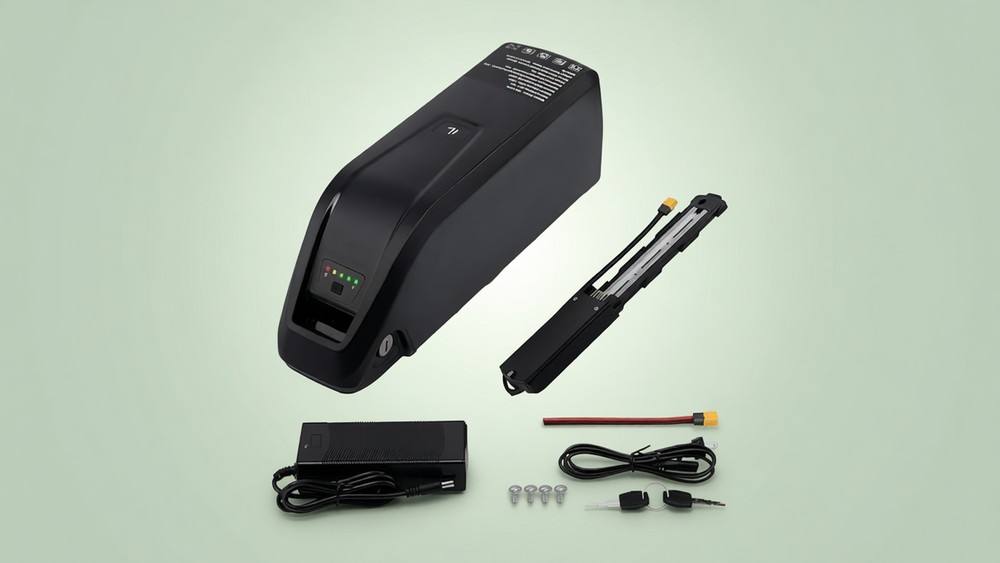
The recorded dimensions are 14.56 by 3.74 by 4.8 inches, a long low brick for a downtube rail. The discharge base carried 5 pins, and the box included an XT60 lead for controllers wired for that plug. Both details matter, and they matter in that order.
The 5-pin base puts this pack in a known connector class. Parts sellers list the same external downtube case families with 4-blade, 5-pin or 6-pin discharge bases, and the greenbikekit connector page documents all three.
Pin count tracks the current class: a 5-pin base is the 25A to 30A tier, so a 30A board sits at the top of what its own connector class is sold for. That is consistent with the recorded BMS, and it is one more reason the 2000W claim never had a path.
Measuring before ordering
A downtube replacement is a three-measurement job: case length against your rail, cross-section against your bracket, and pin count against the base. The Yose Power 48V 15Ah downtube review covers the same fit logic on a live listing, and the comparison table filters this form factor by voltage and price per watt-hour.

Weight, range and charging at 720Wh
The recorded weight is 10.8 pounds, about 4.9 kilograms, and 720Wh over that mass lands near 0.147 kWh per kilogram. That is below the 0.18 to 0.21 band where complete packs usually sit, which is the plausible direction. A downtube shell with a lock and a board inside weighs something, and a pack that claimed far more energy per kilo than the band allows would be the one to distrust.
Forty-eight volts times 15 amp-hours is 720Wh, three quarters of the 0.96 kWh anchor. The em3ev 48V battery guide puts that anchor at 30 to 40 miles on throttle alone and 50 to 65 with light pedal assist, so this pack scales to roughly 23 to 30 on the throttle and 38 to 49 with a light leg. Mixed riding with hills lands between the bands.
Charging runs at the included 2A rate, which puts a full charge at 7.5 hours from empty.
Overnight covers it, and mid-day top-ups do not. A 4A charger would halve the time if the pack's port accepts it, and that acceptance was never recorded. At full charge the pack should sit at 54.6V, which is 13 cell groups times 4.2 volts and the standard 48V termination.

What a replacement hunt inherits
No rating was ever captured for this pack, so there are no owner reports to quote and none will ever exist. What remains is a coherent spec box with one failed claim, a weight that closes the physics, and a certification badge that was never checkable. That is a fair summary of the bargain-battery market, and it is why the record here reads the way it does.
If you ride a 48V downtube system with a motor at or under 1,000W, the capacity class and the fit pattern are worth hunting in a successor. Demand the certificate number this listing never gave, match the three measurements before checkout, and treat any motor claim above the BMS ceiling as a typo until the seller proves otherwise. Compare 48V 15Ah downtube packs on Amazon with those checks written down.
Our review archive covers packs across every form factor, and the comparison table ranks what is live right now by price per watt-hour.
Frequently Asked Questions
Can this pack really run a 2000W motor?
No. The recorded 30A BMS tops out at 1,440W continuous at 48 volts, and a 2000W motor draws about 42A. The claim failed against the pack's own recorded hardware, and nothing in the listing resolved it.
Was the UL certification real?
There is no way to know. The title printed the words but never gave a certificate number, so the claim could not be checked even when the listing was live. Treat an unverifiable badge as a claim, not evidence.
Will it fit my bike's downtube mount?
Measure three things: your rail against the 14.56 by 3.74 by 4.8 inch case, your bracket against the cross-section, and your base against the 5-pin layout. All three must match, and the pin count is the one buyers skip most often.
What motors does the 30A BMS actually cover?
Everything from the 200W floor to about 1,000W with real headroom, since a 1,000W motor draws about 21A. Motors approaching 1,440W run the board at its ceiling with nothing in reserve.
How long does charging take?
15 amp-hours at the included 2A charger is 7.5 hours from empty. A 4A charger halves that if the port accepts the higher current, which was never recorded for this pack.
Is 720Wh enough range for commuting?
For most commuters, yes. The scaled bands run about 23 to 30 miles on throttle alone and 38 to 49 with light pedal assist, and a rider who pedals along at a low assist level usually lands well above the midpoint.