Hunting a downtube replacement starts with a tape measure and ends with a connector you can't identify. The frame side is fixed: whatever bolted to your downtube before will bolt there again, in the same footprint, talking to the same controller. Everything else about the purchase is reading a listing for the things it doesn't say.
The VEVOR 48V 13Ah was a listing that read well and said little. A big-brand name, a clean 624-watt-hour spec, a 3A charger in the box, and a weight that sits where a pack this size should sit. It also shipped with no stated board rating, no stated plug type, and not one customer review, and it vanished from Amazon before any of those gaps got filled.
What's left is a rare kind of case study: a pack whose spec sheet closes almost everywhere, and whose evidence never arrived. This piece re-checks the arithmetic that held up, names the three gaps that never got filled, and lists what a replacement has to match.
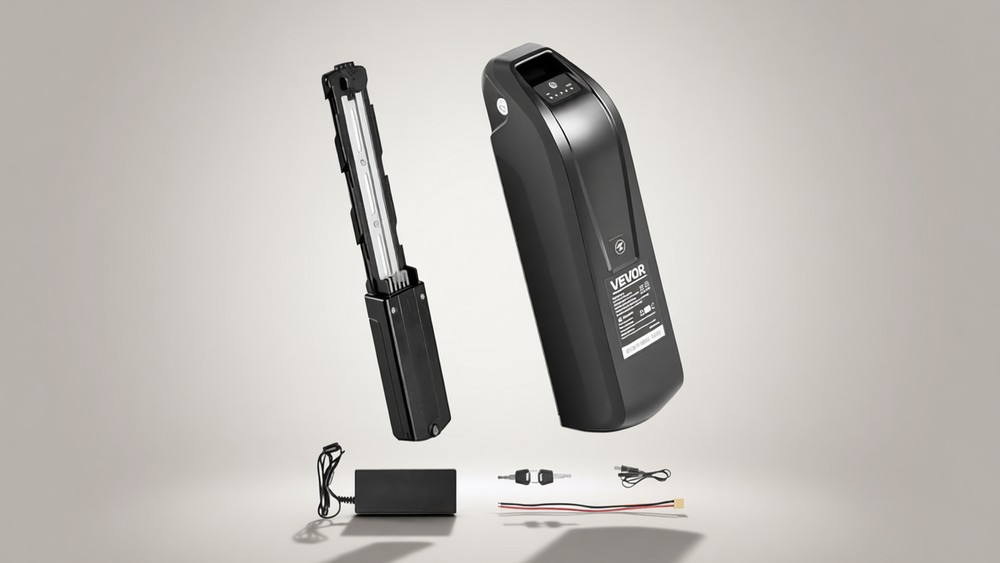
The VEVOR 48V 13Ah was a downtube-mounted pack rated at 48 volts and 13 amp-hours, 624 watt-hours, with a 3A charger, a keyed lock and an LED charge gauge in the box.
No price was ever recorded for it in our data, and the listing died before it collected a single customer review, so this rebuild runs on the recorded spec sheet alone. Current replacements in the same shape live in the 48V downtube class on Amazon.
The numbers that check out
The tank math closes first. 48 volts times 13 amp-hours is 624 watt-hours, which matches the recorded spec and sits in the useful middle of the 48V range, big enough for a real commute, small enough to carry indoors.
The charger math closes too. A 3A charger on a 13Ah tank gives a floor of 13 divided by 3, about 4.3 hours from empty, and the recorded claim was about 4.5 hours. That's the gap the taper at the top of a charge explains, and it means the figure was honest rather than optimistic.
Most packs in this class ship 2A chargers, which would put the same tank at a 6.5-hour floor, so the 3A unit saved roughly two hours per full charge.
The weight figure is the one I'd flag as genuinely credible. The pack was recorded at 10.45 pounds, and 624 watt-hours at 10.45 pounds works out to about 0.13 kWh per kilogram at pack level. That sits comfortably below the published lithium-ion cell band of 0.16 to 0.30 kWh per kilogram, which is exactly where a complete pack with case, board and hardware should land.
Packs that print weights too light for their size are the ones to distrust, and this wasn't one of them.
On the cell claim, the listing said 18650 cells, the most common format in the industry, and the em3ev 48V guide, written from 500 cycles of testing, notes that reputable-maker 18650 cells hold their charge far better over two years than no-name cells. The listing never named its cell maker, so that check stayed open.

The three gaps the listing never filled
First, the board. The listing claimed motor fit up to 1000W but never stated the BMS amp rating, and the safety features it did list are things every board has.
The guess, labeled as a guess, is that a 1000W motor at 48 volts draws about 21 amps under full load, so the board was plausibly rated 25 to 30A continuous. That's reasonable arithmetic and it is not a spec. Anyone running a motor near the top of that range would have needed VEVOR to confirm the figure in writing.
Second, the plug. The listing mentioned a discharge socket and never named its type. XT60, XT90, Anderson and bullet connectors all circulate in this class, and the 5-pin hailong lesson from the LGECOLFP rebuild is the same discipline in a different case: the connector kills more replacement orders than any spec mismatch.
On this pack the buyer couldn't even count pins from the listing, because the type was never printed.
Third, the proof. The pack had zero reviews when we recorded it in February 2026 and never collected any before the listing died.
VEVOR is a real company with support desks across many product categories, and that's worth something on a warranty claim. But a brand name is commentary, not proof, and the listing never produced any.
Range, scaled and labeled
No range figure was ever recorded for this pack, so here's scaled math with the label attached.
The em3ev range table states 30 to 40 miles on the throttle and 50 to 65 on low pedal assist for a full-size 960 watt-hour 48V tank. At 624 watt-hours this pack carried 65 percent of that anchor, which scales to about 19 to 26 miles on the throttle and 32 to 42 on low assist.
The old write-up estimated 20 to 30 miles on moderate pedal assist from a 500W motor. That figure sits inside the low-assist band's lower half, so it was defensible, just short of what the scaled math allows on gentle input. The practical read for a commuter: a 10 to 15 mile round trip runs this pack for two or three days between charges.

Matching a replacement downtube pack
The listing is gone from Amazon, confirmed dead as of November 2026. What it left is a checklist for anyone replacing a curved-shell downtube pack in this size class.
The footprint. The recorded case was 14.57 by 3.74 by 4.25 inches on a curved polycarbonate shell sliding onto a metal base plate. Measure the old pack and the clear downtube space between water bottle mounts and cable runs before ordering anything.
The connector, identified yourself. Since this listing never named its plug, look at the connector on your controller side and match that. The replacement seller who will photograph the plug before shipping is the one to buy from.
The charger voltage. Any 48V pack must charge at about 54.6 volts. The h-hailong 48V rebuild documents what happens when a seller prints a charger voltage one cell above that: the pack is not what its label says.
The conveniences. The keyed lock and LED gauge on this pack weren't luxuries. The lock ties the pack to the frame for parking, and the gauge answers the one question you actually have before a ride without powering up a display.
Who this shape fit: commuters and casual riders in the 10 to 30 mile range who wanted a mid-size tank from a brand with a support desk, without stepping up to a 20Ah pack's weight and price.
The 48V 13Ah slot has been hard on its occupants lately, this pack died young and unreviewed, and the Yose Power 48V 13Ah silver fish died before its first review too. Current candidates live in the 48V 13Ah class on Amazon, and the comparison table shows which ones carry real review counts.

Frequently Asked Questions
What charger came with it?
A 3A charger, recorded at about 4.5 hours for a full charge. The arithmetic agrees: 13 amp-hours divided by 3 amps is a 4.3-hour floor before the taper. A replacement 48V pack must charge at about 54.6 volts regardless of the charger's amperage.
How much did it weigh?
10.45 pounds, recorded. That works out to about 0.13 kWh per kilogram at pack level, comfortably below the cell band where a complete pack should sit. The figure is one of the more credible specs the listing printed.
What motors could it run?
The listing claimed up to 1000W. At 48 volts a 1000W motor draws about 21 amps at full load, which covers 250W to 750W motors with headroom if the board matched the claim.
Was the BMS amp rating ever stated?
No. The listing named the safety features but never the continuous amp figure, and the plausible 25 to 30A read is a guess from the 1000W motor claim, not a recorded spec. Ask any replacement seller for the figure in writing.
Did it ever collect reviews?
No. The listing had zero customer reviews when recorded in February 2026 and died without ever collecting any, so nothing about how long it lasts, fitment quirks or support behavior was ever shown.
What should a replacement match?
Four things, in order: the base-plate footprint and the 14.57 by 3.74 by 4.25 inch case size, the controller-side connector identified by eye, a charger printed at about 54.6 volts, and a stated BMS amp rating from the seller.