A 40-amp board on a full-size 960 watt-hour tank is a spec sheet that promises everything at once, and that's what the H HAILONG 48V 20Ah sold. It was a downtube shell with the biggest board in its price class, a fast 4A charger in the box, and a recorded price near the middle of the market.
One number in the recorded sheet doesn't sit still, though. The charger was rated at 58.8 volts, and that's 14-cell arithmetic on a pack wearing a 48V label. Either the label was loose or the charger was, and a buyer had to know which.
The listing is gone from Amazon now, so you can't read the box yourself. What's below: what the recorded numbers meant, where the charger math leads, what the two recorded owners have reported, and what a replacement pack has to match if your build was wired around this shell.
My read of the recorded sheet is that this was a power-first pack, not a bargain play.
You paid for the board and the fast charger, and the tank was full size, so nothing was out of proportion except the label. If your controller wants a board this big, the 48V 20Ah hailong-shell class on Amazon is where the replacements live, and the checklist at the end tells you which numbers to confirm before you order.
The big board on a full tank
The recorded sheet put a 40A continuous board on the pack, and forty amps at 48 volts is a 1,920-watt ceiling.
Most budget hailong shells this campaign has measured carry 25A or 30A boards, which cap a pack near 1,200 or 1,440 watts. A 1,500W hub on one of those shells runs its controller close to the board's limit. On this one it sat well inside it. Startup spikes and long climbs are where a small board trips, and the extra headroom is what keeps that from happening.
The energy side was just as full-size. Twenty amp-hours at 48 volts is 960 watt-hours, which is the standard big-tank figure for this voltage class. The board was never the limit on this pack, and the tank wasn't either, which is what made the mismatch in the charger number stand out.
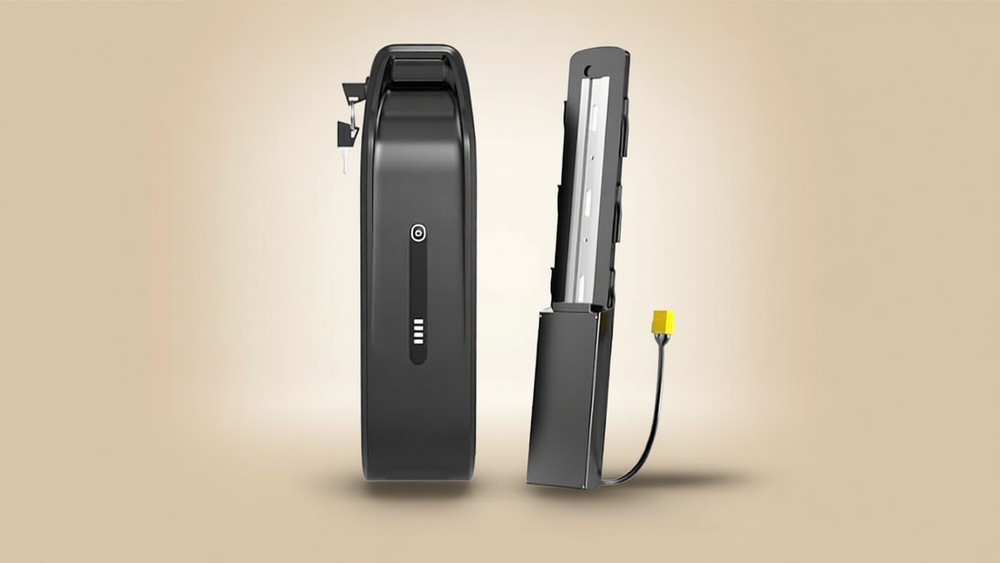
The case itself was the familiar dolphin shape, about 14.4 by 4.6 by 3.8 inches, with a spring-lock slide-in mount that speaks to any universal hailong bracket. An LED gauge showed the charge state on the case. The shell was ABS, rated for splashes and road spray, not for submersion, which is the norm for the form rather than a shortcoming.
The charger math that doesn't close
Here's the number that makes this pack worth writing about. The recorded bundle included a 58.8V charger, and 58.8 is fourteen cells times 4.2 volts. A fourteen-series pack is 52V-class labeling.
A pack wearing the standard 48V label is thirteen cells in series, and thirteen times 4.2 is 54.6 volts, which is exactly the figure the em3ev 48V guide names as the mandatory 48V lithium-ion charge voltage.
So the recorded sheet pairs a 48V title with a charger voltage one cell above it. Both readings are possible. If the pack was really fourteen cells under a loose label, the bundle was honest and the label was wrong. If the pack was really thirteen cells, the printed charger was a misprint, and feeding it to the pack would have pushed it past full.
A replacement buyer doesn't have to solve the mystery, because there's a rule that works either way: match the charger to the full-charge voltage printed on the pack or its original charger, not to the marketing label. The label tells you the family. The voltage tells you the truth.
What the label system hides
The listing offered the same shell in 36V, 48V and 52V configurations, which is normal for the form and also where the confusion starts.
A 36V pack charges at 42 volts, a 48V at 54.6, a 52V at 58.8. Three labels, three voltages, one case that looks identical from the outside. The charger in the box is the only figure on a listing that tells you which pack you're actually getting, and on this one it disagreed with the title.
Range and weight on the recorded sheet
Range is the easy part here, because 960 watt-hours is the anchor the em3ev range table linked above is built on. Its row for this class reads 30 to 40 miles on the throttle and 50 to 65 on low pedal assist. No scaling is needed for this pack.
Weight, hills and cold pull those numbers down, and the table is a guide, not a promise.
The recorded weight was 13.24 pounds, which sits just above the 10-to-12-pound band the same em3ev page prints for complete 48V 20Ah packs.
Run the density check and the figure holds together: 960 watt-hours in six kilograms is about 0.16 kWh per kilogram at pack level, and against the Wikipedia lithium-ion cell band, which runs from 0.16 to 0.30 kWh per kilogram, the cells alone would eat the entire printed weight at the bottom of that band. The number only closes with upper-band cells, so read it as a tight figure rather than a padded one. Heavier than typical, and honest about it.

Charging time
Twenty amp-hours divided by 4 amps is five hours from empty, and the bundled 4A charger was the fast end for this class.
The em3ev guide puts a 2A charger at about ten hours on a 20Ah tank and a 3A or 4A unit at five to six. If you're buying a replacement, the charger amperage is worth as much attention as the voltage, because a 2A unit turns a big tank into an overnight job.
What the two recorded owners said
When the previous article was written in July 2026, the listing carried two reviews, both five-star. Two owner statements were recorded, and they're worth keeping at exactly that strength.
One owner has reported running the pack in parallel with a stock Lectric battery and more than doubling their range and watt-hours.
The other has reported fitting it into a step-through frame with no special bracket work. Between them, the two accounts cover the pack's two real uses: a range doubler for a bike that accepts a second pack, and a swap into a frame that takes a universal hailong mount.
Anyone planning the parallel route should budget for a balancer. Two packs wired together discharge at whatever rate their boards allow, and a balancer keeps both packs working at the same rate instead of letting one carry the load. The old article's advice there was sound even though the brand it named can't be checked anymore.

Replacing it without inheriting the label problem
The listing claimed 1,000-plus cycles with over 80 percent capacity retention, and that promise sat at the top of the Wikipedia cycle-life band of 400 to 1,200 cycles, where cycle life is defined as the point capacity falls to 80 percent. It was a ceiling claim, and with the listing gone it's history now rather than an offer.
What a replacement has to match, in order:
The full-charge voltage. This is the lesson of the pack. Read the voltage printed on the charger or the pack, and buy a replacement that charges to the same figure. 54.6 and 58.8 are not interchangeable.
The shell and bracket. The case was about 14.4 by 4.6 by 3.8 inches on a universal hailong bracket. Measure the old shell and the mounting points before ordering, because hailong-style cases share a look and not a footprint.
The connector. The same outer hailong case ships with 4-pin, 5-pin or 6-pin discharge connectors, as the greenbikekit hailong connector page documents. Check the pin count on the old pack's base. The Ransyri 48V 12Ah short-case rebuild adds the slot-length check a pin count alone doesn't cover.
The board. Match the amps to your controller. A 40A board is headroom, and paying for it makes sense only if your motor or your plans need it.
At the recorded price of 249.99 for 960 watt-hours, this rung worked out to 26 cents per watt-hour, the middle of the 324-pack table. Nothing about the price was the problem.
Our reviews of the 36V rung of the same shell family and the 52V version show what the brand recorded at other voltages, and the battery comparison table lists what's currently trackable. The current 48V 20Ah hailong-shell listings on Amazon are the direct replacements.

Frequently Asked Questions
Why did a 48V pack ship with a 58.8V charger?
Because the two labeling systems are a cell apart. 48V packs are usually thirteen cells in series and charge to 54.6 volts, while 58.8 volts is fourteen cells, which wears a 52V label.
The recorded listing carried both numbers, and the honest reading is that one of them was loose. Match the charger to the pack's printed full-charge voltage.
How far does 960 watt-hours actually go?
The em3ev table puts a full 48V 20Ah tank at 30 to 40 miles on the throttle and 50 to 65 miles on low pedal assist. Expect the low end with a heavy rider, hills, or cold weather.
Did it really fit a Lectric XP?
The recorded record says two owners made it work, one in the downtube alongside the stock pack and one in a step-through frame with no extra bracket work. That's two accounts, not a guarantee. Measure your frame's mount and the shell footprint before ordering any replacement.
How long does a full charge take?
At the recorded 4A charger, about five hours from empty. A 2A charger would take twice that, which is why charger amperage matters on a 20Ah tank.
Can I run it in parallel with my stock battery?
Two owners have reported parallel use, and the recorded advice stands: use a balancer so both packs discharge evenly. Match voltages exactly, and check that your bike's wiring takes a second pack at all before buying anything.
How long would the pack have lasted?
The listing claimed 1,000-plus cycles with over 80 percent retention, the top of the published 400-to-1,200 cycle band for lithium-ion cells. With one charge a day, that's roughly three years of daily riding at the claim's own terms.