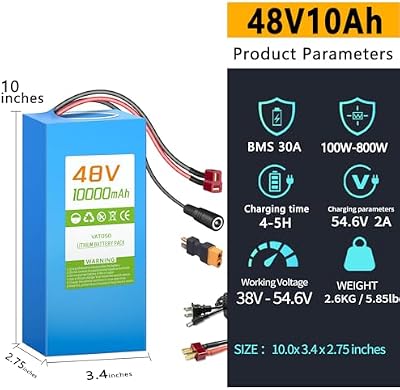
Small universal battery packs trade a mounting bracket for freedom, and that trade suits some builds far better than others. The Vatoso 48V 10.4Ah is a 10 by 3.4 by 2.75 inch rectangular brick with a 30A BMS, aimed at ebikes, scooters, ATVs and DIY projects, and both listings are in stock at 109.99.
Since then the picture has grown more complicated, in a way that matters if you are about to order.
The pack now sits on two live Amazon listings at once, the two pages carry different review records and different spec prints, and the parameters card on one of them disagrees with its own title about the motor size it supports. This rebuild walks through both listings, the thirty-two-rating record the newer page has collected, and which numbers on the page survive their own arithmetic.
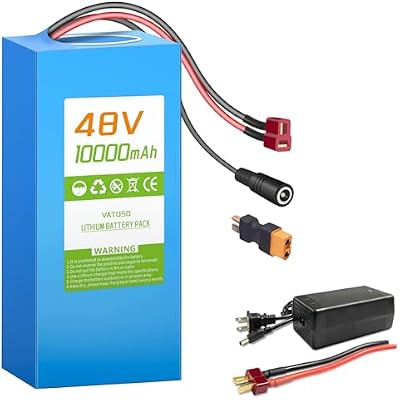
Two Listings, One Pack, Two Records
Order this pack today and you could land on either of two pages. The first carries ASIN B0GW2MQB2T, the listing we rebuilt in October, with the size parenthetical in the title and eight ratings.
The second carries ASIN B0DJZ23RH9, same seller, same 109.99, a near-identical title without the parenthetical, and thirty-two ratings at 4.1 stars. Same brand, same price, same claimed 10.4Ah capacity, two separate pools of buyer feedback.
The two pages also print different specs, which is the part a buyer cannot average away. The older listing's spec block rates the casing IP56. The newer one's bullet claims a waterproof shell at IP54.
The older page names the Jetson Bolt Pro as compatible. The newer one names no bike at all, and its model number carries the digits 4810, which look like 48V 10Ah against the title's 10.4Ah. Neither page explains the relationship, so the working assumption is one product family sold under two ASINs, and the record you should judge is the family's, not one page's.
Our own data row sits somewhere in the middle and is stale in both directions: it carries the older 10Ah capacity reading, a 480 watt-hour figure, a 100W-800W motor band and a brand field that parsed as the string 48V. The live titles have moved to 10.4Ah and 1000W. The specs box on this page tracks the row until the next data refresh, and the words below track the listings.
Five Ways This Listing Argues With Itself
The newer listing's title claims support for 100W-1000W motors. Its own parameters card prints 100W-800W. The 30A BMS accommodates both readings, since 30 amps at 48 volts is a 1440W ceiling, and 1000W draws about 21 amps while 800W draws about 17.
But the dispute is not about the BMS, it is about which ceiling the seller will stand behind, and the two most prominent surfaces on the page give different answers.
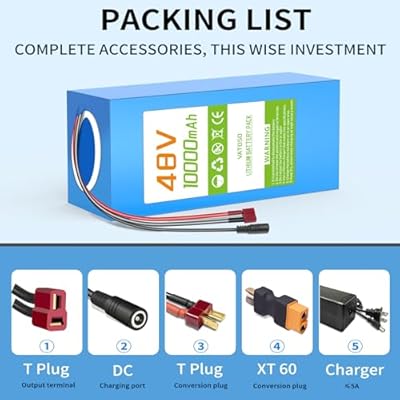
The packing-list card labels the battery, in large print, as a 36V battery. The card sits on a 48V pack's page, the title says 48V, the spec rows say 48 volts, and the working voltage print of 38V to 54.6V is correct 13-cell arithmetic.
It is almost certainly a copy error from a sibling listing, but voltage is the entire game on a replacement pack, and a listing that mislabels its own voltage on its own artwork has spent some of the trust it asks you to extend elsewhere.
The charge claims disagree with the charger. The bullet promises the pack recovers energy in 4 hours, the card prints 4-5H, and the printed charging parameters are 54.6V at 2A.
Ten point four amp-hours at 2 amps is 5.2 hours before the taper near full, so both printed figures sit at or under the floor, and a real fill from empty runs closer to six. Four hours describes a top-up, not a fill.
Then there is the waterproofing. The bullet says waterproof shell, IP54. The IP code means dust-protected and resistant to splashing water, not submersion and not pressure, and one owner has settled the question the hard way, riding ten miles home through a severe thunderstorm and reporting plainly that this battery is not waterproof, whatever the listing says.
Finally, the bullet claims 1500+ charge cycles, far above the 400 to 1,200 cycle band the industry convention quotes at 80% remaining capacity. Treat it as aspiration.
What Thirty-Two Buyers Report
The newer page's record is the deepest this pack family has shown, and every one of the eleven texts captured carries a purchase badge. The histogram as printed runs 63% five stars, 13% four, 7% three, 4% two and 13% one, and the written record runs from November 2025 to September 2026, all of it inside the last year.
The most-endorsed text, at nine helpful votes, is a build report rather than a commute report. One owner has upgraded a kid's Razor MX650 with this 48V pack, wired it to the factory cutoff, routed their own charger connection, and reports the bike now does close to 30 mph with an 85lb rider on it, on stock motor, controller and throttle.
The same owner supplies the caveat that belongs in every voltage-boost story: the motor gets hot after an hour, because it is a 36V motor being pushed at 48V. Speed scales roughly with voltage, and so does motor current and heat, which is why the owner's own hot-motor note is the honest part of the report. The Lnkjdfgw 36V 12Ah rebuild covers the same MX650 swap from the 36V side.
The second-highest endorsement, at six votes, is the record's most serious line. One buyer reports the pack blew up and started a fire the day after purchase, and advises charging it outside the house. The listing prints no safety certification anywhere, no UL file number and no cell brand, so there is nothing on the page to weigh that account against.
One alarming report inside thirty-two ratings is not a pattern, but on an uncertified budget pack it is exactly the class of report a buyer should know about before choosing where the charger lives.
The rest of the record splits the way DIY records usually do. One owner has run it as a second battery in parallel. One reports a Bafang BBS02B second pack on a titanium road bike, with the thunderstorm account above.
One fried the recharge port before ever installing the pack, and one calls installation very difficult with no return possible. One zip-tied an oversized pack onto an Ienryd M4 scooter and calls it worth it anyway. Two owners like the charger's cooling fan, which matches the packing card's builtin-fan note, and one likes that there is no off-on switch to press by accident.
The Numbers That Hold
The capacity that survives scrutiny is 499.2 watt-hours, 48 volts against 10.4 amp-hours, at about 22 cents per watt-hour from the 109.99 price. That sits in the cheapest third of the comparison table, and it is the strongest fact on either listing.
The weight closes too: the parameters card prints 2.6kg, which works out to about 0.19 kilowatt-hours per kilogram, mid-band for a lithium pack, with room for the case, the fuse and the BMS board the safety card describes.
Range follows from the capacity honestly. On mid-level assist at 15 to 20 watt-hours per mile, the pack carries roughly 25 to 33 miles. Throttle-heavy riding at 25 to 35 pulls that to roughly 14 to 20.
For a ten-mile round-trip commute with charging at work or overnight, the numbers work. For forty-mile days, this is the wrong capacity, and the Vatoso 48V 20Ah doubles the runway.
The warranty runs 3 months from the manufacturer, which is short for the band. Several generic packs in this price band carry 12 or 18 months, and the twin listing's terms are not visible enough to compare. Factor the short window into the price, and lean on the credit-card or marketplace protections rather than the warranty if something goes wrong late.
Buying the Family Without Buying the Wrong Page
The right buyer for this pack is building something, and every fit report on both pages agrees: the successful installs are a kids dirt bike, a road bike with a mid-drive kit, a scooter held with oversized zip ties and a parallel second-battery rig.
Nobody has bolted this into a brand bike's dock, because a rectangular brick with no bracket needs straps, a plate or a bag to live anywhere. If that is your project, the 30A BMS is genuine headroom at 22 cents per watt-hour, and the family record is reassuring on function and sobering on the one fire account.
Check which page you are ordering from before you pay, because the spec prints differ: the IP rating, the named-model claim and the review pool are not the same on both.
And whichever page you land on, the verification checklist is the same. Weigh the box against the printed 2.6kg, check the charger's label for 54.6V, test capacity with a meter inside the return window, and charge it somewhere a failure would not matter. The Vatoso 48V 12Ah sibling covers the same idea with more capacity if the runway is too short.
Frequently Asked Questions
Which of the two listings should I buy from?
There is no meaningful difference in price or claimed product, so the decision is about the page, not the pack.
The older listing carries a polarized record with two refund complaints in four texts. The newer one carries a deeper record with the fire account. Read both, and order from whichever page you trust more, because the pack family is the same.
Is it waterproof?
No, and the evidence comes from three directions. IP54 is a splash rating, not a waterproofing one.
The newer listing's own parameters card never claims submersion protection. And one owner has ridden through a thunderstorm with this pack and reports it is not waterproof. Ride it in rain if you like, but do not pressure-wash it or leave it in a puddle.
Does it really charge in 4 hours?
Only from a partial state. Both printed charge figures, the bullet's 4 hours and the card's 4-5H, sit at or under the 5.2-hour floor that 10.4 amp-hours implies at the printed 2A rate. From empty, plan on around six hours with the taper.
Can it push a 36V bike at 48V?
One owner has done exactly that on a Razor MX650 and reports close to 30 mph with a hot motor after an hour. The swap raises speed roughly in proportion to voltage and raises motor heat with it, and the controller must tolerate the higher full-charge voltage. It worked on that stock Razor controller, which is one data point, not a rule.
How worried should the fire report make me?
One purchase-badged report inside thirty-two ratings, with no certification on the listing to weigh it against. That is not a pattern, and plenty of uncertified budget packs run for years. It is a reason to charge the pack on a hard surface away from anything flammable, and to test it under supervision in the first week, which costs nothing.