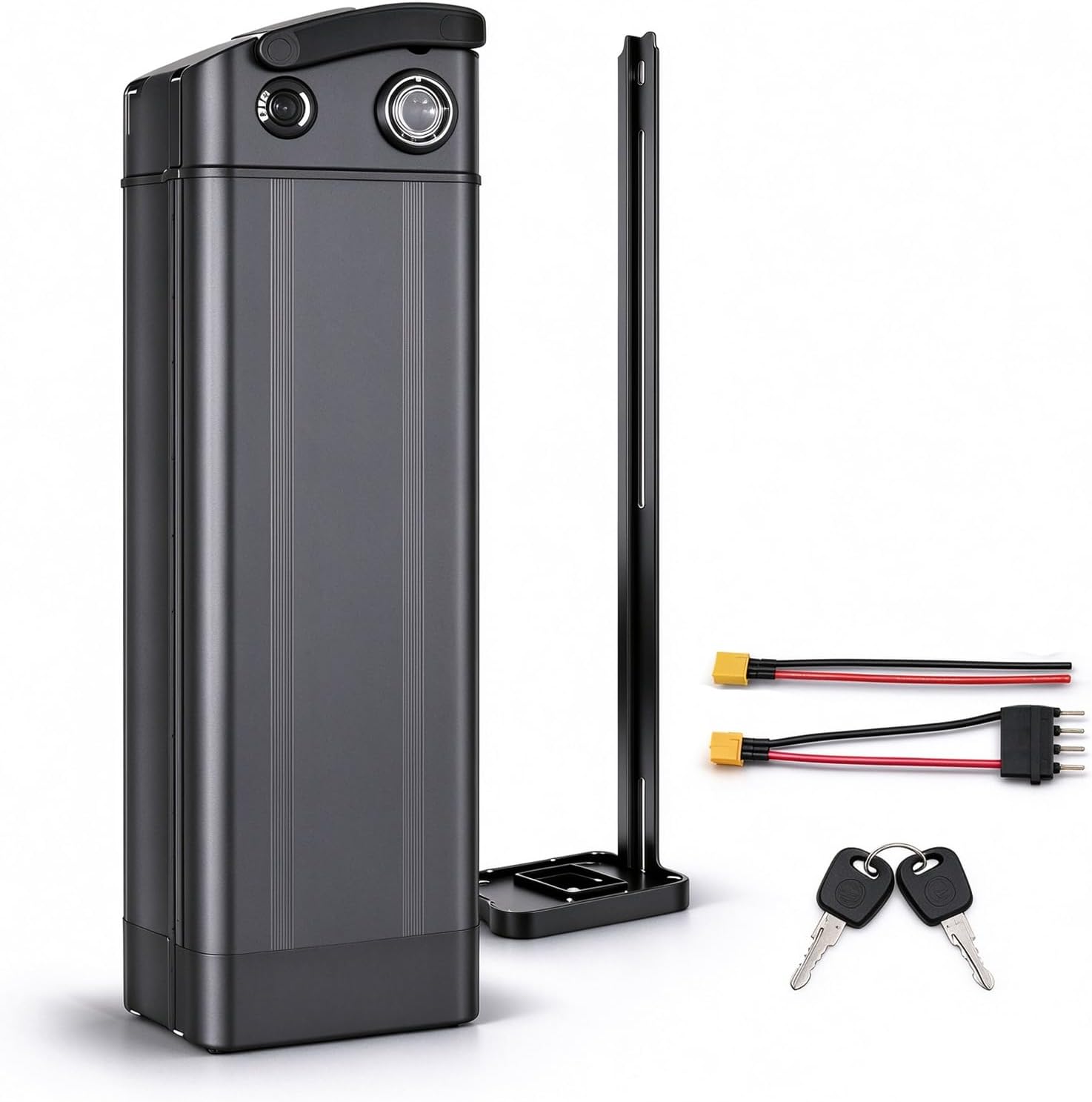
Silver fish packs live or die on fit. The slide-in rail case mounts where your bottle cage bolts on, so the case either matches your frame's bracket and clearance or it does not, and no amount of capacity fixes the wrong shape. SHEWAIHE knows this market well enough to sell its 48V 20Ah in three different shapes, and this review covers the newest shape: a silver fish.
The listing itself is a mess of small contradictions, and the biggest one matters to your motor.
Three different BMS numbers appear on the page, and the one in the bullet is not the one that matches the motor claim. On our battery comparison table the pack sits in the cheapest fifth of the 324 batteries we track by price per watt-hour, so the value case is real. The details below sort out what to believe and what to confirm before you order.
The SHEWAIHE 48V 20Ah silver fish battery is a 960 watt-hour pack, and 960 is what 48 times 20 gives, so the headline math holds. Whether your bike can use all of it depends on a number the page prints three different ways.
Three numbers where one belongs
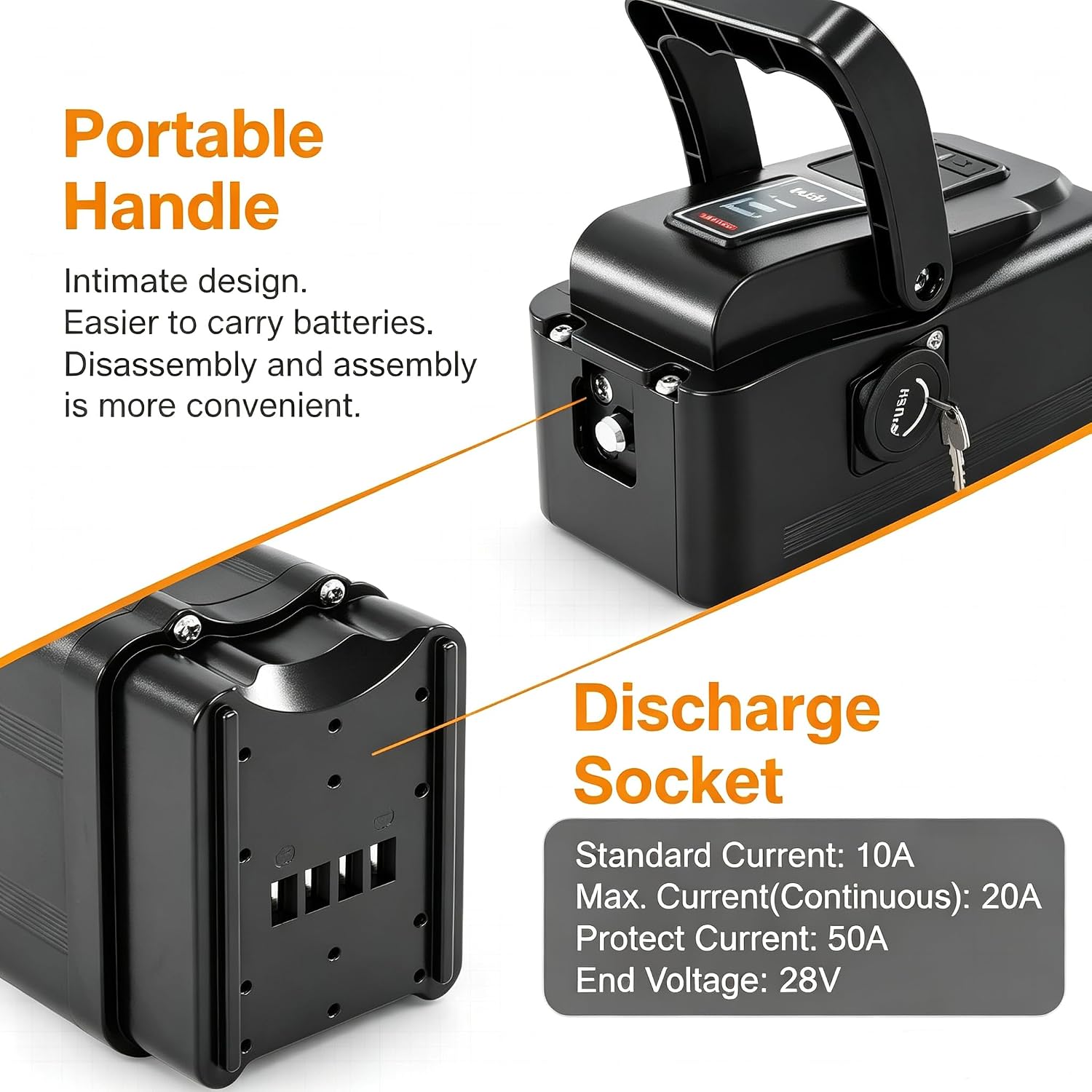
The first bullet says this pack carries a 40A BMS. A gallery card says something different in three parts: standard current 10A, maximum continuous current 20A, protect current 50A. The bullet's 40A matches nothing on the card.
The continuous figure is the one that describes real riding, and 20 amps at 48 volts works out to 960 watts. That closes neatly with the same bullet's 0-1000W motor claim. The card's numbers and the motor claim agree with each other, and the 40A bullet is the odd figure out, reading like a protect rating borrowed as a discharge rating.
Plan around 960 watts continuous. That runs most 500W and 750W conversion kits with room to spare, and it covers the full 0-1000W range the listing claims at the top end. A rider who needs a genuine 40A continuous board, which means 1,900W and up, is shopping a different tier of pack entirely, and this is not it despite the bullet.
The fit is the real product
The case measures 15.35 by 2.95 by 4.37 inches, which is the classic silver fish footprint, and the discharge port sits on the bottom with four pins. The listing's instructions are simple: slide the pack into the frame-mounted rail, and the base connector carries the current. No tools, no modifications, provided your bike already carries the bracket.
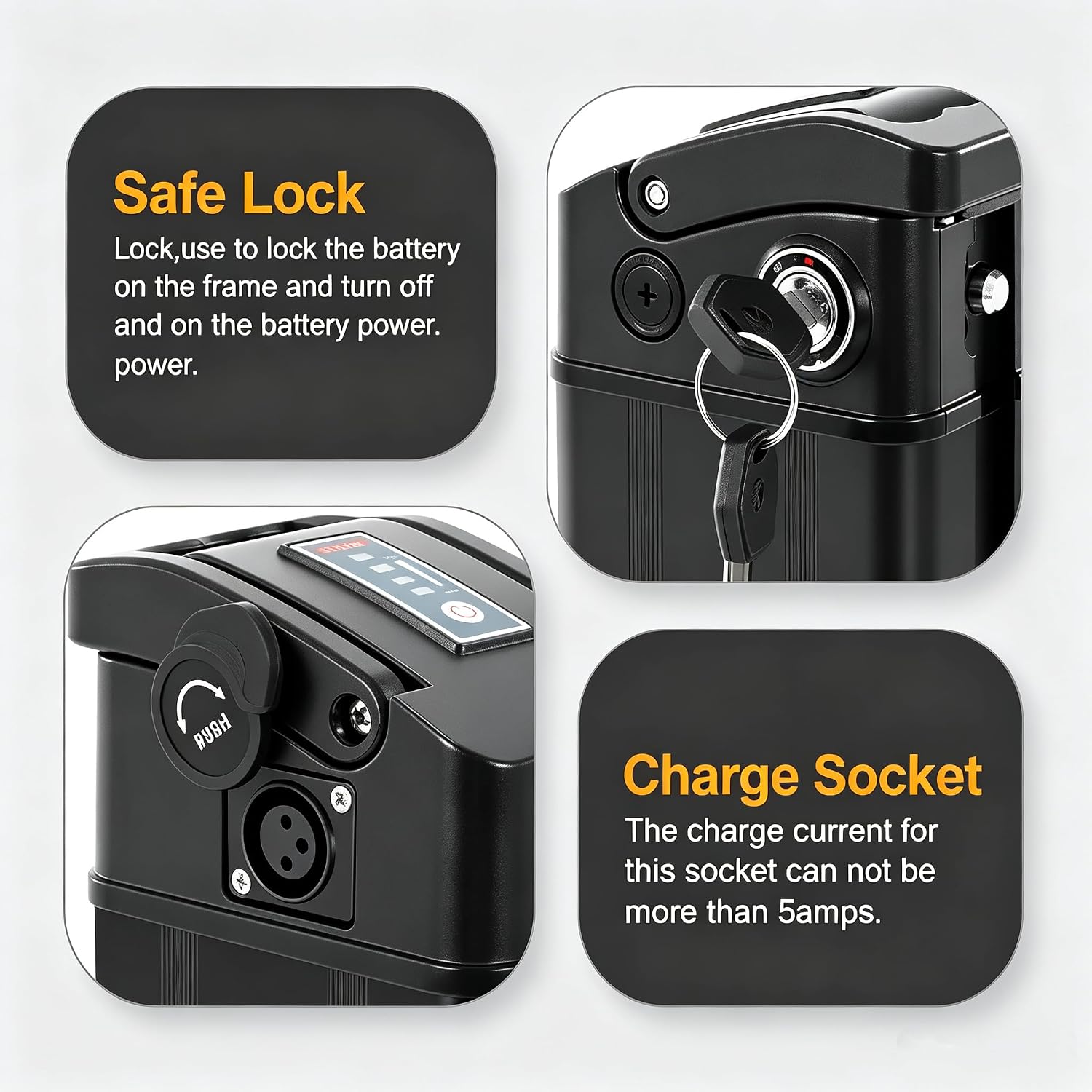
Two details on the cards deserve attention before you buy. The lock does double duty: it holds the pack on the frame and it switches the battery's power off, so the lock position doubles as an off switch. And the charge socket has a printed limit of 5 amps, which caps how fast any charger can refill this pack no matter what ships in the box.
One more fit note: the pack carries an LED level gauge, and the rail mount is the reason this shape suits framed bikes while the same brand's other 20Ah shells suit conversions. The capacity is identical across all three shapes. The shape is the decision.
The charger question, and the weight to watch
The details table's included-components row says charger. The bullet's box list says battery, holder, two keys, six screws, manual, and never mentions one. The page argues with itself about whether a charger ships, and I cannot settle it from here.
So treat the charger as a question for the seller, and get the answer in writing before you order.
The arithmetic either way is easy. Twenty amp-hours at the socket's 5A ceiling refills in 4 hours. At the 2A chargers that commonly ship with budget packs, the same refill takes 10 hours, and that difference shapes whether you can top up at lunch.
The voltage check matters more than the amps. This is a 48V-class pack, which almost always means 13 cells in series and a charge voltage of 54.6 volts.
No charge voltage is printed anywhere on the page text, so confirm the printed number on the charger itself when it arrives. A 48V pack should charge at 54.6V, never 42V and never 58.8V.
The weight is the number to watch
The bullet prints 10 pounds for the battery. That is 4.54 kilograms, and 960 watt-hours over 4.54 kilograms lands near 0.21 kilowatt-hours per kilogram at pack level. The Wikipedia lithium-ion battery article lists the best laboratory figures far higher, but mass-produced complete packs commonly land between roughly 130 and 200 once the case, board and wiring take their share.
So 0.21 sits at or just above the top of the band that real packs reach. It is not impossible, and cell technology has improved, but it is tight enough that the scale on arrival is worth a look.
Weigh the pack when it lands. A unit at or under about 4.5 kilograms is plausible. A unit meaningfully heavier means the printed figure described something else, and the capacity is the first thing to meter with a full charge and a ride of known distance.
None of this is an accusation. It is the standard check we run on every pack whose printed weight lands in the top slice of the band, because the arithmetic is free and the disappointment is not.
The record and the range card
The star widget prints 5.0 from 3 global ratings, and no written reviews were readable at review time, because Amazon's review pages render only for signed-in sessions and that tooling was down. Three strangers clicked five stars and left nothing readable behind them. That is the thinnest class of evidence a listing can carry, so the score is presentation, not proof, and the listing's own arithmetic is the real material here.
The range card at least shows its work. It prints the test conditions: 20 degrees Celsius, a 70 kilogram rider, a 48V 350W motor, pedal assist on.
Under those conditions it claims 45 to 50 kilometers in power mode. Nine hundred and sixty watt-hours over 45 to 50 kilometers is 19 to 21 watt-hours per kilometer, about 31 to 34 per mile, which is consistent arithmetic for assisted riding on a 350W bike. A claim with printed test conditions is worth more than a bare number, whatever the record looks like.
The filing also says something about who this pack is for. Amazon ranks it inside Toys and Games, under hobby remote-control vehicle batteries, not bike components. Filing categories are sloppy, but a bike pack buried in the RC section usually means a listing that sells to both crowds and optimizes for neither.
SHEWAIHE 48V 20Ah FAQ
Does the 40A BMS mean I can run a 1500W motor?
No. The card's continuous rating is 20A, which is 960W at 48 volts, and that matches the 0-1000W motor claim. The 40A figure in the bullet matches nothing else on the page. Run up to about 1000W continuous and treat the board's protect rating as headroom, not as a working limit.
Will it fit my bike?
Measure two things: the space where the rail mounts on your bottle-cage bosses, and the clearance for a case 15.35 inches long, 2.95 inches wide and 4.37 inches tall. Your bike needs the matching silver fish bracket, which the pack drops into without tools. If your frame has no bottle bosses or no clearance, this shape will not work regardless of capacity.
Is the charger included?
The page says both. The details row names a charger, the bullet's box list omits one. Ask the seller in writing, and check the printed voltage on whatever arrives: 54.6V is the correct charge voltage for a 13-cell 48V pack.
How does it compare to the other SHEWAIHE 20Ah packs?
Same watt-hours, different shapes. The folding and universal shells suit conversions and odd frames, this silver fish suits standard frames with a rail bracket, and the 36V sibling covers lower-voltage systems. Pick by shape first, because the capacity is the same across the family.
Buy it for the rail fit, confirm two things
The hardware case here is decent: correct watt-hour math, a card whose current ratings agree with the motor claim, a range card with printed test conditions, and a one-year warranty. The weak parts are the page, not the pack: a bullet that inflates the BMS figure, two box lists that disagree, and a five-star record with no readable words under it.
So buy it for the fit, and confirm two things in writing: that the charger ships, and what voltage it prints. At 204.99 it lands in the cheapest fifth of our comparison table, and a 960Wh pack in a standard rail case is a lot of range for that money.
The manufacturer row names Shenzhen Lian Pai Yuan Technology, the same factory name we noted behind the DYMOZYNE 48V 12Ah pack, which is context rather than proof of anything. Weigh the pack on arrival, meter one full charge, and you will know more about this listing than its star widget will ever tell you.