This SHEWAIHE pack is a 960Wh universal-form battery sitting in the cheapest fifth of our 48V table by price per watt-hour, with a 40A BMS that supports serious builds. The charger is the problem: the included 2A unit takes ten-plus hours from empty, which shapes daily use. The universal form factor suits DIY conversions and scooters, and it does not drop into branded bike mounts without measuring. Conversion builders win here.
Range math for a 960Wh pack
Start with the pack: 48 volts times 20 amp-hours is 960 watt-hours nominal. Depth-of-discharge limits put usable energy at roughly 770 to 820 watt-hours before the BMS cuts off to protect the cells.
Consumption next. Pedal-assist riding at 15 to 20 watt-hours per mile gives you roughly 39 to 55 miles. Throttle-only riding at 25 to 30 watt-hours per mile lands between 26 and 33 miles. Those bands assume the cells deliver the label, and with generic packs the first full ride is the only test that counts.
The 1500-cycle claim deserves the standard skepticism. Lab treatment assumes shallow discharges and stable temperatures, and generic packs commonly land in the 500 to 1000 cycle range in real use before dropping to 80 percent capacity. The flame-retardant housing is a genuine plus in a market where most listings say nothing about fire behavior, and it does not replace careful charging habits: hard surface, never unattended, and stop using any pack that swells or runs hot.
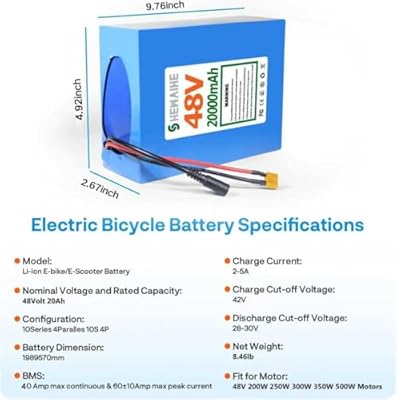
Because this is a universal pack without a bike-specific mount, fitment is on you. Measure the space in your build against the 9.76 by 4.92 by 2.67 inch case before ordering, and remember that a pack without a native bracket needs a strap or tray solution you provide.
Weight and terrain move these bands like they move every pack's. A heavy rider on hills burns toward the top of the throttle band, and a light rider on flat ground with gentle assist can stretch past the bottom of the assist band. Winter compounds it: cold cells deliver less, so the same commute that took a quarter of the pack in September can take a third in January. The practical method is simple. Ride your actual route three times, note the watt-hours or percentage consumed, and let your own numbers replace both the listing's claims and the bands in this article.
The 2A charger is the real spec to plan around
The included 2A charger fills 960 watt-hours in roughly ten to thirteen hours from empty. That is an overnight-plus proposition, and it is the pack's most annoying trait for anyone riding daily. Plug in at seven in the evening and the pack is ready for a morning commute, but an afternoon top-up between errands is not happening.
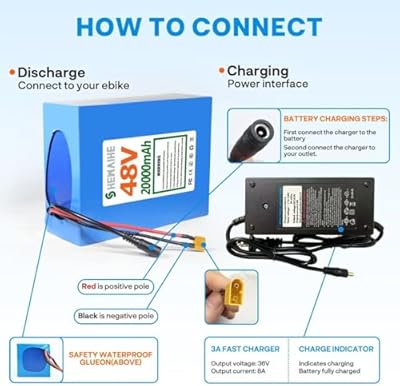
Three responses work. Charge every night regardless of level, which the pack tolerates fine. Buy a faster charger separately, checking connector type and voltage before you plug anything in, because a mismatched charger is a genuine hazard. Or treat the pack as a swap-and-charge unit with a second charger kept where the bike lives during the day.
The slow charge is the difference between this being a daily-commute tool and a weekend tool. Conversion builders who ride occasionally will not care. Daily riders who forget a night will, and the honest review says so plainly rather than burying it in the spec table.
The 40A BMS, and who actually needs it
A 40A ceiling at 48V supports up to roughly 1900 watts of draw, which covers most 1000W to 1500W builds without the BMS clipping peak power on hills. That is the pack's differentiator against the cheaper 20A and 30A units that choke high-draw controllers partway up a climb.
The flip side: most stock ebikes draw well under 30 amps, and buying BMS headroom your controller never touches is wasted money at this price point. Match the spec to the build. A 750W commuter gains nothing from 40A, while a 1500W conversion gains exactly what it needs.
The universal form factor cuts both ways. For scooter builders, trikes, and custom frames, a pack without a proprietary mount is the point. For anyone replacing a branded bike battery, the generic case will not seat in the original tray, and no amount of wishing changes the dimensions. Know which buyer you are before you order.
The T-connector extension cable in the box is worth a sentence too, because it signals who this pack is for. T-connectors are the DIY-standard discharge interface, common on conversion kits and scooter controllers rather than on branded bike docks. If your build speaks T-connector natively, the pack integrates in minutes. If your bike expects a proprietary dock, you are looking at an adapter chain, and every adapter is one more connection to inspect, strain-relieve, and waterproof. Budget builders accept that as part of the work. Branded-bike owners should not.
Who should buy it, and who should spend differently
Buy it if you are building or converting something that takes a generic pack, you want big capacity at a price in the cheapest fifth of the table, and your controller draws under 40 amps. The capacity-per-dollar argument is easy to make for a DIY build.
Spend differently if you need a pack that drops into a branded mount, because the universal case will not fit most frames. Spend differently if you commute daily and cannot live with a ten-hour charge, because the 2A charger in the box is the pack's defining limitation. And spend differently if you want published cells or a safety certificate, because DYMOZYNE's 20Ah packs price similarly and claim a UL certificate, and the battery table shows the full price-per-watt-hour picture across both.
Frequently Asked Questions
How far can I go on one charge?
Roughly 39 to 55 miles on pedal assist and 26 to 33 on throttle alone, from about 770 to 820 watt-hours of usable energy.
Why does it take so long to charge?
The included 2A charger moves a 960Wh pack slowly: ten to thirteen hours from empty. A faster charger is a separate purchase.
Will the 40A BMS make my bike faster?
No. The 40A ceiling is headroom for high-draw controllers, and your controller governs output regardless.
Will it fit my branded ebike?
Measure first. The universal case is 9.76 by 4.92 by 2.67 inches and does not seat in most branded trays.
Are the 1500-cycle claims real?
Plan for 2 to 4 years of regular riding. Lab cycle claims assume ideal treatment, and the first full ride tells you what the cells actually deliver.