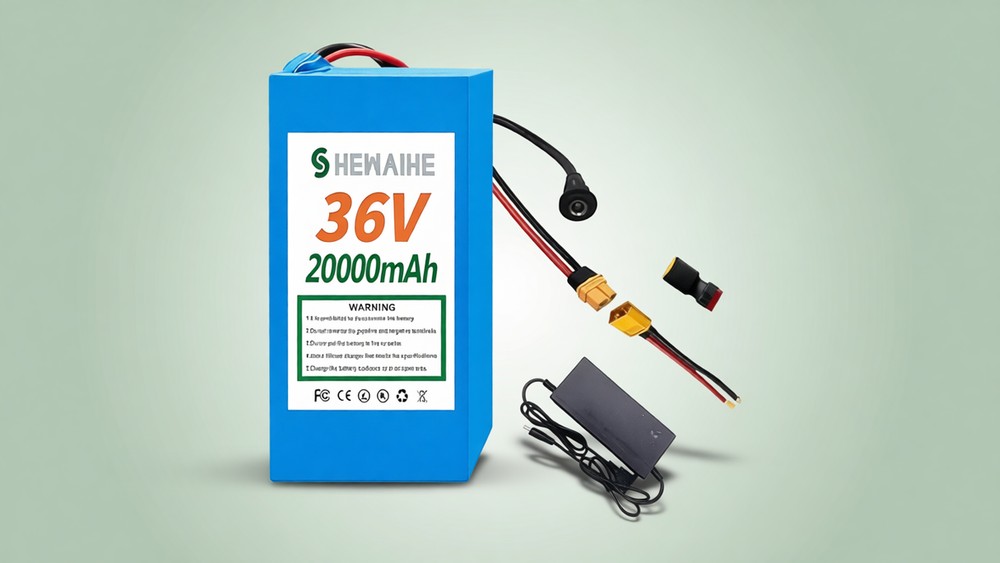
This SHEWAIHE 36V 20Ah pack is the least-shaped battery in our whole table. No case style gets named, no mounting hardware ships, and no bike brand appears anywhere on the listing. The seller's own metadata files it as a power-tool battery, and the sales rank sits inside Cordless Tool Battery Packs, not ebikes.
At 153.00 for 720 watt-hours it still lands in the cheapest fifth of the 301 packs we track, so the DIY crowd should read on, and everyone else should know what they'd be assembling.
Three weights, one that closes
The listing prints three weights and they disagree by more than double. The battery-weight row says 4.5 pounds.
The boxed-weight row says 10 pounds. The specification card, which lives in the listing images, says net weight 8.46 pounds.
The card is the only figure that survives arithmetic. A 720 watt-hour pack at 3.84 kilograms works out to about 0.19 kilowatt-hours per kilogram, which sits in the middle of the 0.16 to 0.30 band where bare mass-produced cells live, and leaves sensible room for wiring and a board.
The 4.5-pound row would need 0.35 kilowatt-hours per kilogram, above what bare cells reach before any case or protection, so that row can't describe the pack. The 10-pound row reads as the boxed figure, which is the harmless direction for a weight claim to err. I'd weigh this one on arrival and expect something near the card.
That's the opposite of the LOLRKO 48V 14Ah we rebuilt earlier this week, where every printed weight pushed the density above the best cells on the market. Here the card's figure closes the math, and even the heavy boxed reading has an explanation.
What the specification card says
The page text is thin, five bullets of marketing, so the card carries the real specs. It prints a 10 series, 4 parallel configuration, a 42 volt charge cut-off, a 28 to 30 volt discharge cut-off, a 2 to 5 amp charge current, and a motor fit list running from 200 to 500 watts.
The 10S reading checks out against the voltages. Ten cells at 4.2 volts each gives the printed 42 volt charge ceiling, and ten at 2.8 to 3.0 volts gives the printed discharge floor. With four parallel groups carrying 20 amp-hours, each cell contributes about 5 amp-hours, which is large-format 21700 territory, because a common 18650 tops out near 3.5 amp-hours.
The chemistry row says Other Than Listed, so the seller never tells you which cell sits inside, and the card's configuration line is the closest thing to an answer.
One dimension figure sits on the card, but it does not resolve at listing resolution, and the page text gives no size at all. That matters because bullet five tells you to check the battery size before you order. I'd want the seller to state those millimetres in text before buying blind.
The card also prints a 40 amp maximum continuous current with a peak rating above it, which matches the bullet's 40A BMS claim.
At 36 volts, 40 amps is a 1,440 watt ceiling, and the card's own motor list tops out at 500 watts, about 14 amps of draw. There's nothing to catch here. The bullet's phrase, ideal for any 36V motor configuration, is broader than the card's list, and the card is the one that names numbers.

The charge floor is ten hours
The pack ships with a 2 amp charger. Twenty amp-hours at 2 amps is a ten-hour floor before the taper, so an empty pack is an overnight job. The card's charge-current line says 2 to 5 amps, which leaves the door open for a 5 amp charger to cut that floor to about four hours, but nothing faster ships in the box.
The box list is where the listing argues with itself. The bullet promises the pack, the 2 amp charger, a T-to-XT60 female adapter, and an XT60 extension cord.
The details row names only the charger and the extension cord. The package card adds an AC cable and two connectors of its own. Three lists, three slightly different stories, and the only consistent items are the pack and the charger.
A four-text record that settles little
The listing shows 3.5 stars from 5 global ratings, and four people wrote text. Two carry Amazon's purchase badge and two don't.
The verified one-star landed two days before we scraped. Its full text is, "It doesn't fit in the Jetson E-bike." That's a fitment failure, not a function failure, and Jetson's rides take proprietary cases rather than raw bricks, so the surprise is small.
The other verified text, from July, reads, "Works as it should. Time will yell if it lasts." That's the most honest sentence in the record, because it admits the durability question is open.
The two unverified five-star texts are same-day, one-liner approvals with no range figure and no capacity test between them.
Nobody in this record metered the pack. The seller's big claims, A-grade cells holding over 80 percent after 1,500 deep cycles, sit above the 400 to 1,200 full cycles that lithium-ion chemistry typically manages, and nothing in the record tests them.
I treat that 1,500-cycle line as a printed ambition, not a measurement. The interesting footnote is the Jetson connection, because the LOLRKO record includes an owner who overvolted a Jetson ride-on off-label. Generic packs and Jetson rides keep meeting, and it keeps not going well.

Where the value sits
At 153.00 for 720 watt-hours, this pack costs about 21 cents per watt-hour, which puts it in the cheapest fifth of our comparison table. The only recent rebuild cheaper is the Sinigerel 48V 20Ah at about 16 cents, and that one carries a one-year warranty row and a record you can read. The SHEWAIHE carries a one-year warranty row too, the only warranty statement on the listing.
What you're buying at that price is energy without a shape. The page text carries no waterproofing claim and no IP code, no case style, and no hardware to attach it to anything. If your build already has a box, straps, and a controller waiting for an XT60, the price is genuinely good. If you expected a battery you could bolt on, nothing on this listing delivers that.
Common questions about the SHEWAIHE pack
Is this a drop-in replacement for a case-style ebike battery?
No. Nothing on the listing names a case, a mount, or a compatible bike. The seller's own category data files it as a power-tool battery, and the one fitment report in the record is a failure. Plan your own enclosure before you order.
How long does the pack take to charge?
The included 2 amp charger puts a ten-hour floor on a 20 amp-hour pack, before the taper that slows the last stretch. The card allows up to 5 amps of charge current, so a matched 5 amp charger would roughly halve that, if you buy one separately.
Can I trust the 1,500-cycle claim?
Treat it as a seller's ambition. Typical lithium-ion chemistry manages 400 to 1,200 full cycles, so the claim sits above the usual band, and the buyer record contains no capacity tests at all. Charge it partway for storage and you'll do more for its life than any printed figure.
What motor can this pack run?
The card names 36 volt motors from 200 to 500 watts, and the 40 amp continuous ceiling reaches 1,440 watts, so the whole named list draws well inside the limit. The bullet's claim of any 36V motor configuration is broader than the card's own list, so I'd stay with the card.