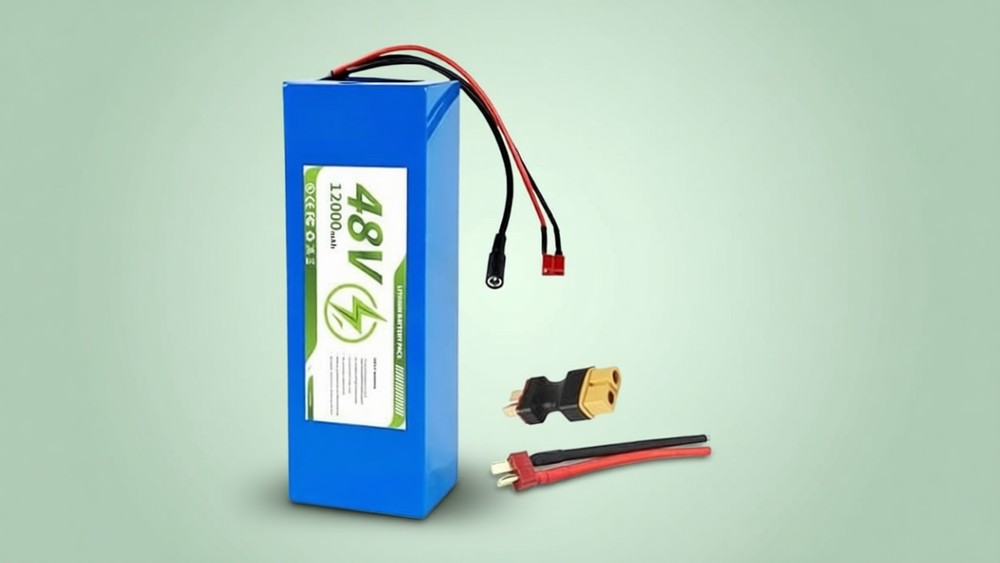
A universal battery is the part of the ebike market where nothing matches your bike by design. These packs ship as bare bricks with a strap or a bracket, aimed at people converting a bike, reviving a scooter or powering a DIY project, and the fit question is yours to answer before you order. The DYMOZYNE 48V 12Ah sits squarely in that class.
That class has its own way of failing. A downtube pack either fits your frame or it does not, and the listing settles it. A universal pack fits wherever you can put it, and the failure modes are quieter: a connector that does not match your controller, a charger that never arrives, cells that were never named in the first place.
This article walks through what the listing actually specifies, what it leaves out, the three texts that make up the whole rating record, and the arithmetic you can do on the page's own numbers before deciding.
The DYMOZYNE 48V 12Ah lithium battery sells for 139.99 with 576Wh on the label, 48 volts times 12 amp-hours. On our comparison table that works out to about 24 cents per watt-hour, which sits in the cheaper third of the 301 packs we track, a little under the median. The specs box renders the live position as prices move.
The rating record is three ratings and three texts, all five-star, and the record is the weak point of this page. The one purchase-badged text, from July 2026, is two Spanish words.
The other two are unverified, and the longer of them reads like listing copy, praising an outstanding battery life in language that echoes the product's own pitch. No text carries a single helpful vote, so there is no ranked center to weigh. You are buying this pack on its spec sheet, not on anyone's experience.
What the page specifies, and what it refuses to
The spec table is short and the useful rows are short. Voltage reads 48 volts.
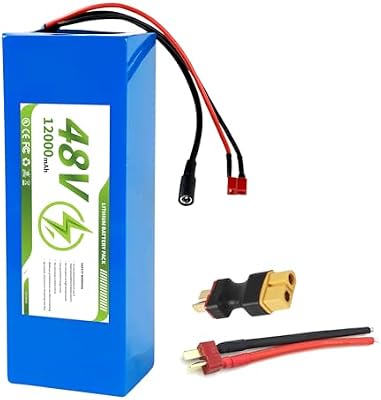
The dimensions read 10.1 by 3.54 by 2.75 inches, and the first bullet agrees with the table, which is rarer on listings like this than it should be. Measure whatever space you have for the pack against those numbers before ordering.
What the table leaves out matters more. There is no amp-hour row, so the 12Ah figure exists only in the title. There is no cell chemistry row, no weight row, and no charger row of any kind.
Most striking for a DIY-focused pack, there is no Included Components row at all, so the page never says whether a charger ships in the box. For a product whose buyers are wiring it into something themselves, the connector type is the first fitment question, and the page does not name one.
None of these omissions is fatal on its own. Together they mean every practical question you have goes through the seller's message button, and you are waiting on a 24-hour support promise to find out what ships.
The 30A BMS and what it can power
The title leads with the 30A BMS, and the third bullet spells out the protections: short circuit, overcharge, overdischarge and temperature. That is a standard list for a modern BMS, stated plainly.
The arithmetic behind the claim is the useful part. Thirty amps on 48 volts caps continuous draw near 1,440 watts. A 1,000W motor at full load draws roughly 21 amps on 48 volts, so it sits under the limit with room to spare.
The title's own range says compatible with 100W to 1000W motors, and the top of that range is honest by the numbers.
The bottom of the range is stranger. A 100W motor is scooter and toy scale, drawing about 2 amps on 48 volts, and nothing else on the page explains why it appears. It reads like a number copied from a category template rather than a claim anyone tested. It does not hurt the pack, though it tells you how the title was assembled.
Range math for a 576Wh pack
Capacity times voltage gives 576 watt-hours, and the label math checks out. What that buys depends on how you ride.
At a gentle pedal-assist draw of 15 watt-hours per mile, 576Wh is about 38 miles. At a throttle-heavy 30 watt-hours per mile it is about 19. Both figures assume the cells deliver their rated capacity, which no buyer has measured in writing, and which generic unbranded cells do not always do.
That is a short-range pack by modern ebike standards, and the page does not pretend otherwise. If your rides sit under 20 miles round trip, the capacity is adequate. If you are planning longer touring, the same money in a larger pack buys roughly twice the energy, and the comparison table shows the alternatives side by side.
The claims that reach past the page
The durability bullet makes the boldest statement on the listing: more than 1,000 charge-discharge cycles with capacity still at or above 80 percent. Cycle life has a standard definition, and manufacturers typically count cycles until capacity falls to 80 percent of rated value.
Typical lithium-ion cycle durability runs 400 to 1,200 cycles, so the claim sits at the top of the normal band rather than beyond it. It is a credible number on paper, and no buyer has ever held this pack long enough to check it in writing, since the newest text in the record dates from July 2026.
The temperature claim needs a harder look. The bullet promises stable performance from minus 20 to 40 degrees Celsius, but that range describes discharge.
Charging below freezing can plate lithium onto a cell's anode, and even from 0 to 5 degrees Celsius the standard guidance is to reduce the charge current. If you ride in genuine cold, the pack may well discharge fine at minus 20, and you should still bring it inside to warm up before you plug it in.
The warranty rows do not quite agree with each other. The fifth bullet promises a one-year warranty with round-the-clock technical support, while the spec table's warranty row reads a bare 1 with no unit attached. The numbers match, the sloppiness does not, and the row tells you nobody proofread the page.
The title carries the same fingerprints: a missing space in "Compatible with100W", the word lithium battery printed twice, and a typo in "48vlithium".
Who is actually behind it
Three names sit behind one pack. The brand is DYMOZYNE, the manufacturer of record is Shenzhen Lian Pai Yuan Technology, and the buy box seller is Wxxiangai.
None of those names is established enough to search for a track record, which is normal in this tier of the market and worth knowing before you order. If the pack arrives with the wrong connector for your build, the person who answers your messages is Wxxiangai, not a brand with a support site.
The best sellers rank sits at #1,098 in Scooter Batteries and Battery Chargers, a mid-band number for a part that sells steadily into small builds rather than a mass-market product.
For buyers weighing this against other no-name universal packs, the LGNUO 52V 20Ah review covers the same class at a larger capacity, and the Yasco 48V 13Ah review walks through buying on a listing with an even thinner record. The same method applies here: the spec sheet is the whole case, and the current listing is the source for every figure in this article.
Frequently Asked Questions
Is the DYMOZYNE 48V 12Ah good for a 1000W ebike?
The BMS math says it can power one. Thirty amps on 48 volts is a 1,440W ceiling, and a 1,000W motor draws about 21 amps at full load. What the numbers cannot tell you is how long it lasts under that draw, since 576Wh empties fast at 1,000W and no buyer has reported runtime on this pack.
Does it come with a charger?
The page does not say. There is no Included Components row and no charger specification anywhere on the listing, which is the single most practical gap on the page. Ask the seller before you order, and confirm the charger voltage matches a 48V pack.
Will it fit my bike?
It is a universal pack, so it fits wherever you can mount 10.1 by 3.54 by 2.75 inches of battery. Check your mounting space against the dimensions, then check which connector your controller uses, because the listing names no connector at all.
Can I trust the 5-star rating?
Treat it as a formality rather than evidence. The record is three ratings and three short texts, the only purchase-badged one is two words, and the most detailed text repeats the listing's own language. Nothing in the record is negative, and nothing in it is deep enough to be positive evidence either.
How long does 576Wh actually last?
Plan on about 38 miles at a gentle 15 watt-hours per mile of pedal assist, or about 19 miles under heavy throttle at 30. Cold weather, hills and an under-spec cell count can each pull the real number below the plan.