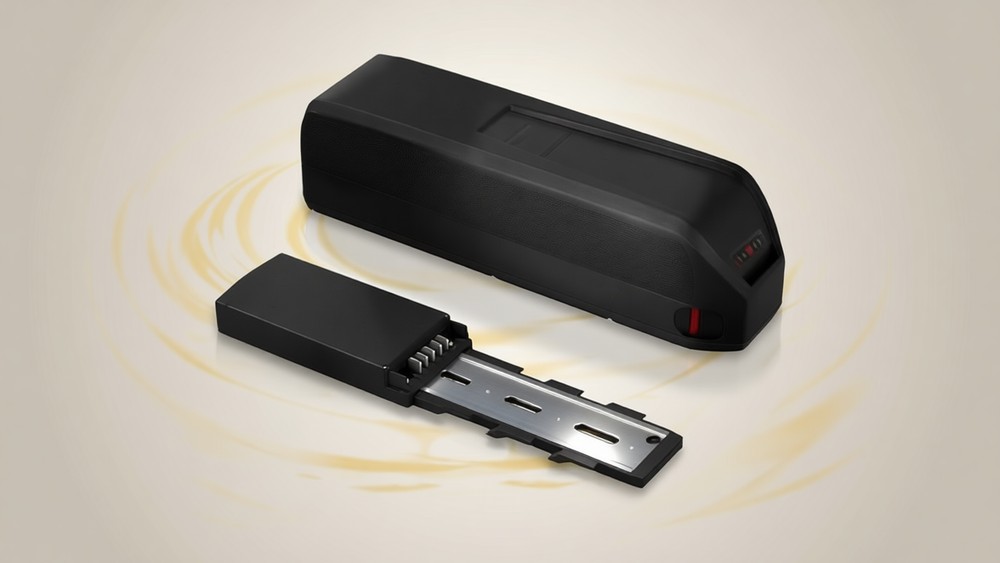
Most budget 48V packs arrive as a bag of connectors and a roll of strap, and the buyer supplies the mounting idea. The Q RQTEBAT took the other approach. The recorded box held a slide-in five-pin base with a mounting plate and screws, a two-key lock, a power switch, and a pair of connector extension leads, all at 139.79. The listing is gone from Amazon now.
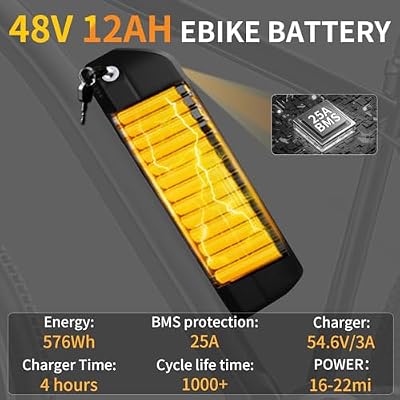
What survives is the data recorded in July 2026: a 48V, 12Ah pack holding 576 watt-hours behind a 25A protection board, plus a full spec sheet. That sheet is worth taking seriously, because almost everything on it survives an arithmetic check. Budget packs usually trip somewhere obvious. This one trips somewhere subtle.
The one claim that fails is the cycle-life figure, and it fails against the charger the pack shipped with. A 54.6V charger date-stamps the chemistry as ordinary lithium-ion, and ordinary lithium-ion does not reach the cycle count this listing printed. The sections below run the full arithmetic, scale an honest range band, and end with a replacement checklist.
On value, 139.79 for 576Wh works out to 24 cents per watt-hour, which lands close to the middle of the 324 packs in our comparison table. That's a fair price, not a bargain, and the old review's affordable framing flattered it. A mid-table pack at mid-table money is exactly what it was.
Almost Every Number Checks Out
The energy math is clean. 48 volts times 12 amp-hours is 576 watt-hours, and the printed figure matches the multiplication exactly, which cheap listings manage less often than you'd hope.
The protection board math holds too. A 25A board on 48V caps the pack near 1,200 watts. A 500W motor draws about 10A at full throttle, a 750W motor about 16A, and the 1,000W ceiling printed in the listing's own title works out to about 21A. All three fit. The honest caveat is headroom: 21A against a 25A board leaves about 4A of margin, and hills push momentary current well past the steady number. This pack runs a 1,000W system, but without the easy margin a 30A or 40A board gives.
Charging closes as well. The recorded charger was 54.6V at 3A, and 54.6V is exactly thirteen cells in series at 4.2V, the standard 48V lithium-ion figure. At 3A, a 12Ah pack has a 4-hour floor, and the recorded 4-to-5-hour claim sits right on it with the usual taper explained. Nothing here needed generosity.
The recorded footprint was 15.3 by 4.8 by 4.9 inches on a slide-in base. Measure your mount before ordering anything in this class, because slide-in bases are not interchangeable between brands.

The Cycle Claim Fails Against Its Own Charger
The listing claimed grade A cells with a minimum life of 1,500 cycles. Ordinary lithium-ion does not get there. Wikipedia's lithium-ion page puts the normal range at 400 to 1,200 cycles, and 1,500 sits above every figure in that band.
One common chemistry does rate past 1,500: lithium iron phosphate, which Battery University's chemistry reference lists at 2,000 cycles and higher. But a lithium iron phosphate 48V pack is built from sixteen cells at 3.2V and charges near 58.4V. This pack shipped a 54.6V charger, which is thirteen cells at 4.2V, and the charger is the figure that cannot lie. It date-stamps the cells as ordinary lithium-ion.
So the 1,500-cycle claim reads as aspiration, and the realistic plan is the published band. Heavy commuters charging nightly should expect a few years of service, not the near-decade the printed figure implied.
We cover this exact test elsewhere. The BtrPower 48V 18Ah rebuild shows the mirror image: a pack whose recorded voltages matched real lithium iron phosphate, whose chemistry claim was therefore at least plausible, and whose charger was never recorded. Here the charger was recorded, and it settles the question the other way.
Range, Weight, and the Small-Tank Trade
The old review promised 15 to 25 miles, a figure built on assumptions nobody recorded. The better method scales from an independent range table. The em3ev 48V 20Ah guide anchors 960Wh at 30 to 40 miles on throttle and 50 to 65 with light pedaling. This pack holds 0.60 of that energy, so the scaled expectation is roughly 18 to 24 miles on throttle alone and 30 to 39 with light assist. Riders on hills or in cold should plan nearer the low numbers.
Weight tells the small-tank story. The recorded 10.7 lb against 576Wh works out to about 0.12 kWh per kilogram at the pack level. The same em3ev guide puts complete 20Ah packs at 10 to 12 lb, which is roughly 0.18 to 0.21. The gap is not a defect. A small pack carries the same case, base, lock, and board as a big one, so the fixed hardware weighs more per watt-hour. It does mean this pack buys you less energy per pound than the big tanks, and the 10.7 lb figure is worth checking on arrival along with everything else.
The listing called the case fully waterproof but printed no IP rating, and no IP code was ever recorded. Treat it as a rain claim. Rain riding is fine, but puddle depth and pressure washing are not. Store the pack indoors either way.
What the Record Can and Cannot Tell You
The July 2026 record held four ratings at five stars with no written texts substantial enough to quote, so none are quoted here and none have been invented. Four ratings is a small sample by any standard, and it says nothing about how the cells age.
No owner has metered this pack in public, so the capacity was never independently confirmed. That's the single most useful thing a buyer of any unbranded pack can change: run the pack down from a full charge in the first week and check the watt-hours against the label. A meter reading settles what the listing only asserted.
The recorded warranty was 12 months, a middling term for this class. It is long enough to cover a dead-on-arrival cell and short enough that the first-week meter check matters more.
Matching a Replacement
The exact listing is gone, but the type is not. Tagged search results for this brand show what the name sells today, and the full comparison table sorts 324 current packs by price per watt-hour if the brand matters less than the value.
Match five things. The footprint, 15.3 by 4.8 by 4.9 inches, against your mount. The five-pin base against whatever plate your frame carries, because pin counts vary between brands and the plug must mate. The 25A board, which is a floor for a 750W system and a tight one for 1,000W. The 54.6V charger, which any ordinary 48V replacement should match. And a first-week capacity meter reading, which is the check this pack never got.
If the mount decides the purchase, the Shewaihe 48V 13Ah review covers a pack whose outlet position shapes the whole install, a different constraint that bites the same way.
Frequently Asked Questions
How far does the Q RQTEBAT go on a charge?
Plan on roughly 18 to 24 miles on throttle and 30 to 39 with light pedaling, scaled from an independent 48V range table against the pack's 576Wh. Hills, cold, and a heavy bike push the number down.
Can it run a 1000W motor?
On paper yes. 1,000W draws about 21A on 48V, and the board is rated 25A. The margin is thin, and sustained climbs push current past the steady draw. A 750W system suits this pack better.
How long does a full charge take?
The recorded 3A charger has a hard floor of 4 hours on 12Ah, and the recorded claim of 4 to 5 hours matches it once the taper is included.
Is the battery waterproof?
The listing said so, but no IP rating was ever recorded. An IP code is a tested figure, and this pack has none on record. Treat it as rain-resistant and keep it out of deep water.
What should I check before buying a similar pack?
The footprint against your mount, the base pin count against your plate, a board rated at least 25A, a charger printing 54.6V, and a capacity meter reading in the first week.