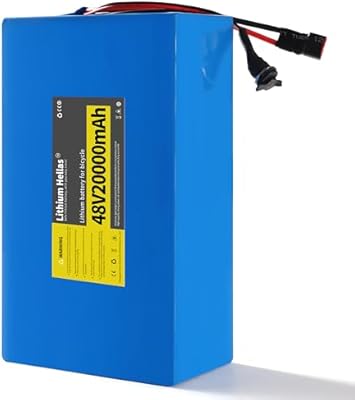
The Lithium Hellas 48V 20Ah offers 960Wh at a price in the cheapest fifth of our battery table, with a T-plug that covers most kits without soldering, a 30A BMS for mid-power controllers, and 5-star buyer reports including documented swaps. Its real niche is the lead-acid swap: reviving an old ebike whose heavy pack is dying anyway. DIY builders and custom-build riders win here, and builds that draw heavy current need a bigger BMS.
What the lead-acid swap actually changes
The chemistry case is the reason this swap is worth doing at all. Lithium stores far more energy per pound than lead-acid. It charges faster, lasts many more cycles, and holds voltage deep into the drain. A half-empty lead-acid pack does the opposite: it sags hard on the very inclines where you need help. Category guides on the two chemistries land on the same verdict: the lead-acid pack is heavy, wasteful, and dying anyway.
The day-one gap owners report is the flat drain curve. Lithium power stays strong until the pack is nearly empty, so the bike doesn't slowly weaken as the ride goes on. For riders who have lived with lead-acid sag, the change is immediate and obvious. The last mile of a ride feels like the first mile, which is something lead-acid never gave.
The physical swap is straightforward because the pack is sized for frames where the old block sat, and the listing positions it as a direct replacement rather than a custom project. No frame cutting, no custom mounts, and a much lower total weight on the bike. For a dying pack, the replacement decision makes itself. The old one has to go anyway, and this one drops into the same space with more than double the energy you can use and a fraction of the weight.
Range math for 960 watt-hours
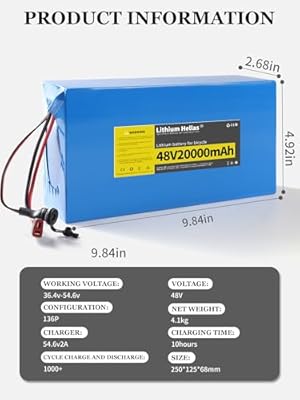
The math: 48 volts times 20 amp-hours is 960 watt-hours nominal, with roughly 770 to 820 watt-hours usable after depth of discharge. At 15 to 20 watt-hours a mile on pedal assist, that is 39 to 55 miles. Throttle-only at 25 to 30 watt-hours a mile gives 26 to 33 miles. Buyer reports clustering at 35 to 50 miles fit inside the assist band. They vary with rider weight, terrain, and assist level as always.
The 30A BMS supports about 1440 watts of steady draw. That covers most mid-power controllers without clipping on grades. Builds that draw more than 30 amps continuously need a bigger pack, and the BMS will cut power to protect the cells rather than let them cook. Check your controller's draw before buying, because the limit is a hard one.
The flat curve also makes the range math more trustworthy. A pack that sags lies about what is left. This one does not, so the first-week test on your own route produces a number you can plan around for years.
The weight change deserves its own math because it grows. A typical lead-acid 48V pack weighs two to three times what a lithium pack of similar capacity does, and that gap rides on the bike everywhere: how fast it speeds up, how fast it stops, how it corners, and whether you can lift it onto a car rack. Riders who swap old daily bikes often say the bike feels new again, and the motor working against less weight stretches the range bands above, because each mile costs less. The swap pays twice: more energy, and less weight to lug around.
T-plug, US stock, and the small print
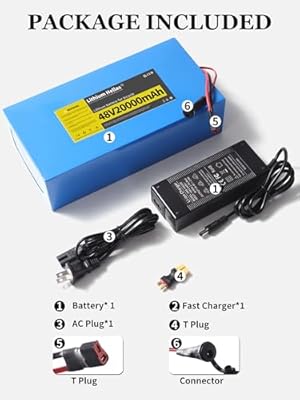
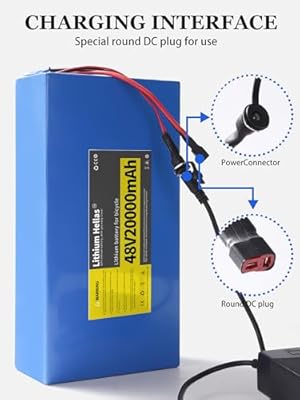
The T-plug connector covers most kits without a soldering iron, which keeps the install a plug-and-play afternoon for typical builds. Proprietary connectors need adapter work, and that work takes real time, so budget it before ordering rather than discovering it at install.
US-stock shipping with quick service is a real gap at this price. Questions get answered, returns stay simple, and a pack that arrives with a concern doesn't become a six-week international email chain. For a first-time buyer, that support layer is worth as much as any spec, because the failure mode that matters most is not the pack dying but the buyer being stuck with no help. The hard shell keeps the cells aligned on rough roads. The included 2A charger runs at an overnight pace for 960 watt-hours.
The buyer-review picture is unusually clean for a budget pack: 5-star ratings across the review base at scrape, praise for quick service, and build reports including a documented Razor SX500 swap where the pack fed a 36V 1000W controller. That last build matters as a data point because it shows the pack working in a real swap rather than a listing photo, and the 35 to 50 mile reports came from owners riding their own routes, not from a seller's claims.
Who should buy it, and who should spend differently
Buy it if you're reviving a lead-acid bike, the strongest use case by far. The old pack is dying, this one drops into the same space with more energy you can use, and the price sits in the cheapest fifth of our table on watts per dollar. It also fits custom builds that need a standard universal block with US-based support behind it.
Spend differently if your build draws over 30 amps continuously, because the BMS will throttle it on climbs exactly when you need full power. Spend differently if you need UL certification papers, because this listing claims none. And spend differently if you want 48V-class comparison shopping, because the DYMOZYNE 20Ah review covers a rival with a UL claim at a similar price, and the battery table shows the live picture.
Frequently Asked Questions
Does it work as a lead-acid replacement?
Yes. The T-plug covers most mid-power controllers, and the case is sized for frames where the old block sat. Match your connector before ordering.
How far will a 960Wh pack take me?
Roughly 39 to 55 miles on pedal assist and 26 to 33 on throttle alone, from about 770 to 820 watt-hours of energy you can use. Buyer reports cluster at 35 to 50 miles.
Is the 30A BMS enough for my motor?
For most mid-sized motors, yes. Builds drawing over 30 amps continuously need a higher-current pack.
Does it ship from the US?
Yes. Reviewers repeatedly cite fast arrival and simple returns from US stock.
What if the T-plug doesn't match?
Adapter work. Budget the time before ordering, and check your controller's connector first.