Some listings fail on price, some fail on secrecy. The strange thing about this one is that it fails on neither and still leaves you holding the bag. The LGNUO 52V 20Ah pack sells at a per-watt-hour price that lands in the cheaper third of everything we track, which is rare for a 1040Wh pack with a 30A board and a charger in the box.
Then you look for the bike it fits and the page says nothing. The title calls it a universal power pack for outdoor projects. No model number, no compatible-bike list, no named connector beyond the XT60 extension that ships with it.
When we checked in late October 2026, the listing also carried zero ratings and zero written reviews, confirmed signed in.
This article walks through what the printed specs tell you, the arithmetic worth running before you order, and what a buyer can reasonably check when no owner has reported back yet.
The LGNUO 52V 20Ah battery sells for 239.00, which works out to about 23 cents per watt-hour for the 1040Wh the voltage and capacity describe. Among the 301 packs in our comparison data, that's genuinely good value, and the specs box on our table renders the live position as the numbers move.
The catch is the shape of the risk. The LGNUO 36V 10Ah sibling we rebuilt the same week prints nearly everything and prices terribly. This one prices well and tells you almost nothing about where it goes.
You'd be buying on the strength of the printed numbers alone, and you'd be doing it on a listing no buyer has ever rated.
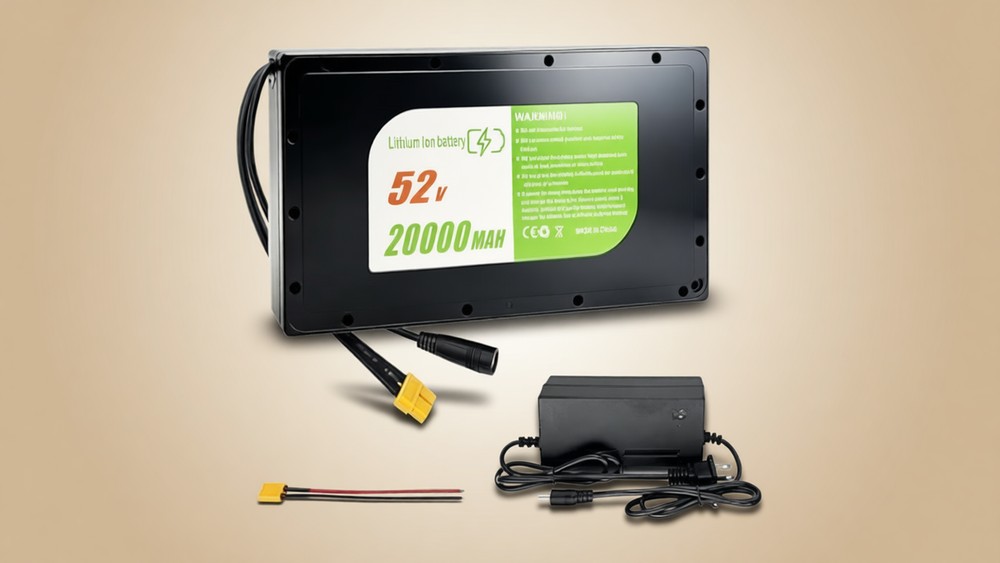
What the page prints, and what checks out
Start with the numbers that survive checking. The case measures 9.8 by 5.6 by 2.79 inches, which the same line converts to 24.9 by 14.2 by 7.1 centimeters, and both conversions are correct. The weight reads 10 pounds and 4.55 kilograms in the same breath, and 4.55 kilograms is 10.03 pounds, so those rows agree too.
After the 36V sibling shipped dimension figures that disagreed by a missing zero, a listing whose conversions actually reconcile is worth naming.
The charger math holds as well. The box includes a 58.8V 3A charger, and 58.8 volts is exactly fourteen cells in series at 4.2 volts each, which is what a 52V pack is.
A 48V pack charges at 54.6V from thirteen cells, so the charger label confirms the string count the same way a license confirms an identity. The 8-9 hour full-charge claim also survives arithmetic: 20 amp-hours at 3 amps is 6.7 hours of constant-current charging, and the taper near full adds the rest. That's an honest estimate rather than a marketing one.
The board is the other printed strength. A 30A BMS at 52 volts passes about 1,560 watts, and the title claims the pack serves motors up to 1,400W. That's about ten percent of headroom, enough that a sustained climb shouldn't trip the board.
The protection list covers overcharge, over discharge, over current and short circuit, which is standard wording and standard coverage.
The packing list is short but complete on the essentials: the pack, an XT60 plug extension cord, the 58.8V charger and a manual. Nothing in the list is a surprise purchase later.
A universal pack that names no bike
Now the part the page doesn't say. The title sells a universal power pack for 200W-1400W outdoor projects, while two spec rows, Recommended Uses and Antenna Location, both name Bicycle and Scooter.
Our own data lists this ASIN as an ebike battery, because that's how the market treats it, but the listing never commits. No bike brand appears anywhere. No model numbers, no frame-fit dimensions beyond the case size, no connector named in the bullets themselves.
Compare the disclosure to the sibling. The 36V 10Ah Hailong pack prints a key lock, an LED level indicator, a power switch and a USB port in its bullets. This 52V page mentions none of those features, so you can't tell from the listing whether the pack carries a charge-level display, a lock, or any switch at all.
Those are the features you touch every ride, and the page is silent on all three.
The waterproof claim has the same shape as the sibling's. The bullet promises a hard shell that prevents direct contact with water and protects against impacts, and no IP code appears anywhere. A case that sheds rain is normal.
A rating you could compare against your riding, an IP65 against hose spray or an IP67 against a ditch, is what would mean something, and the page doesn't give you one.
The practical result is that the fitment job lands entirely on you. If your build takes an XT60 and has room for a 24.9 by 14.2 by 7.1 centimeter case, the pack may serve. If you expected a mount, a bracket or a documented bike list, nothing on the page provides one, and you should ask the seller before ordering rather than after.
Nobody has rated it, so we checked these instead
The zero is the loudest fact on the page. Zero ratings, zero written reviews, confirmed signed in on the reviews page, and the listing itself prints no rating element at all. There's no histogram to read, no owner account to weigh, no star band to argue with.
The stock counter reads 13 left, so the listing isn't brand new. The buyers just haven't written.
With no record, the checkable evidence is the listing's own consistency and the family around it. The listing is internally consistent: the dimensions agree across units, the charger matches the cell count, and the board matches the motor claim. The manufacturer of record is LGNUO itself, which differs from the 36V sibling's Dongguan Yizhan Electronics Technology, and the seller of record is RuiQihailong.
The brand family overlaps the LZIXYM packs we track, though this listing names a different manufacturer than the LZIXYM factory, so treat factory conclusions from the sibling as context rather than proof.
The best sellers rank is #413 in Scooter Batteries and Battery Chargers, which tells you the listing sells in small volume, consistent with a record nobody has written yet.

The useful move with an unrated listing is to ask the seller the questions the page dodges, and this page dodges three. Whose cells are inside, since the bullet says only grade A li-ion?
Does the case carry an IP code the bullets left off? And which bike models has this exact pack been fitted to, since the listing names none? A seller who answers with specifics is a different risk than one who replies with a greeting card, and on a zero-record listing the reply is the only due diligence available.
What the price buys, and who should pay it
Divide 239.00 by 1040Wh and you get about 23 cents per watt-hour. Our comparison data tracks 301 packs by that measure, and this one sits in the cheaper third. The exact position renders live on the specs box of our table, so check it there rather than trusting a snapshot.
The contrast inside the same brand is the sharpest fact in this article. The LGNUO 36V 10Ah we rebuilt the same week prints more features than this pack and prices at about 36 cents per watt-hour, among the most expensive we track.
The 52V pack prices at about two thirds of that for nearly three times the energy. If the printed specs are true, this is the better buy of the two by a wide margin.
But the printed specs are all there is. A cheap price on an unrated listing is a fair deal only if the pack performs, and nothing on the page or in the record confirms performance.
The 30A board, the correct charger voltage and the reconciling dimensions are reasons to believe the listing was written carefully. They are not evidence anyone has ridden 100 miles on this pack, because nobody has reported back.
Range depends on capacity, terrain, rider input and assist level, so plan with arithmetic rather than promises. As labeled math rather than a claim: 1040Wh at a typical assist-heavy 15 watt-hours per mile is about 69 miles, and hard throttle riding cuts that well short.
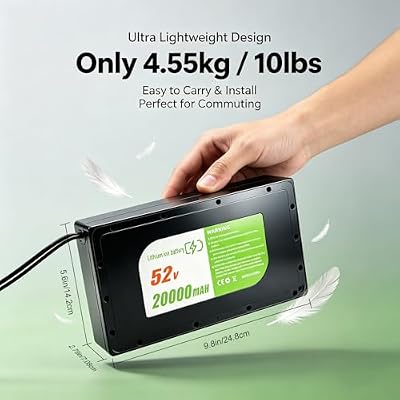
This pack makes sense for one buyer: someone with a 52V build, an XT60 on the discharge side, room for the case, and the patience to ask the seller the three questions above.
For that buyer, about 23 cents per watt-hour for 1040Wh with a 30A board and a correct charger in the box is a strong price. If you want owners behind the numbers first, the wider 52V market has rated options, and our LGNUO 52V 30Ah review covers the bigger sibling from the same brand.
You can also compare every 52V pack we track on Amazon before settling on an unrated one.
The zero-record corner of this market now has two entries on our site. The Yasco 48V 13Ah hides its specs behind a Color row, while this LGNUO prints real numbers and leaves the fitment to you. Neither has an owner record yet, and that, not the price, is the fact that should decide your patience.
Frequently Asked Questions
Does the LGNUO 52V 20Ah battery have any reviews?
None when we checked in late October 2026. The listing prints no rating element and the reviews page reads zero customer reviews, confirmed signed in. The stock counter reads 13 left, so the listing has been up long enough to sell some, and the buyers just haven't written.
Is the 58.8V charger correct for a 52V pack?
Yes. A 52V pack is fourteen cells in series, and fourteen times 4.2 volts is 58.8. That is the same logic that makes 54.6V correct for a 48V pack at thirteen cells. If a seller ever pairs a 52V pack with a 54.6V charger, the pack would chronically undercharge, so the printed charger voltage alone is a point in the listing's favor.
How long does a full charge take?
The listing claims 8-9 hours from empty to full on the included 3A charger, and the arithmetic supports it. Twenty amp-hours at 3 amps is 6.7 hours of constant-current charging, and the absorption phase near full adds one to two hours more. Plan on overnight rather than a lunch break.
What do I need to verify before ordering?
Three things, because the listing names none of them. That your controller's discharge connector matches the XT60 the pack ships with, or that you're willing to re-terminate. That your frame or mount has room for a case measuring 24.9 by 14.2 by 7.1 centimeters and about 10 pounds.
And with the seller: whose cells are inside, whether the case has an IP code, and which bikes the pack has been fitted to. On a listing with no owner record, those answers are the record.