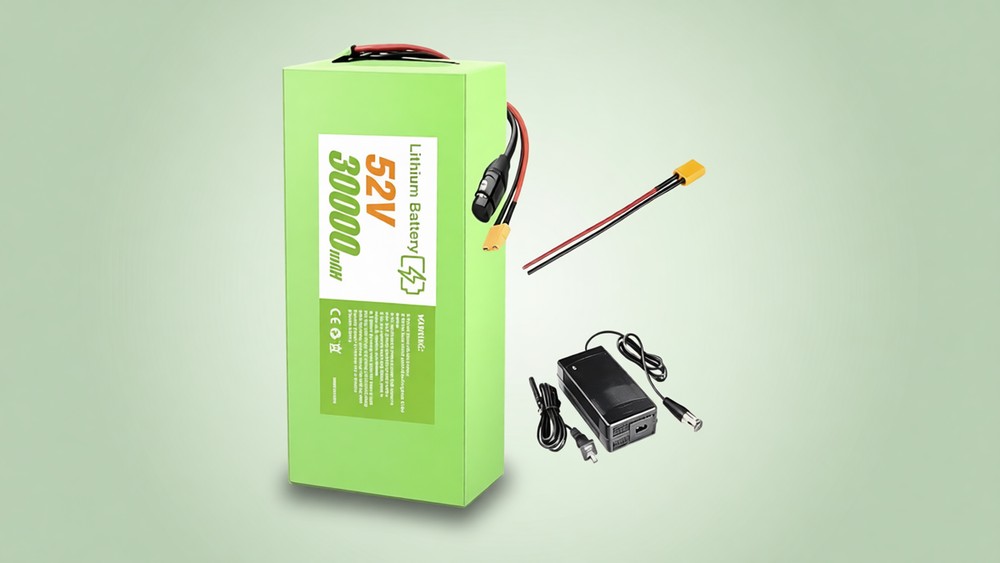
A dead pack leaves you shopping with one number in your head: how many watt-hours your old battery carried. When the replacement that matches it costs half what the bike brand wants, the listing deserves a long look before the card comes out. That is the situation with the LGNUO 52V 30Ah, a 1560Wh pack sitting at a price that undercuts most of what we track.
Arithmetic is not the hard part. What is hard is that a listing this new carries almost no record.
Two buyers had written anything at all when we checked, and what they wrote points in opposite directions. One posted a happy review on October 12. The other posted a BMS failure report on October 9, plus a return process that would not take the pack back.
So this review reads the record the way a buyer should: what the two texts actually settle, what the weight and BMS numbers on the page can and cannot support, and the charge and range math you can plan around before spending that kind of money on a pack this new.
Two texts, one BMS failure already
At 329 when we checked, the LGNUO 52V 30Ah works out to about 21 cents per watt-hour. That sits in the cheapest fifth of the 301 batteries in our comparison table, and near the front of the 52V packs specifically.
On paper this is one of the better value positions we track, and the specs box below renders the live position so you can check it against the pack you were about to buy instead.
The record is the catch. The listing held a 3.0 rating from exactly two ratings when we scraped it, which means one five-star and one one-star, and both texts are recent enough to sit inside the same fortnight. It also showed only 13 left in stock, so owners are joining slowly and the record will stay thin for a while.
The happy text is short and specific. The buyer says the size was perfect for their ebike's rear rack compartment, that hookup was simple, and that the price sits far below the stock replacement. That's three useful data points about fit, install and price, and nothing at all about how the pack behaves over months.
The unhappy text is shorter and harder to dismiss. Its title names a BMS failure, and the body says the pack is normally not returnable due to laws even when it is defective. A BMS fault is the failure mode that bricks an otherwise good cell pack, and the return problem this buyer describes is the real cost when it happens.
The weight line that fails its own arithmetic
The listing's parameter bullet says Weight: 29 lb (6.7 kg) in a single line, and those two figures argue with each other, because 6.7 kg is 14.8 lb. One of them is wrong by a factor of two, and the page never says which.
You can test them against the capacity. Divide 1560Wh by 6.7 kg and the arithmetic says about 233 watt-hours per kilogram, which is roughly double what a complete pack with a case, a BMS and nickel strip connections actually reaches. Over the heavier 13.2 kg reading, the same division says about 118 watt-hours per kilogram, which is the kind of figure real complete packs post.
The listing states the marketing figure and the plausible figure in the same breath, and only one of them can describe the box that arrives.

There is a standard reason to distrust the flattering number. Battery University's cycle-life reference notes that manufacturers tend to overrate their batteries because very few users run spot-checks and complain when the capacity comes up short.
The practical response costs nothing: plan your mounting around the heavier 29 lb figure, weigh the box when it arrives, and meter a full charge through a known load before you trust the 30Ah label. If the pack weighs closer to 15 lb, you've learned something before the return window closes.
What a 40A BMS lets you run
The bullet promises a 40A BMS against overcharge, over-discharge, over-current and short circuit. At the 52V nominal voltage, 40A is about 2080W of continuous draw, and it rises to about 2350W at the 58.8V full-charge voltage. The listing claims the pack suits 200W to 2000W motors.
Run the top of that range against the ceiling and the margin disappears. A 2000W motor sitting under a 2080W BMS has almost nothing left for surges, hills or headwinds, and a BMS that trips on a hill cut is a walk home. The safe read treats this as a pack for motors comfortably under the limit, where the 40A rating is headroom rather than a target.
One spec-table oddity is worth naming: the table lists Recommended Uses For Product as Wheelchair, while the bullets only ever mention ebikes, scooters and solar equipment. That's the mark of a reused listing template, and it's one more reason the page's claims deserve testing rather than trust.
Charging and range, worked from the stated numbers
The box includes a 58.8V charger running at 3A, which is about 176W into the pack. A full 1560Wh at that rate takes about nine hours plus the taper at the end, so it's an overnight charge, not a lunch break. The listing also includes an XT60 extension cord in the box.
Range depends on the draw, so the honest method states its assumptions out loud. A pedal-assist rider near 20 watt-hours per mile would see this pack stretch toward the high seventies of miles.
A throttle-heavy rider closer to 35 would land in the mid forties. Neither figure is a property of the battery, because both follow from riding style, terrain and speed, and no owner in the record has reported a real-world range number yet. Treat the first weeks as your own test window and compare against the table's math.
Reading a two-vote record without fooling yourself
A 3.0 from two ratings is not a mixed verdict, it's a coin that has landed once on each side. Both texts carry Amazon's order-confirmed marker, which tells you almost nothing in a pool this small, because there's nobody else in it.
What the record does settle: one buyer fitted the pack in a rear rack compartment, hooked it up simply, and considered it better value than the stock replacement.
One buyer has hit a BMS failure and expects the return to be refused. What it doesn't settle: range, cycle life, water exposure, cell brand, charge behavior in cold weather, or how the 40A BMS treats a sustained climb. Nobody in a record this young has had time to report any of it.
The one-star buyer's return line deserves a second read before you order. The listing's entire answer to service is a line about 24-7 online customer service, and a 1-year warranty in the spec table only helps if a defective pack can actually go back. Ask the seller, in writing, what happens with a failed unit before you pay, and keep the first month tight against that warranty window.
Frequently asked questions
Will it fit my bike?
The only fit evidence in the record is one buyer calling the size perfect for a rear rack compartment. The stated dimensions are 320 x 155 x 78 mm, so measure the space your old pack occupied before ordering, and remember the listing's own weight line is unreliable. Our battery table sorts every pack we track by price per watt-hour if you want a wider field first.
How long does it take to charge?
The included charger runs 58.8V at 3A, about 176W, so a full charge takes about nine hours plus the taper. Plan on overnight.
What motor can it feed?
The 40A BMS allows about 2080W continuous at 52V nominal. The listing claims it suits motors from 200W to 2000W, but a 2000W motor sits at the ceiling with no surge room, so treat motors well under that as the sane pairing.
Is the capacity real?
The listing contradicts itself on weight by a factor of two, and one reading implies an energy density complete packs do not reach. Weigh the box on arrival and meter a full charge through a known load. Battery University documents why maker capacity figures deserve a spot-check rather than trust.
Can I return a defective one?
One buyer reports the pack is normally not returnable due to laws even when defective. The spec table lists a 1-year warranty and the listing advertises 24-7 customer service, but ask the seller the return question in writing before you buy, because the one written data point on this is pessimistic.