Most of the budget packs crossing my desk this month fail their own arithmetic: a weight that needs cells nobody sells, a charge time shorter than the charger allows, a BMS ceiling smaller than the motor the title sells to. So a listing where every number checks is worth pausing on, even one with no reviews behind it.
The LGNUO 48V 20Ah battery is that listing. It sells at 189.99 with a 3A charger in the box, and on our battery comparison table it sits in the cheapest fifth of the 324 packs we track by price per watt-hour.
The catch is the record: the page prints no star value, no rating count, nothing. You would be an early owner, and I will treat you like one.
I pulled the page apart, OCR'd the gallery cards and ran every printed figure against the arithmetic. The results surprised me. Here is what the listing says, what it proves, and where it stays silent.
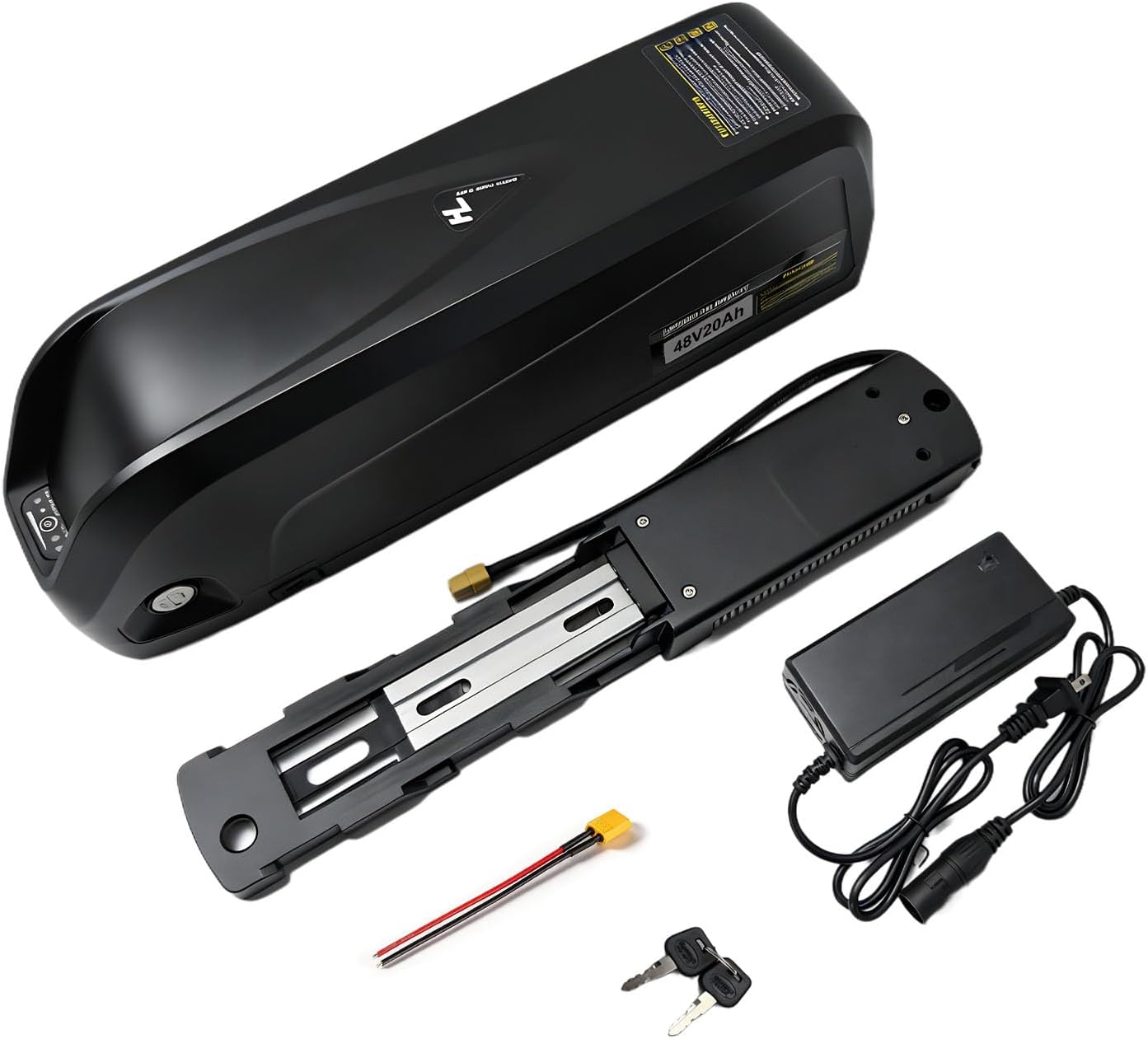
An empty record and three names on the box
There is no review record to read. The star widget that usually prints on the page shows nothing, no rating count, no histogram, no written text. That puts this pack in the same class as the other zero-record listings we have rebuilt, and the method is always the same: judge the listing, the specs and the arithmetic, because the crowd is not there yet.
The names behind the box deserve attention. LGNUO is the brand. The seller is Hengpeng Power Supply.
The manufacturer row reads Huizhou Hengcheng Electronic Technology Co., Ltd. Three names, one product. That is normal for this corner of the market, and the factory name matters more than the brand, because Huizhou Hengcheng also builds the 30A LGNUO pack covered in our LGNUO 48V 20Ah review earlier this month, and the third shell from the same factory in the Viset Li 48V 20Ah review. Same factory, different shells, different BMS ratings.
What the record does say: the pack files under Automotive at a rank in the five hundreds of thousands, it lists only 10 units in stock, and the crossed-out list price sits above the 189.99 buy price. None of that tells you how the pack rides. The specs have to.
The arithmetic, line by line
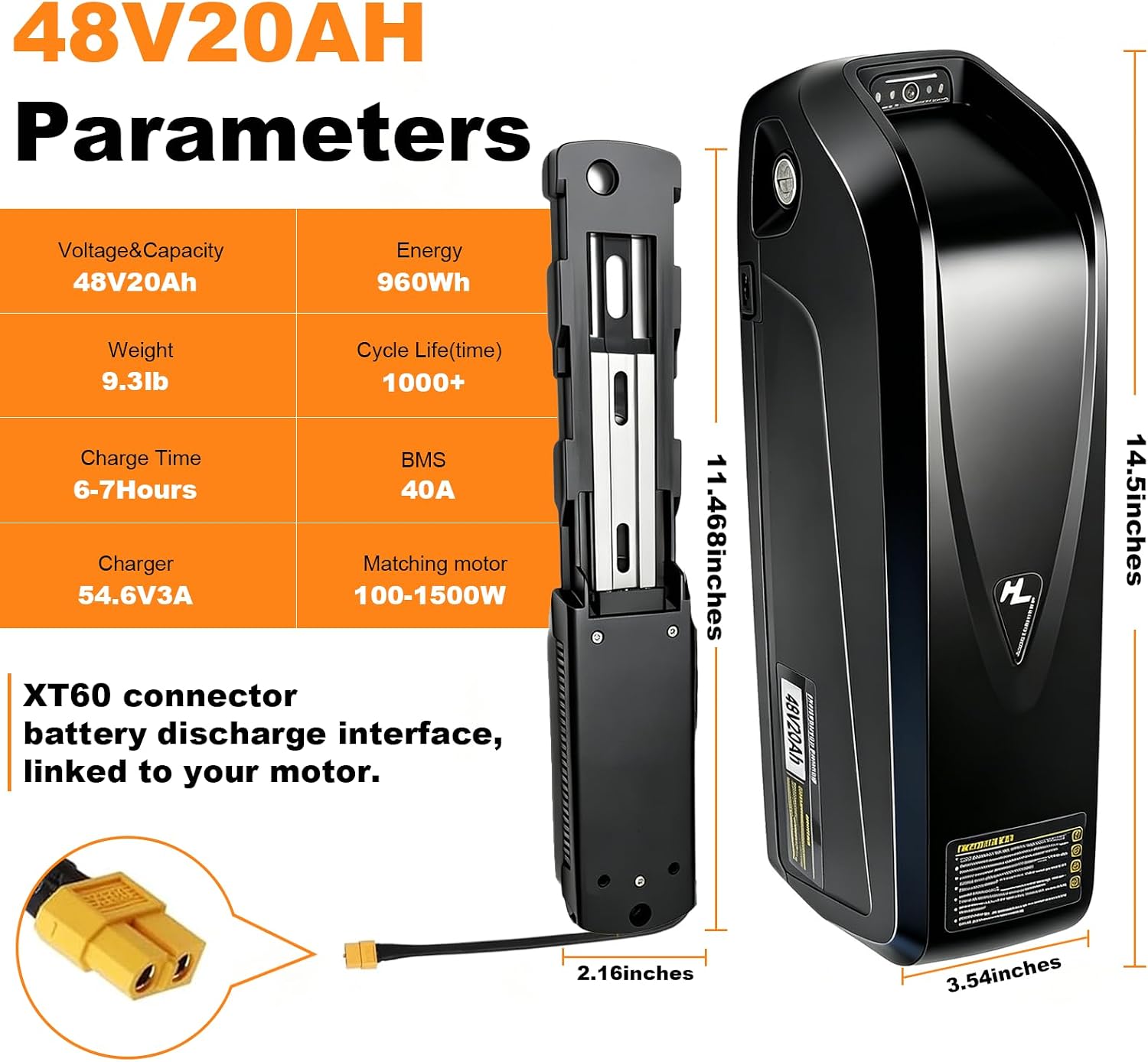
Start with the energy claim, because everything else hangs off it. 48 volts times 20 amp-hours gives 960 watt-hours, and the title says exactly that. No inflation, no rounding up.
The charger math closes. The box ships a 54.6V 3A charger, and 54.6 is what 13 cells in series at 4.2 volts each should charge to, which is correct 48V-class math.
Refill time at 3A on a 20Ah pack has a floor of 6.7 hours, and the gallery card says 6 to 7 hours. That is the rare listing whose own charge claim matches its own charger. Two packs we reviewed this month claimed 6.5 hours on a same-size pack, which is below the floor the physics allows.
The weight math closes too. The battery row and the gallery card both print 9.3 pounds, which is 4.2 kilograms.
Divided into 960 watt-hours that lands near 0.23 kilowatt-hours per kilogram, mid-band for mass-produced lithium cells. The boxed assembly at 10.5 pounds still lands near 0.20.
Compare that with the packs we caught this month whose printed weights implied 0.24 to 0.28 kilowatt-hours per kilogram before the case and BMS weighed anything. This one needs ordinary cells and leaves room for the enclosure, which is what an honest pack looks like on paper.
The power claim has headroom in the honest direction. The built-in BMS allows 40A continuous, and 40 amps at 48 volts is a 1,920W ceiling. A motor running at the claimed 1,500W maximum draws about 31 amps, so the ceiling sits comfortably above the largest motor the title mentions.
Most listings in this band do it the other way round, printing a 25A or 30A board under a 1500W promise.
The 5-pin base, the XT60 and what fits
The pack measures 14.5 by 3.54 by 4.33 inches and mounts on a 5-pin base that slides onto a plate screwed to your frame. An installation card in the gallery walks through the base-plate sequence, the same one the factory's other shells print. The lock is keyed, the LED strip on the case reports charge state, and the discharge leaves the pack on an XT60 connector.
That connector is the part to check before you order. The title names an XT60 connecting wire and a 5-pin base, which reads as signal and charge contacts living on the base while the fat power lead runs on the XT60 to your controller. Plenty of frames take a pack of this size, but plenty of controllers expect a different plug.
The listing says to confirm the fit, and for once the advice has a specific referent: measure your compartment against 14.5 by 3.54 by 4.33 inches, and look at what your motor's power lead actually ends in.
No bike brands appear anywhere on the page. This is a universal pack with a universal mounting scheme, which means the fitment work is on you and the return window is your fitment tool.
One oddity in the gallery: a card advertising regenerative braking energy recovery, promising the pack recharges during coasting and downhill runs. Regenerative braking is a motor and controller feature, not a battery feature.
The pack accepts whatever charge the system sends it. If your kit does regen, fine, the pack will take it. If it does not, the card describes a ride you will never have. Treat it as marketing that wandered in from the motor category.
What 1000 cycles actually promises
The listing claims Grade A cells good for over 1,000 cycles. That number gets misread more than any other figure on a battery page, and the Wikipedia lithium-ion battery article explains the convention: manufacturers typically specify cycle life as the number of cycles until capacity falls to 80 percent of its rated value.
A 1,000-cycle claim is a promise that the pack still holds about 768 watt-hours after 1,000 full trips to that 80 percent line, not that it dies at 1,001. It is also a claim nobody has verified on a pack with no review record, so file it under the manufacturer's promise rather than an owner's finding.
The same article puts the best laboratory silicon cells near 0.35 kilowatt-hours per kilogram, which is the ceiling that makes the printed weights above believable. Ordinary mass-produced cells sit below that, and this pack's arithmetic sits below it too, exactly where a real pack should.
The case claims IP65, which handles rain and hose spray, and the BMS tiles list the usual protections: overcharge, over-discharge, overcurrent, short circuit, over-temperature. Nothing exotic, nothing missing.
LGNUO 48V 20Ah FAQ
How long does it take to charge?
About 6.7 hours at the included 3A charger, and the listing's own 6-to-7-hour card agrees with that math. If you ever add a faster 5A charger, the floor drops to 4 hours, though a pack on a 5A charger runs warmer than the included unit and buys you little on an overnight refill.
Will it fit my bike?
Measure first. The pack needs 14.5 by 3.54 by 4.33 inches of mounting space on a plate mount, and your controller needs to end in an XT60 plug or take an adapter. No bike brands are named on the listing, so the fitment burden sits with you.
Can I trust a battery with no reviews?
You can inspect it. The arithmetic on this page is internally consistent in a way most budget listings are not, and the factory behind it has a track record we have written about. But no owner has ridden this exact listing yet, so buy inside a return window, meter the first full charge, and weigh the pack against the printed 9.3 pounds when it arrives.
How does it compare with the 30A LGNUO pack?
The 30A sibling is a different case with a T-plug, a 2A charger and a 10-hour refill floor, and it costs less. This 40A pack charges twice as fast and carries a bigger BMS ceiling for larger motors. Same factory, different jobs, and the sibling review has the full decode.
Order it if your build stays under 1500 watts
This is a pack for a rider who wants the bigger BMS without paying the premium brands' price, and who is comfortable being the first owner on the board.
The value case is real: it sits in the cheapest fifth of our table, the charger and the charge-time claim agree with each other, and the weight says ordinary cells in a real case. The empty record is the cost of that price, and the empty record is also your protection, because a listing this new sits inside a return window for everyone.
The twin listing from the same factory, the Zlvwem 48V 20Ah, sells the near-same hardware for 15 more with a coupon and no charger named, which is why this LGNUO page is the one to order first. The Zlvwem review covers its borrowed spec table in full.