A listing with no brand name on the page asks you to buy an anonymous 48V 20Ah pack on the strength of its numbers, so the numbers are where this review starts. The VISET LI 48V 20Ah pack sells at 169.99, ships from a third-party seller in two to three days, and carries a 4.8 star value on the page. The rating count renders in page code that never loaded for my scrape, so I won't quote one.
The brand story is the first decode. The live title reads only 48V 20Ah Ebike Battery with 30A BMS. Sold by HZXinYuan. The VISET LI name exists in Amazon's own brand field for the listing and in our battery table, but a buyer scanning the page itself never sees it.
That matters less than it seems, because the same seller's family of listings is what you are actually choosing. What matters more is a model card that cannot survive its own arithmetic, and that is where this pack earns its scrutiny.
The Value Case, Stated Plainly
On our table this pack sits in the cheapest fifth of everything we track, at about 18 cents per watt-hour against a field whose middle sits near 26. For a 48V pack that is genuinely good value on paper, and the value case deserves to be stated before the objections.
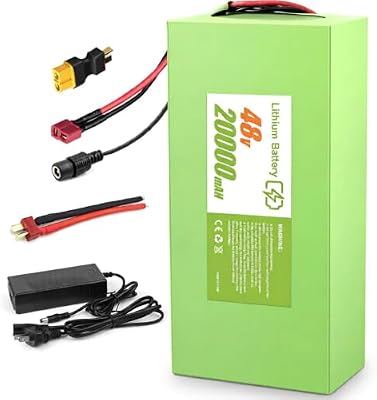
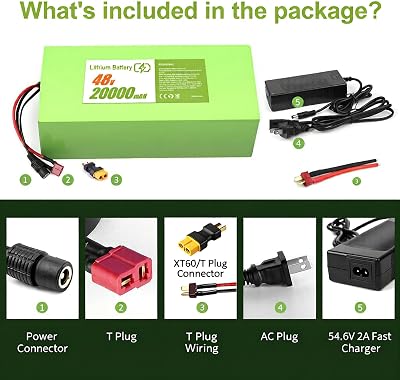
The box contents support it. The package card lists the battery, an XT60/T-plug connector, a power connector, AC wiring and a 54.6V 2A charger, so nothing needs a second order before the first charge. The charge port accepts T-plug or XT60, the connector most DIY builders already own.
The card also prints a 30 amp continuous BMS with a 60 plus 10 amp peak rating, which at 48.1V nominal is about 1,440W of sustained power. That covers a 1,000W motor with headroom and puts the pack in range of most 48V conversions people actually build.
So the paper case is real. The question is which printed numbers survive the arithmetic, and the weight is the one that does not.
The Weight That Cannot Hold Seventy-Eight Cells
The model card gives us everything needed to test the capacity claim, and the test fails cleanly. The card reads 13 series by 6 parallel, which is 78 cells, and 20 amp-hours across 6 parallel strings means each cell is a 3.3Ah unit, the very top of the common 18650 range.
If these are ordinary 18650 cells, and a 3.3Ah cell is the top of that format's range, seventy-eight of them at roughly 48 grams each come to about 3.7 kilograms in bare cells alone. The card prints a net weight of 3.8kg. That leaves about a tenth of a kilogram for the BMS board, nickel strip, wiring, connector and case, which no finished pack on the market achieves. Wikipedia's lithium-ion overview helps make the point concrete, because ordinary cells top out near 260 watt-hours per kilogram and finished packs give a slice of that back to everything around the cells.
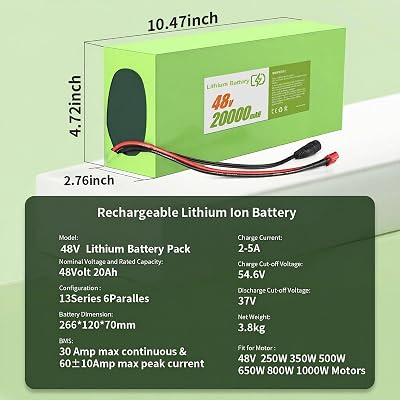
Stated as energy density, 960 claimed watt-hours at 3.8kg is about 253 watt-hours per kilogram at pack level, a figure better than any finished pack we have decoded. For comparison, the 79.99 YLuBik pack we decoded alongside this one prints 5.4kg for the same claimed capacity, and even that sits at the optimistic edge at 178. The VISET LI listing claims the same capacity in 1.6kg less than a listing that is itself stretching.
One printed number is wrong, and the weight is almost certainly it, because capacity is what sells and weight is what ships. My advice for the buyer is to plan around a pack that delivers meaningfully less than 20 amp-hours, and to test early inside the return window. The voltage rows on the card at least agree with the configuration, since the 37V discharge cut-off is 13 strings at 2.85V and the 54.6V charge cut-off is the standard 13S full charge.
Two Thousand Watts Against a Thirty-Amp Board
The motor fit story splits between the title and the card, and the card is the more honest print. The title and two bullets say the pack suits 200 to 2000W motors. The model card's own fit list reads 48V 250W, 350W, 500W, and stops there.
The physics sides with the card. A 2000W motor at full load wants more than the 1,440W the 30A board sustains, so the title's top figure describes a motor the pack cannot feed continuously. The card's 500W ceiling fits inside the BMS with room for the peaks the 60 plus 10 amp rating allows, which is how a BMS is meant to be sized.
My reading for a buyer is to pair this pack with motors up to about 750W and treat anything larger as beyond the printed design. Riders who draw near the ceiling on every ride also chew through cycle-life claims faster, and this listing makes two of those.
The cycle-life bullet says the pack withstands thousands of charge-discharge cycles in one sentence and can be reused over 1,000 times in the next, then adds a service life of up to 5 years. The 1,000-plus figure matches the convention the industry quotes at 80% remaining capacity, but thousands and 1,000-plus are not the same claim, and nobody edited the difference.
Rainy Days, a PVC Layer, and No IP Rating
The waterproof claim is the listing's boldest comfort statement, and it is printed without the one number that would make it checkable. A bullet says the battery features a waterproof casing so you can easily handle rainy days. No IP rating appears anywhere on the page or cards, and IP codes are the printed standard those claims get held to.
The gallery undercuts the bullet too. One card praises a water-resistant PVC outer layer in marketing language, while the warning card instructs the owner never to place the battery in fluids and to store it cool and dry. PVC wrap is splash resistance at best, and the warning card knows it.
Charging is the last honest-number check. The bullet calls the included 2A charger fast, but 20 amp-hours at 2A is a 10.0 hour floor before the taper, which is an overnight charge in plain words. The card's own charge-current band runs 2 to 5A, so a buyer who wants a 4 to 5 hour turnaround needs a 5A charger the box does not include, and the card's band says the pack can take one.
Frequently Asked Questions
Is this the same VISET LI brand as the other packs you reviewed?
The brand field connects it to the VISET LI 48V 15Ah pack we rebuilt earlier, but the live page never prints the name, the seller is HZXinYuan, and the manufacturer field reads Huizhou Hengcheng Electronic Technology. Buy the listing in front of you, not the brand story.
What motor size should I actually pair with it?
Stay at or under about 750W. The card's own fit list tops out at 500W, the 30A continuous BMS sustains about 1,440W, and the title's 2000W ceiling describes a motor the board cannot feed at full load for long.
How long does the included charger take?
Ten hours at minimum, because the included charger is 2A and the pack claims 20Ah, and the taper adds more. The card's charge-current band allows up to 5A, so an aftermarket 5A charger would cut the floor to four hours.
Is it safe to ride in the rain?
Treat it as splash-resistant at most. The casing is PVC wrap with no IP rating printed anywhere, and the listing's own warning card says to keep the pack away from fluids and store it dry. Ride in damp conditions with the connectors shielded, and do not leave it out in weather.