Hunting a replacement pack for an older folding or step-through ebike is mostly a fitment problem. The bike doesn't care what the listing promises in general terms. It cares whether the shell slides into its mount and whether the connector mates, and most budget listings answer neither question.
This LGNUO 48V 13Ah silver fish pack is the rare exception. It names a dozen specific bikes and battery models it replaces, it prints the charger voltage instead of hiding it, and it includes the mounting base and connector in the box.
The review record behind it is close to empty, and that's the tension of this listing. Two ratings, one written sentence about the seller, and a three-star rating with no text at all. Everything useful here comes from the spec sheet, so this review is about reading that spec sheet properly and knowing which parts survive checking.
At 169 for 624 watt-hours, the value lands in the middle of our battery table, and I'll show you the harder comparison with LGNUO's own bigger packs further down.
The record is one sentence about the seller
The page shows a 3.9 star average built from two global ratings. One is a five-star, one is a three-star, and the histogram prints nothing in between. Exactly one person wrote anything, in August 2026, and here is the whole text: "Trustworthy seller. I'm happy with this great battery and fast shipping."
Read that carefully and notice what it never mentions. Nothing about range, nothing about whether the pack fit the bike, nothing about how it holds up over weeks of riding. It praises the seller and the shipping speed. It also carries no purchase badge, so it isn't even tied to a confirmed order.
The three-star rating has no text at all, which means the only critical signal on the page is mute.
Somebody gave this pack a middling score and left, and nobody will ever know why. That silent rating isn't evidence of a fault, and it isn't evidence against one. It's an open question you should carry with you.
This is the same shape of problem we worked through on the Yasco 48V 13Ah rebuild: when the record carries no usable signal, the listing itself has to carry the whole case. On this page, unusually, parts of the listing actually can.
The fitment list is the real spec sheet
The fourth bullet is where this listing earns its keep. It names the bikes and battery models this pack replaces: fat-tire folding frames in the FAT20810 and FAT20S900 series, the Starfish, Dolphin MiFa, Rex, Prophete, Aldi, Avocet, Viking and Byocycles brands, the Phylion XH370-10J cell, the Zhenlong ZL1010-F, and the Peacedove. That's a concrete answer to will-it-fit, the question most zero-record listings dodge entirely.
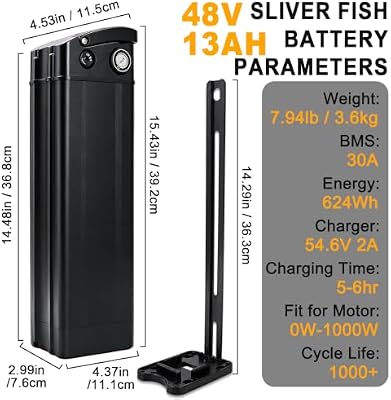
Treat the list as a starting point, not a guarantee. Model names drift across production years, and one bullet on the page calls this a seat tube battery while the title calls it a silver fish, two names that overlap but aren't the same thing. The pack measures 15.5 by 3 by 4.4 inches, printed as 392 by 76 by 111 millimeters, and the two sets of numbers agree.
Measure the bay anyway
Whatever the list says, the tape measure decides. Check your dead pack's length, width and height against those numbers, check your mount's connector against the XT60 four-pin interface the box includes, and only then order. A wrong-capacity or wrong-shell return costs you a fortnight of riding either way.
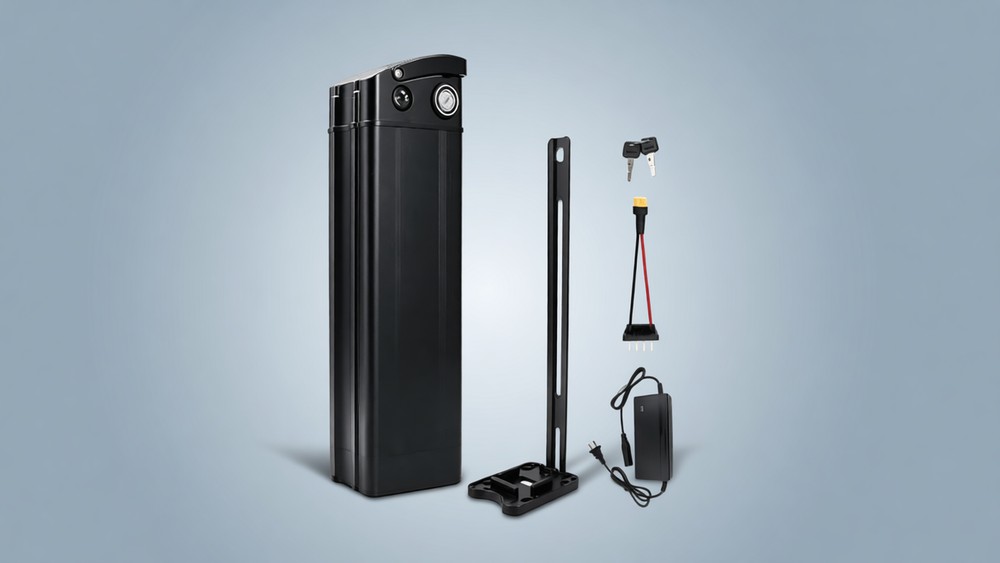
One more detail in the buyer's favor: the what-you-get bullet lists the mounting base, two keys, the XT60 four-pin connector and the manual alongside the battery, so the hardware needed to physically install the pack is in the box rather than on a second order.
The charger math checks out
The listing says the box includes a 54.6V 2A charger. Here is why that single number matters more than it looks. A 48V lithium pack is built from 13 cell groups in series, and 13 times the 4.2V full-charge voltage of a lithium cell is 54.6 volts.
The printed charger matches the printed pack voltage exactly, which is the arithmetic some competitor listings get wrong by one cell group and never explain.
Contrast the Varstrom 48V 16Ah listing, which printed 54.6V charging advice while an owner measured a 58.8V charger and a 58.3V pack top, a one-cell-count disagreement the page never resolved. This LGNUO page passes the same test cleanly.
The 2A current sets the charge time. Thirteen amp-hours into two amps is six and a half hours at minimum, and that's before the slowdown at the end of charging, so plan on seven hours or a bit more for a full cycle. That's an overnight charge, not a lunch-break one.
Where the listing goes quiet
The cycle-life bullet claims the cells withstand thousands of charge-discharge cycles without significant degradation, and it's worth noticing how the claim is written.
The cycle-life bullet claims the cells withstand thousands of charge-discharge cycles without losing much capacity, and it's worth noticing how the claim is written. The words are hyphenated in the listing itself, a small oddity, and no number is given anywhere. Outside sources put a typical lithium-ion pack at roughly 400 to 1,200 full cycles before capacity drops to 80 percent. That band comes from Wikipedia's lithium-ion battery article.
Thousands without much loss sits at or above the top of that band, and with no cycle number, no cell brand, and no test behind it, the claim is a slogan, not a spec.
The same quietness shows up elsewhere. There's no water-resistance rating anywhere on the page, on a pack that rides exposed on a frame. The weight rows disagree slightly, with the bullets printing 7.94 pounds and the spec table printing 3.5 kilograms, which is about 7.7 pounds, a small gap but one more sign nobody proofread the page.
And the "Sliver Fish" misspelling in the title is harmless but tells you the same thing.
None of these gaps prove a problem. They draw the boundary of what the listing will stand behind, which on a one-sentence record is everything.
Value against its own siblings
At 169 for 624 watt-hours, this pack works out to about 27 cents per watt-hour. That sits close to the middle of the 301 packs we track on the comparison table. Mid-table is honest value, neither a steal nor a rip-off, and the included charger and mounting base soften the true cost of a replacement since you're not buying those separately.
The harder comparison sits inside LGNUO's own rows. The brand's 52V 20Ah universal pack sells for about 22 cents per watt-hour, with nearly two-thirds more energy in the box. The 36V 10Ah sibling sits near 36 cents, worse than this one.
And the closest comparison of all, LGNUO's own 48V 20Ah silver fish pack with a 40A BMS, sells for 219, which is about 50 more for 960 watt-hours instead of 624, half again the energy plus a stronger BMS for about 23 cents per watt-hour. If your bay can take the longer pack, the 20Ah is the better buy of the two shells.
The stock line says only 9 left, and that number is doing quiet work on the page next to the thin record.
A low stock count isn't evidence about quality, and neither is a single five-star sentence. The price-per-watt-hour math is the only comparison on this listing that a buyer can verify, and the table keeps it current. Check the current LGNUO price on Amazon before deciding.
Frequently Asked Questions
Will it fit my bike?
Check the fitment bullet against your bike or your dead pack's model name, then verify with a tape measure: 15.5 by 3 by 4.4 inches, an XT60 four-pin discharge connector, and a mounting base in the box. The list names FAT20810 and FAT20S900 folding frames, Prophete, Viking, Byocycles, the Phylion XH370-10J and several others, but the measurements decide.
How long does it take to charge?
Plan on seven hours or a bit more. The included 2A charger needs six and a half hours minimum to refill 13 amp-hours, and charging slows near the top of the cycle.
How far will it go?
About 41 miles on gentle pedal assist at 15 watt-hours per mile, dropping to about 21 miles under constant throttle. Hills, cold weather and rider weight all pull those numbers down, and the 25 to 75 mile spread Wikipedia's electric bicycle article describes for ebikes puts this pack at the lower-middle of the range.
What can the 30A BMS power?
A 30A limit on 48 volts is a 1,440W ceiling. A 1000W motor draws about 21 amps flat out, comfortably inside, and a 750W motor sits around 16. The listing's 0 to 1000W motor claim is consistent with its own BMS.
Should I trust the reviews?
There's almost nothing to trust or distrust. One sentence praising the seller with no purchase badge behind it, one silent three-star rating. Buy on the spec sheet and the return window, not on the record.
Is this the best-value LGNUO pack?
No. It sits mid-table and is the priciest per watt-hour in LGNUO's own lineup. The brand's 48V 20Ah silver fish sibling costs about 50 more and delivers 960 watt-hours with a 40A BMS, so measure your bay and take the bigger shell if it fits.