Buying a replacement pack means trusting a listing you cannot see inside. This Varstrom 48V 16Ah ebike battery is a 768Wh downtube pack with a 30A BMS, and at 234.99 it works out to about 31 cents per watt-hour, which puts it in the pricier third of the 301 packs on our battery comparison table. That's not a bargain price.
Whether the pack earns that premium is what the owner record should tell us, and it mostly does.
The interesting thing about this pack is not the capacity or the BMS. It's that the listing argues with itself in three places, and the owners settle two of the three arguments.
One owner has documented water pooling in a case the listing calls waterproof. Another measured a charger putting out 58.8 volts on a page that recommends 54.6. I'll walk through what ships in the box, what the trail record shows, and where the honest limits sit.
What actually ships in the box
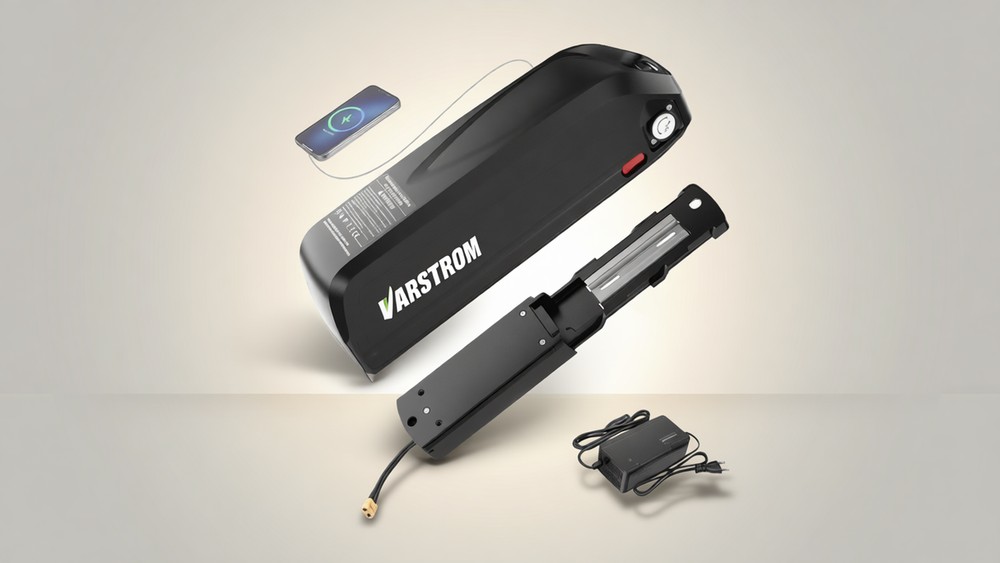
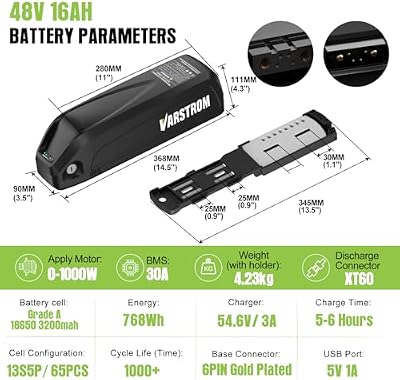
The pack measures 367 x 111 x 90mm, which is a standard downtube bottle shape, and it weighs 11 pounds.
The multiplication checks out: 48 volts times 16 amp-hours is 768 watt-hours, so the title math is honest. Inside you get the battery case, a bottom bracket mount, safety lock keys, a charger, and a conversion cable for motors whose plug is not XT60. The output connector is a 6-pin type, so check what your motor uses before you order.
Beyond the cells, Varstrom includes a power switch, an LED gauge, an anti-theft lock, and a USB port for topping up a phone on a ride. Those are small things, but the USB port in particular is useful on long rides where a phone is your map.
The spec table itself is thin. It lists brand, weight, and unit count, and nothing else. No warranty row appears anywhere, which matters later in this review when a buyer needs support.
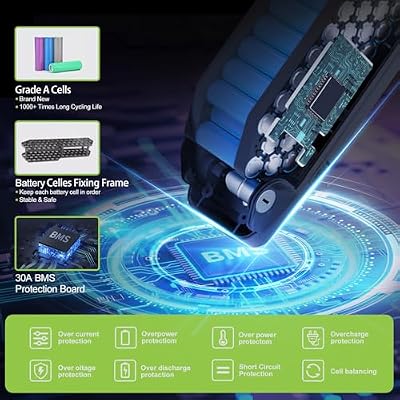
The 30A BMS claim deserves a quick decode. Thirty amps at 48 volts is a 1,440W ceiling, so a motor up to the advertised 1,000W runs with real headroom rather than right at the limit. That's the honest advantage over the 20A packs common at this price.
If you want to see how the 16Ah size sits between the brand's own smaller and larger options, we have separate reviews of the Varstrom 48V 10Ah and the Varstrom 48V 20Ah.
The waterproof claim, tested by an owner's tape
Bullet four says the pack has a waterproof ABS housing. One owner pushes back anyway, and the warning is specific: don't mount it upside down, because water can catch and pool in the shell. That's not a complaint about rain sealing. It's a description of a case that collects water in the wrong orientation, which is a different and more fixable problem.
The practical read is straightforward. Treat the housing as weather resistant, mount it with the ports facing down or sideways, and don't aim a pressure washer at it. The same owner confirms the pack works as intended and ships with the bracket, wires, and keys, so this is a usage note from someone satisfied, not a failure report.
Still, when a listing says waterproof and its own buyer says not waterproof, believe the person who has held the case.
Mounting deserves its own word. One owner has found the stock holder alone too weak for rough riding and switched to a bottle-style mount with hose clamps and screws after a couple of spills. A different owner reports a separate frustration: they could not get the pack off its mount on arrival.
Nothing is broken there, but it tells you the latch grabs firmly, and you should learn the release before you're standing over the bike confused.
The charger numbers disagree by one cell
Here's the strangest contradiction in the listing, and it is a numbers one. Bullet five recommends a charging voltage of 54.6V, which is the standard full-charge figure for a 13-cell 48V pack.
But one owner has measured their charger putting out 58.8V, with the pack itself topping out at 58.3V. Those are 14-cell numbers. The printed figure and the measured one sit a full cell count apart, and nobody at Varstrom explains the gap.
The owner who measured it is not alarmed. They note the pack has never charged above 58.3 volts, that the BMS clearly stops it there, and that they have never come close to running out of range in normal riding. The half-volt they are missing is about punch at the top of the charge, not safety.
A BMS that halts charging below the charger's ceiling is doing its job, and the owner's own testing confirms the charger really does put out 58.8 volts.
What should a buyer do with this? Ask the seller which cell count the pack actually uses before you buy, and if you already own the pack, charge it on a hard surface the first few times and feel the case. The 1000-plus cycle claim with 80 percent retention is a listing promise no short review can verify either way.
What matters more is that the one owner who opened a voltmeter has reported consistent behavior across months of riding.
The trail record is the strongest evidence here
Most reviews for this pack are one line long. The exception is a long account from an owner who has put about 150 miles on theirs, 83 of them on hard mountain trails with rocks, roots, and sand. They run a Bafang BBSHD mid-drive at full throttle, riding what they describe as mostly like a dirt bike, which is about the harshest duty a 16Ah pack can see.
After one 26-mile ride of that kind, they measured the pack still sitting at the high end of 52 volts.
That number means more than it looks. Throttle-only riding on a big mid-drive burns roughly 20 to 25 watt-hours per mile, so 26 hard miles should have consumed somewhere around 550 of the pack's 768 watt-hours.
Coming home to a high charge reading is consistent with that arithmetic. It's also consistent with the smaller reports: one commuter's bars did not move across a 30-to-60-minute ride, and another compared the same work commute on their old cheap pack and this one, arriving at 32 percent before and 98 percent now.
Range claims always depend on assist level, terrain, and throttle use. E-bike batteries typically deliver 25 to 75 miles per charge depending on how much work the motor does, and Wikipedia's e-bike overview makes exactly that point.
For this pack in numbers, plan on about 50 miles with gentle pedal assist, and nearer 30 if you ride it like the trail owner does. Nobody in the record has reported the pack dying early on them, which for an aftermarket pack is the first thing to establish.
Sleep mode, support, and the cost of a universal claim
The harshest usable complaint in the record is about a feature, not a defect. This pack has a sleep mode, and one owner has learned the hard way that if you switch it off while out riding, the only way to wake it is plugging it into the charger. That owner was a good distance from home when they found out.
The lesson is free: leave the pack on while you're out, and treat the switch as an off-switch for storage only.
The single worst account in the record is a support story rather than a hardware one. One buyer received a pack that would not charge at all, found the third-party seller hard to reach, and ended up going through Amazon to get attention. Their update is the damaging part: the seller asked for a video of the defect, received it, and then stopped communicating.
With no warranty row in the spec table, that account is the closest thing the listing has to a durability policy, and it's not a reassuring one.
One more critical text deserves an honest note. A two-star review reads "no range and charger is horrible more like 20ah not 30," which does not match this pack's 16Ah capacity on any reading. I've quoted it as printed because it's in the record, but it does not contain a measurement anyone can check, so it should not move your decision much in either direction.
The compatibility bullet is the widest claim on the page. It lists motorcycles, scooters, tricycles, folding bikes, city bikes, and balance bikes, and the buy-box title adds Voilamart, PEXMOR, and AW motors on top. The record pushes back in three places.
One owner's DTTZH F-6 did not fit. One Canadian buyer found the pack's own mount did not fit their so-called universal platform. A third reports the connections to their bike did not fit because the site information was not precise enough.
None of those buyers is wrong to be annoyed, but none of the failures is a defect either. They're the predictable cost of a claim that wide. This pack has a specific footprint, 367 x 111 x 90mm, and a specific 6-pin output with an XT60 conversion cable included.
If your bike takes a standard downtube bottle pack and your motor speaks XT60 or accepts the adapter, the odds are good. If your bike is a proprietary model, measure the bay and match the connector first, and treat the universal bullet as marketing rather than a promise.
The verdict, then: this is a pack with real range evidence, an honest capacity claim, and three contradictions, two of which its buyers have already settled in practice. You can check the current Varstrom 48V 16Ah price on Amazon before you decide. Buy it if your frame accepts the size and you want a mid-pack upgrade with headroom for a big motor.
Skip it if your mounting situation is unusual, if you need a written warranty behind the purchase, or if every dollar per watt-hour counts, because at about 31 cents each this is not the value pick in our table.
Frequently Asked Questions
How far does the Varstrom 48V 16Ah actually go?
The arithmetic says about 50 miles at a gentle 15 watt-hours per mile, and closer to 30 at the 20-to-25 watt-hours per mile a throttle-only mid-drive burns. The trail owner's 26 throttle-heavy miles with charge remaining fits the second figure. Your real number depends on assist level and hills.
Is the pack really waterproof?
The listing says the ABS housing is waterproof. An owner has warned that water can pool in the shell if you mount it upside down. Treat it as weather resistant, mount it ports-down, and keep pressure washers away.
Why does the charger matter here?
The listing suggests 54.6V charging, which is 13-cell math. One owner has measured a 58.8V charger with the pack stopping at 58.3V, which is 14-cell math. Both figures are printed or measured facts, they sit one cell count apart, and asking the seller which applies is a fair question before you buy.
Will it fit my bike?
Measure your battery bay against 367 x 111 x 90mm and check your motor's connector against the 6-pin output and XT60 adapter. Three buyers have reported fitment misses on non-standard bikes, so the measurement is worth five minutes.
What warranty comes with it?
The spec table carries no warranty row. The listing's practical protections are Amazon's return window and whatever response you get from the seller. One buyer's defect claim ended in silence after a video was provided, so test the pack hard within the return period.