The Joyisi 48V 15Ah is a rear-rack pack, and rack packs are rare where we shop, because our 301-row comparison table files only three batteries under that label. That record is deep, it's mostly positive, and it has been silent since July 2024. The listing argues with itself about capacity, the record contains one genuinely alarming verified complaint, and the price sits at the top of our table. Here is what the whole stack adds up to.
A rack pack with a record older than most of the table
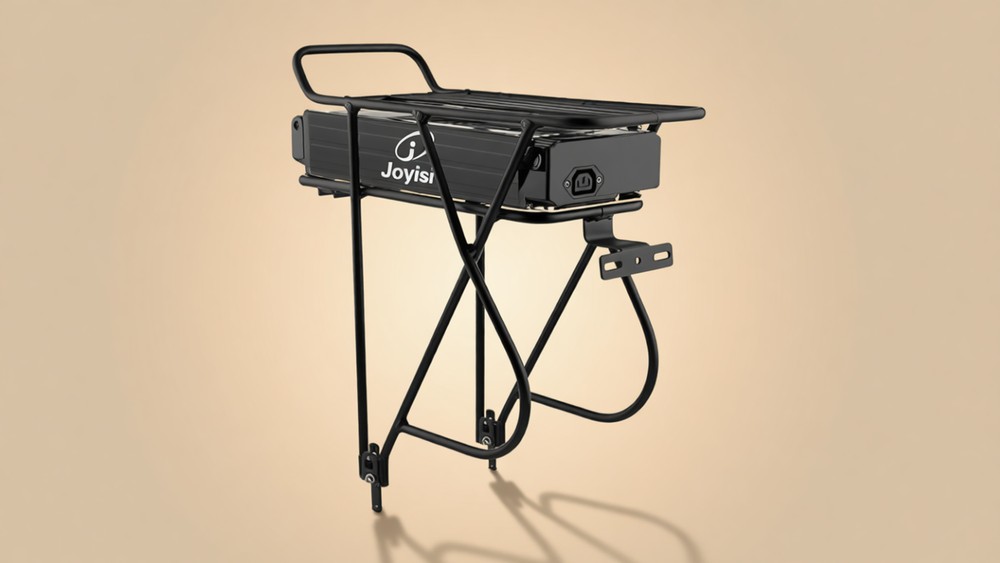
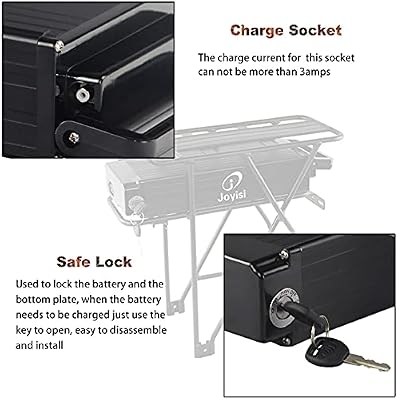
Joyisi sells the R049-6 as a complete unit, pack and rack together, with the rack accepting 24, 26, and 28-inch wheels. You get an Anderson connector on the discharge side, an aluminum shell, a key-operated lock, and a listed one-year warranty with a USA-based support team behind it. The bullet names a 54.6V 2A charger and a 30 amp maximum discharge. Nothing on the page names a cell brand or a chemistry beyond lithium ion.
The live capture in late October 2026 shows the pack in stock with only eight units left and a product page reading 4.4 stars from 144 global ratings. The reviews page header says 74 customer reviews, which is the written-text count, so the two numbers measure different things and we don't average them together. The histogram prints as 70 percent five-star, 14 four, 6 three, 3 two, and 7 one-star. That seven-percent one-star band is worth pausing on for a 4.4 pack, and the fault record below explains most of it.
The age of the record matters as much as the score. The newest written text landed in July 2024, more than two years before this capture, and the oldest texts in the window reach back to 2018. A 4.4 average built on a quiet record tells you how the pack aged for buyers years ago, not what ships today. The category position is a long tail too, somewhere past position six thousand in powersports batteries.
Then there's the price. On our own comparison table, which sorts every pack we track by cost per watt-hour, this one sits among the most expensive of everything we track, and its live position renders in the specs box. You pay a clear premium for the rack form factor. Whether that premium is worth it depends on what your frame can mount, which we get to below. Check the current price on Amazon.
One listing, two capacity stories, and nothing to settle it
The title says 15 amp-hours. The Battery Capacity row in the details table says 13 amp-hours. That's a 720 watt-hour pack against a 624 watt-hour pack, and the two readings land at roughly 47 and 54 cents per watt-hour respectively. Both readings are expensive, so the value verdict survives either way, but a buyer planning range around 720 watt-hours while carrying 624 has lost about an eighth of the plan.
The charge math leans toward 15. A 2A charger needs 7.5 hours to fill a 15Ah pack and 6.5 hours for 13Ah before the taper, and the listing's own instruction says to charge for at least 8 hours. One owner reports 6 to 8 hours from dead, which fits the bigger reading better. Against that, nothing on the page closes the question the way a printed weight would, because Joyisi printed no weight anywhere, in any row, bullet, or image card. Weigh the pack and meter a full charge on arrival, and you'll know which listing you bought.
The voltage side checks out cleanly. A 54.6V charger equals 13 cells at 4.2 volts, and 13S matches a 48V nominal pack. The 30 amp discharge ceiling gives 30 times 48, or 1440 watts, against the 1000 watt motor claim in the title, so a full-load 1000W motor draws about 21 amps and sits comfortably inside the cap. That headroom is honest.
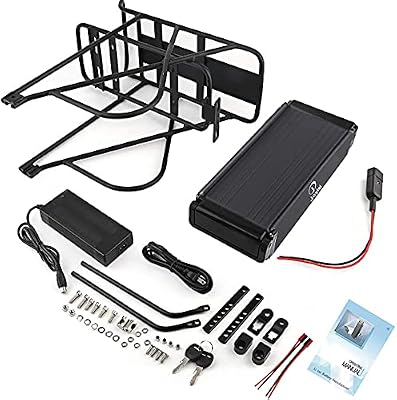
One more gap sits in the box list. The Included Components row reads battery, rack, user manual, no charger, while bullet one names a 54.6V 2A charger and several owners report receiving one. The row is incomplete rather than the charger being absent, but if the box matters to you, ask the seller before ordering.
The fault record: a reversed charge port and three fuses
The most serious text in the record is a verified one-star from October 2020. The owner wrote that the pack "worked great until I tried to charge it," then found "the polarity of the charging wires was wrong" after opening the case. The reversed port fried the charger, the owner resoldered the wires themselves, and the review calls it "a manufacturing error, which could pose a fire hazard." The same text notes a large spark on connection "as others have noted," so this wasn't one unlucky box. A reversed charge port is a factory fault, not wear, and it's the kind of defect you find on the first charge rather than the hundredth.
A different owner left charging-sequencing advice that reads differently in that light. Connect the charge port to the battery first, then plug into the wall, and unplug the wall before touching the battery end again. Whether that habit prevents the spark or just moves it, the record treats the connection moment as the risky one.
Fuses come up three separate times in three years. A verified 2021 owner lost power, traced it to a blown fuse, and noted the pack shipped with a spare. An unverified 2024 text describes two years of service, then a fuse that blew, was replaced, and blew again within the year, after which the pack "kept shorting immediately" and made a popping noise the owner found frightening. A 2023 buyer had the opposite experience with the same part, reporting they bought a replacement fuse themselves and were refunded the next day. Three owners, three fuses. Treat the fuse as a known service item on this pack and keep the spare where you can reach it.
The certification claim deserves its usual skepticism. The bullet says the batteries "have been certified to UL 2271," but no file number appears anywhere on the page, so there's nothing to check. Sellers we have looked at this month use similar wording as compliance language, and until a number exists the claim weighs nothing in the decision. An unverified complaint that the pack uses generic cells rather than name-brand ones is likewise unverifiable, because no cell brand is named on the listing in the first place.
What the rack premium buys, and what it costs
Our table holds 301 batteries and exactly three of them are rear-rack packs. The other two, a Yose Power 48V 20.8Ah rack unit and a Varstrom 48V 18.2Ah rack pack, run near 30 to 33 cents per watt-hour. The Joyisi lands at 47 to 54 depending on which capacity reading you believe. It's the most expensive rack pack we track by a wide margin, so the premium you pay over the other two buys a deeper history and nothing measurable on the spec sheet.
The form factor itself is a real solution for a real problem. The record shows exactly the bikes that need it: a Cranbrook beach cruiser with no bottle mount, a recumbent, an older Walmart mountain bike. One owner with a heavy front hub motor specifically liked carrying the weight at the back to balance the bike. If your frame can't take a downtube or bottle pack, this category exists for you.
Fit, though, is conditional in ways the old listing doesn't spell out. The Cranbrook owner found his seat tube had no screw holes for the rack's support arms, zip-tied the rack as a workaround, and bent a hangar bar under his weight, though he reports Joyisi sent replacement hangars right away. Another owner received no bolts for the rack-to-frame attachment, rated the missing hardware a safety issue, and sourced his own.
The printed instructions draw repeat complaints: one owner calls them basically worthless, another says the YouTube links in the manual are private videos you can't watch. One owner reports the battery rattles on its mount. Measure your eyelets and plan your own hardware before the box arrives.
The strongest recurring positive is the support team, and it shows up in five different texts. A refund the day after a fuse complaint, replacement hangars, a replacement power cable, a new lock and keys after a theft, and a replacement for a unit that stopped charging shortly after arrival. The listing's promise of a USA-based team with lifetime support matches what owners actually describe.
Range reports split exactly by rider weight
The range texts read like a textbook demonstration of why a single range number is fiction. A 120-pound rider averaged about 50 kilometers at 30 km/h. A 250-pound rider cleared 35 mph with power to spare. A 275-pound total on a 1000W motor governed to 750W managed about 25 miles on mild pedal assist. A 300-pound rider on a beach cruiser got 15 miles at 25-plus mph and more at 20. Two riders claimed 40 miles, one of them hedging that his odometer might not be accurate.
The Wikipedia electric bicycle page puts the typical range band at 25 to 75 miles depending on assist level, terrain, and rider weight, and this record spans the low half of exactly that spread.
Longevity claims exist but nobody metered anything. One unverified buyer reports 4 years and 4,200 miles on a first pack. Another logged 1,000-plus happy miles in 2019, and a 2021 owner counted 450. The listing, for once, prints no cycle-life claim to check against the 400 to 1,200 cycle band that the Wikipedia lithium-ion page gives for this chemistry, so there's nothing to catch there. What the record actually establishes is that buyers from 2018 through 2021 kept theirs in service for years, which is a fair signal for a product still sold unchanged.
Common questions about the Joyisi rack pack
Will it fit a bike with no bottle mount?
Probably, but the frame decides it, not the wheel size. The rack bolts to seat-stay eyelets, and the Cranbrook owner's bike had none, which is how the zip-tie and the bent hangar happened. Check for mounting eyelets near the rear axle and under the seat stays, and expect to supply your own hardware if the box list skips the bolts.
How long does charging take?
Plan on an evening. The 2A charger needs about 7.5 hours to fill a 15Ah pack before the taper, the listing instructs at least 8 hours, and owners report 6 to 8 from empty. If the pack is really the 13Ah the details row claims, subtract an hour. Connect the battery end first and the wall end second.
Is the UL 2271 claim verifiable?
Not from the listing. A real certification carries a file number you can look up, and this page prints none. Ask the seller for the number in writing before you buy. Our Sinigerel review covers the same wording pattern, and our Shewaihe 36V review shows the compliance-language version of it.
The seller is asking 339.99 for 720 watt-hours as captured, check the live price on Amazon, and meter a full charge on arrival to learn which capacity story you bought.