A rear rack battery is a bundle deal, and this one bundles more than most.
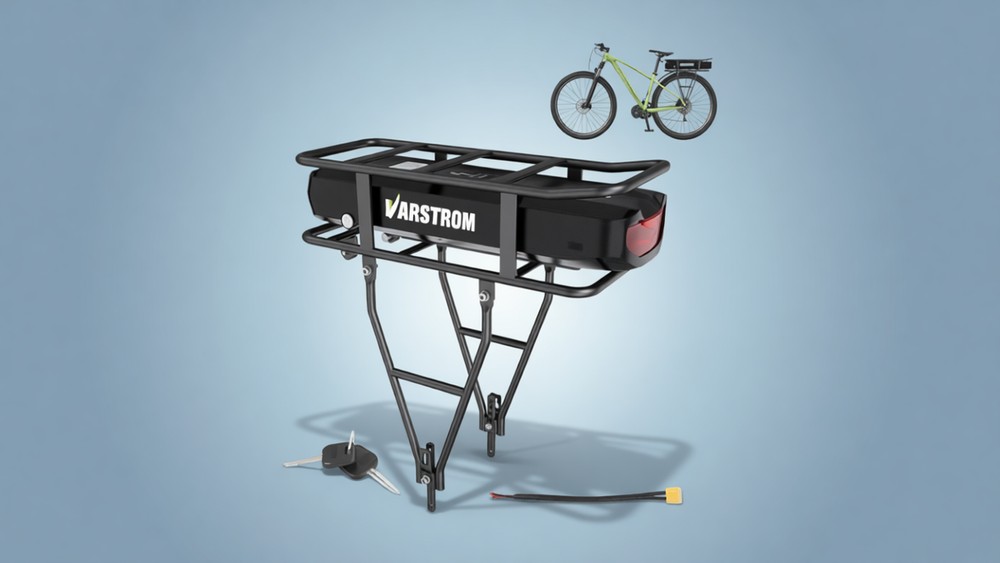
The Varstrom 48V 18.2Ah ships with the rack, a 3A charger, a tail light, a lock and a 50A fuse, which is close to a complete rear-end rebuild in one box. It rates 874 watt-hours, and it prices at about 33 cents per watt-hour, pricier than about three quarters of the 301 packs on our battery table. You're paying for the hardware around the cells as much as the cells.
What the record offers in return is unusual: two written reviews, both one-star, both from badged purchases, and not one positive text anywhere on the page. This article goes through what those warnings actually say, which of them should change how you handle the pack on arrival, where the listing argues with itself about capacity, and whether the bundle math justifies the price.
Every word on the page is a warning
The pack sits at 3.3 stars from 9 global ratings, a histogram of 50 percent five-star, 15 percent three-star and 35 percent one-star with the middle bands empty. Two of those ratings carry text, and both are one-star reviews from badged purchases.
One dates to August 2025, the other to April 2026. Both predate our first article on this pack, which means every written word on the page was already there when we originally covered it. Since then two more ratings have landed and both are wordless, which moved the average from about 3.4 to 3.3.
The 50 percent five-star band deserves its own sentence: not one of those buyers has written anything. The positive half of the record is silent, so the only words on the page are the two warnings, and a reader who wants a counterweight won't find one. That's a thinner record than the rating count suggests, in both directions.
The pack that arrived at zero volts
The April review is the one that should change your first hour of ownership. The buyer reports the pack arrived completely discharged, reading 0V, which is a deep-discharge state. They started charging it, then looked into what that does. What they found: forcing a charge into a deeply discharged lithium pack can cause a fire. They unplugged, and noted that the charger had already run hot.
Their words on the seller were "The seller knew all this and didn't care." Their advice, worth keeping no matter whose rack pack you buy: check the output voltage first, and if it reads below 20V, don't try to charge it.
There's real chemistry behind that advice. Discharging a lithium-ion cell below about 2V can dissolve the copper current collector inside it, which sets up internal short-circuiting when the cell is recharged (Wikipedia). A pack that ships at 0V has been stored empty or self-discharged for a long time, and its cells are in exactly that zone.
The August 2025 review pairs with it on the service side. That buyer's pack didn't fit their e-bike despite the fit claim, and the seller refused a return even though the listing said it should fit.
The warranty row on the current page reads 30 days for returns, one year for repair or replace, and lifetime technician guidance, so the window to discover a fit or voltage problem and act on it is short. Buy this pack early enough in your project to test it inside that month.
The spec row that disagrees with the title
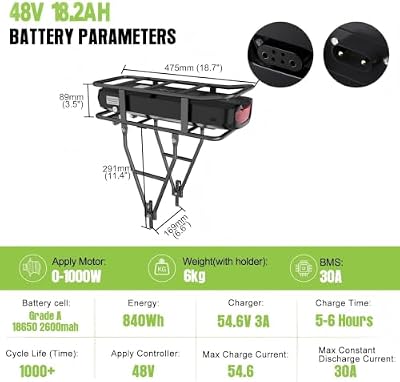
The title says 18.2Ah and 874Wh, and the energy-content row in the spec table agrees. Then the Included Components row calls the battery "48V17.5Ah", which works out to 840Wh. The gap is 34 watt-hours, about 4 percent of the pack, small enough to be a stale copy from a sibling listing and large enough to matter on a long ride.
Our own row tracks this listing at 18.2Ah, but a spec table printed by the seller is a fair counterparty, so ask which capacity ships before you order and go by the case stamp when the box arrives. The gap between the two figures is about 4 percent of the pack.
The charger gives a small clue on time either way. It's a 3A charger, and 18.2Ah at 3A is about a 6-hour floor from empty before the taper, 17.5Ah about 5.8 hours. The listing prints no charge-time claim to check that against, so treat anything under 6 hours as a partial-charge figure.
The rack, the cable and the 30A ceiling
The rack itself measures 476 by 165 by 380mm, about 18.7 by 6.5 by 14.9 inches, and it hangs well behind the seat line at that height. Check it against your actual rack mounts and any pannier clearance before ordering, because a case that tall catches heels, bags and curbs.
One line in the contents list deserves attention: the conversion cable ships without a plug, so mating it to your kit's connector is on you. The title names Bafang, Voilamart, PEXMOR and AW kits and an XT60 connector, and the August 2025 review is a reminder that a named-kit list is still not a fit guarantee.
On power, the 30A BMS works out to a 1,440W ceiling at 48V, and the power claim tops out at 1,500W motors, which draw about 31A. That puts the biggest motor the title names just over the board, so the honest limit is the low 1,400s. It's a smaller overshoot than the 1,000W-on-20A listings we rebuilt this month, but it is the same pattern of a claim ending right where the protection board does.
The spec table also claims 2,000 battery cycles, well above the 400 to 1,200 cycles typical for lithium-ion chemistry, and no public test backs the number.
The weight row, oddly, is one of the honest ones on this page. Item weight is 15 pounds, about 6.8kg, and 874Wh needs roughly 2.9 to 5.5kg of bare cells before case, BMS and rack hardware, so the printed figure leaves room for all of it. Several listings we checked this month did not.
Meter it before you mount it
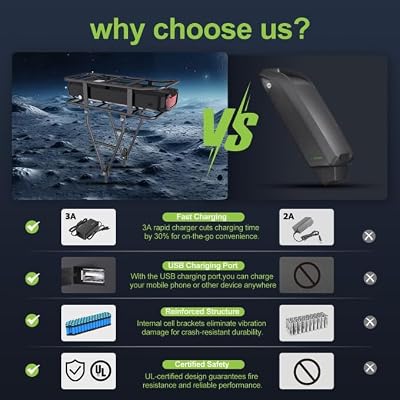
The bundle is the argument for this pack. A rack, a 3A charger, a tail light, a lock, keys and a fuse together would cost real money bought separately, and 874Wh on a rear rack is more capacity than most stock packs ship with.
Against that, the price per watt-hour is steeper than about three quarters of our table, both written reviews are warnings, the positive ratings have said nothing, and the return window is 30 days.
The decision this forces: this is a pack for a buyer who opens the box on day one. Check the voltage before the first charge, weigh the pack against the plausible 6.8kg, read the case stamp against the 18.2Ah title, and mount it within the return window so a fit problem is still returnable.
If that routine sounds like too much friction, the same money buys a lot of pack with a quieter record elsewhere on our table, and our review of the Varstrom 52V 25Ah sibling covers a higher-voltage option from the same brand. Riders building a kit from scratch should also read our conversion kit table, since this pack's fit list is written in kit brands.
Common questions about the bundle
Should I trust the 3.3-star rating?
Trust it less than it looks, in both directions. The 50 percent five-star band is entirely wordless, and both written reviews are one-star warnings from badged purchases. The rating tells you the returns and complaints are real, but it can't tell you whether the silent majority are satisfied or simply didn't write.
What should I check when it arrives?
Three things inside the 30-day return window. Read the output voltage before the first charge and don't charge below 20V, check the case stamp against the 18.2Ah title given the 17.5Ah row in the spec table, and weigh the pack, since about 6.8kg is the plausible figure for 874Wh.
Will it fit my kit and my rack?
The title names Bafang, Voilamart, PEXMOR and AW kits on an XT60 connector, but the conversion cable ships without a plug and one buyer's pack did not fit despite the claim. Confirm the rack dimensions of 476 by 165 by 380mm against your mounts, plan for the connector work, and test the whole assembly within the return window.