Shopping for a replacement Hailong pack means wading through listings that look alike and rarely say who built them. The Hplitebik 36V 15.6Ah Hailong battery is one of those, and it is also one of the thinnest listings we have covered: zero ratings, zero written reviews, no details table, no printed weight, and a UL claim in the title that no certificate on the page supports.
None of that makes it a bad pack. It makes it an unproven one, and the difference matters when a battery is a fire risk if it is built carelessly. What keeps this listing checkable at all is that most of its claims are arithmetic, and we have run all of it below.
The price side is ordinary. At 159.99 for 561.6 watt-hours, the pack sits close to the middle of the 324 batteries in our comparison table on price per watt-hour. You are not paying a premium for an unknown. You are paying a market rate for claims nobody has verified.
A record with nothing in it
The listing carries no ratings and no written reviews. Both review sort orders come back empty, so there is no owner report of fit, range, capacity honesty or support anywhere on the page.
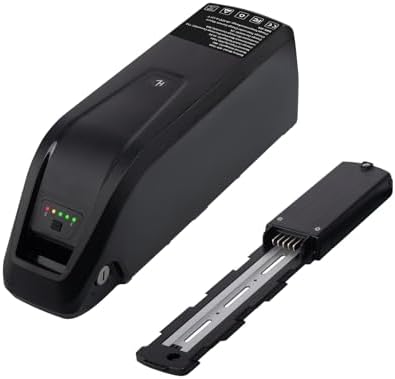
The listing also skips the details table most battery pages carry. There is no brand row, no model number, no warranty term, and no weight printed anywhere. The only concrete facts are the ones in the bullets and the gallery cards: a rain resistant case measuring 14.5 by 3.74 by 4.17 inches, a key lock, a 2A charger, an XT60 cable, two keys, a mounting plate, screws, and a 24 month service plan.
On a listing with a few reviews you can at least read around the praise and find the capacity complaints. Here there is nothing to read. The seller's word and your own arithmetic are the whole record, which is why the rest of this review stays on the page you can verify.
The headline that multiplies by the wrong voltage
The range bullet carries a bold headline: 748.8Wh of real range. The same bullet then says the cells store 561.6Wh. Both numbers cannot describe this pack, and the arithmetic says which one is honest.
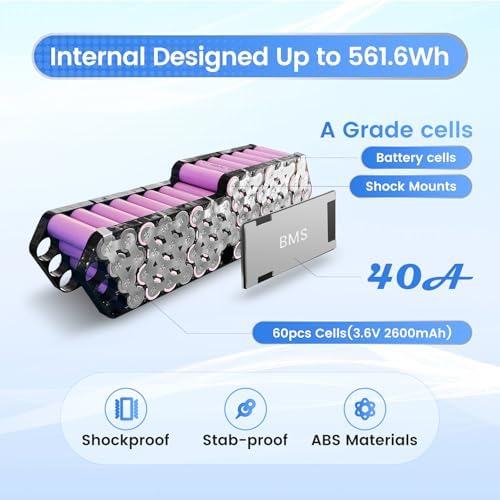
Multiply the pack's 15.6 amp-hours by its 36 volts and you get 561.6Wh. Multiply 15.6 by 48 and you get 748.8. The headline has done 48-volt math on a 36-volt pack, probably copied from a sibling listing's template. The parameter card in the gallery agrees with the smaller number twice, printing 540Wh and up to 561.6Wh, which is the same identity split between 15Ah and 15.6Ah that runs through the whole listing.
Plan range on 561.6Wh and never on the headline. The headline overstates capacity by a third, and a buyer who sized their commute on it would learn the truth on the first long ride.
The seller's own range estimate is 15 to 18 miles of pedal assist per charge. Divide 561.6 by those miles and the claim implies the pack gets drained at 31 to 37 watt-hours per mile, which reads like hard throttle use or hill riding. If your riding is gentler, the same capacity stretches further. Meter your own first ride rather than trusting either end.
Three motor ceilings on one page
The title advertises the pack for 750W, 1000W and 1200W motors. The fitment bullet says it feeds motors up to 1000W. The parameter card says 0 to 1400W. Three ceilings, one page, and none of them match.
The electronics settle it. The board is rated 40A continuous, and 40 amps at 36 volts is 1440W. The card's 1400W ceiling sits just under that board limit, so it describes what the battery can survive rather than what it is for. The title's 1200W sits inside the same envelope. The bullet's 1000W is the conservative reading.
Size your controller against the board, not the biggest number. A 1000W motor at full draw wants about 28 amps at 36 volts, which leaves headroom. A 1200W motor wants 33 amps, which is closer to the edge. If your controller peaks above 40A, this pack will cut power no matter what the title promises.
A UL claim with no certificate behind it
The title says UL-Certified. The first bullet expands on it: the cells, the 40A board and the housing are tested against the short circuit, overcharge and overheating faults behind most battery fires. What the page never provides is the proof. No standard number, no testing lab, and no certificate image appears anywhere in the bullets or the gallery.
Compare the ZLSHELIBK 48V 21.2Ah pack we covered on the same day, which prints two lab certificate cards with a lookup code a buyer can check. That is what a checkable certification looks like. A claim you cannot check is a sentence, not a certification.
Until a certificate surfaces, treat the UL wording as marketing. If the claim matters to you, ask the seller for the standard number and the certificate in writing before you order, and weigh the answer accordingly.
The math that slips, and the card that saves the listing
Two printed claims round the wrong way. The card promises a 7-hour recharge, but 15.6Ah into a 2A charger needs at least 7.8 hours, so the promise sits below its own floor. The card also claims 1500-plus cycles before capacity drops under 80 percent, while Wikipedia's lithium-ion entry puts the common chemistries at 400 to 1,200 cycles. The claim sits above the whole band, and with zero owner history there is nothing to test it against.
The listing's most useful image is a caution card, not a feature card. It reads, in effect, that this battery mount is different and cannot be replaced directly. That matters more than any range figure, because Hailong-style packs come in 4-pin and 5-pin base flavors that do not interchange. This pack feeds through a 5-pin base and an XT60 plug, and the seller's own ladder holds three 5-pin rungs and one 4-pin rung, so the flavor confusion is real. Our YLuBik 48V 15.6Ah Hailong review walks the base-matching method, and the UAZ 36V 20Ah pack covers the 4-pin side of the family.
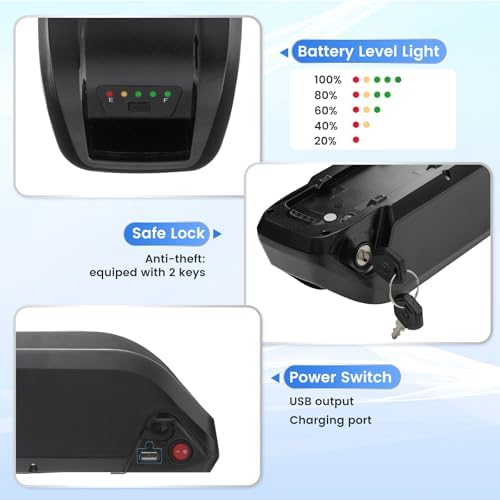
Measure your base plate and discharge connector before ordering, exactly as the listing's own reminder bullet asks. The gallery also shows a 5V 1A USB port for topping up a phone mid-ride, a battery level light with two anti-theft keys, and an application card that lists e-bike, scooter, tricycle and motorcycle.
What the cards never add is a weight, so the capacity-versus-weight sanity check we run on most packs is unavailable here.
Frequently Asked Questions
Will it fit my bike without changes?
Only if your base is the 5-pin flavor and your controller takes an XT60. The listing's own caution card warns that the mount differs from ordinary Hailong bases and cannot be swapped directly. Measure the base plate and the discharge points before you order.
How far should I plan on one charge?
Plan on 561.6Wh, not the 748.8Wh headline. The seller's own 15 to 18 mile estimate implies hard use, so gentler riding should stretch it further. Treat your first ride as the measurement that counts.
Is the UL certification real?
The page offers no standard number, no lab and no certificate image, so there is nothing to check. Ask the seller for the certificate in writing. Listings that have the paperwork usually show it.
Who does this pack make sense for?
A rider whose bike takes a 5-pin base, who needs a mid-price 36V pack, and who accepts that no owner has verified any claim on it yet. If you want owner evidence first, the UAZ 36V pack carries real reports, and the ZLSHELIBK pack carries checkable certificates.