A rider replacing a tired 36V pack wants three questions answered before money moves: will it fit the mount, will it feed the motor, and will it survive the season. This UAZ 36V 20Ah 4-pin shell answers the first one plainly with a 4-pin base and XT60 output, and it answers the second one three different ways, which is the problem this review works through.
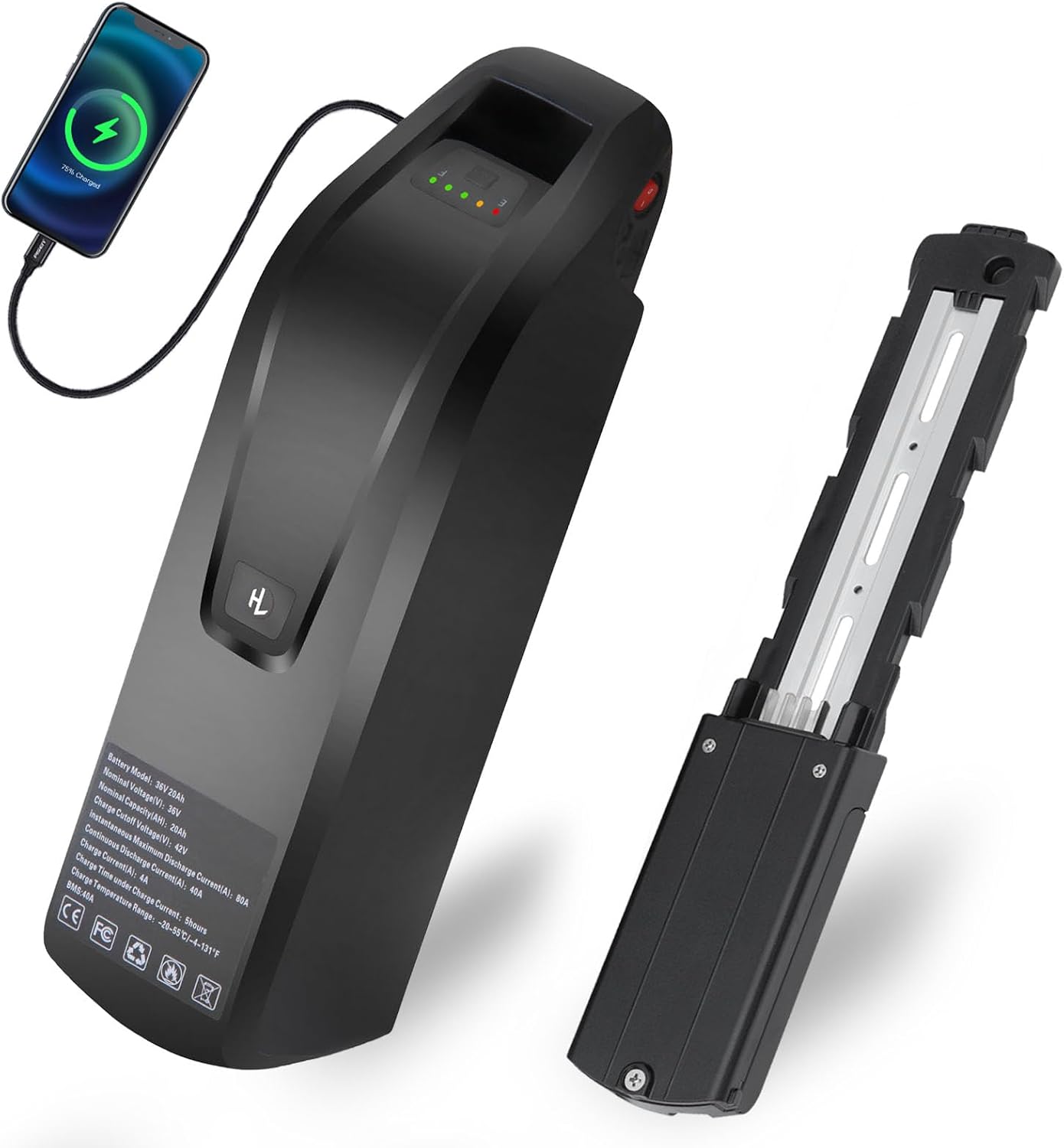
The pack holds 720 watt-hours in a Hailong-style case with a keyed lock, a USB port and an LED gauge.
The third question is where the page gets interesting, because the record behind this listing is not really this listing's record. I dug through the reviews, the spec table and the gallery cards, and most of what follows is about which printed number you can actually plan around.
One record, three shells
The 4.1-star average rests on 15 global ratings and 12 written texts, and the same record, word for word, appears on the 17.5Ah sibling listing we reviewed alongside this one.
Amazon pools reviews across variants of one parent listing, and this 4-pin family shares everything: the same histogram, the same dates, the same texts. Treat the record as evidence about the UAZ 4-pin family rather than a verdict on this exact shell, and read the family's fitment history as the real content of those 12 texts.
The histogram reads 68 percent five-star, 9 percent four, 9 percent three, no twos and 14 percent ones. Every text we captured carries a purchase badge, and the run spans May 31 to October 17 of this year, so the pool is recent and all of it comes from people who bought through this page.
Fitment and support dominate the criticism. One buyer's entire October text reads: The battery hada 4 pin nd my bike needed a 5 pin. That is the single most useful sentence on the page, and it costs nothing to act on.
In June, one buyer has reported ordering what they thought was a spare and receiving a replacement their bike could not use, with the refund still missing more than a month later. A third owner has described a pack that never took a charge across two days on the charger and went straight back.
The useful positive comes from an Ecotric Fat Tire owner, who has found the pack slots onto the existing hardware with no adapter work and charges slowly, at around seven hours.
Another rider has noted the case runs bulkier than the original battery on their bike while praising the pickup and range. Both notes point the same way as the family's own bullet: measure your mounting space before ordering, because this is a full-size downtube shell.
Three power ceilings and the smallest one wins
The listing cannot settle on how much motor this pack feeds. The title says 250 to 1500W. The 50A BMS bullet says motors up to 1200W.
The details table's Amperage row says 30, with no unit qualification beyond the number itself.
The arithmetic sorts them. A 1500W motor at 36V draws about 41.7A, and a 1200W motor draws about 33.3A. Both figures sit inside a 50A board and both sit above a 30A one, and a 30A board at 36V caps at 1080W.
So the three printed ceilings are really two stories: either the board is 50A and the title's 1500W is the honest top end, or the details row is right and the true ceiling is 1080W.
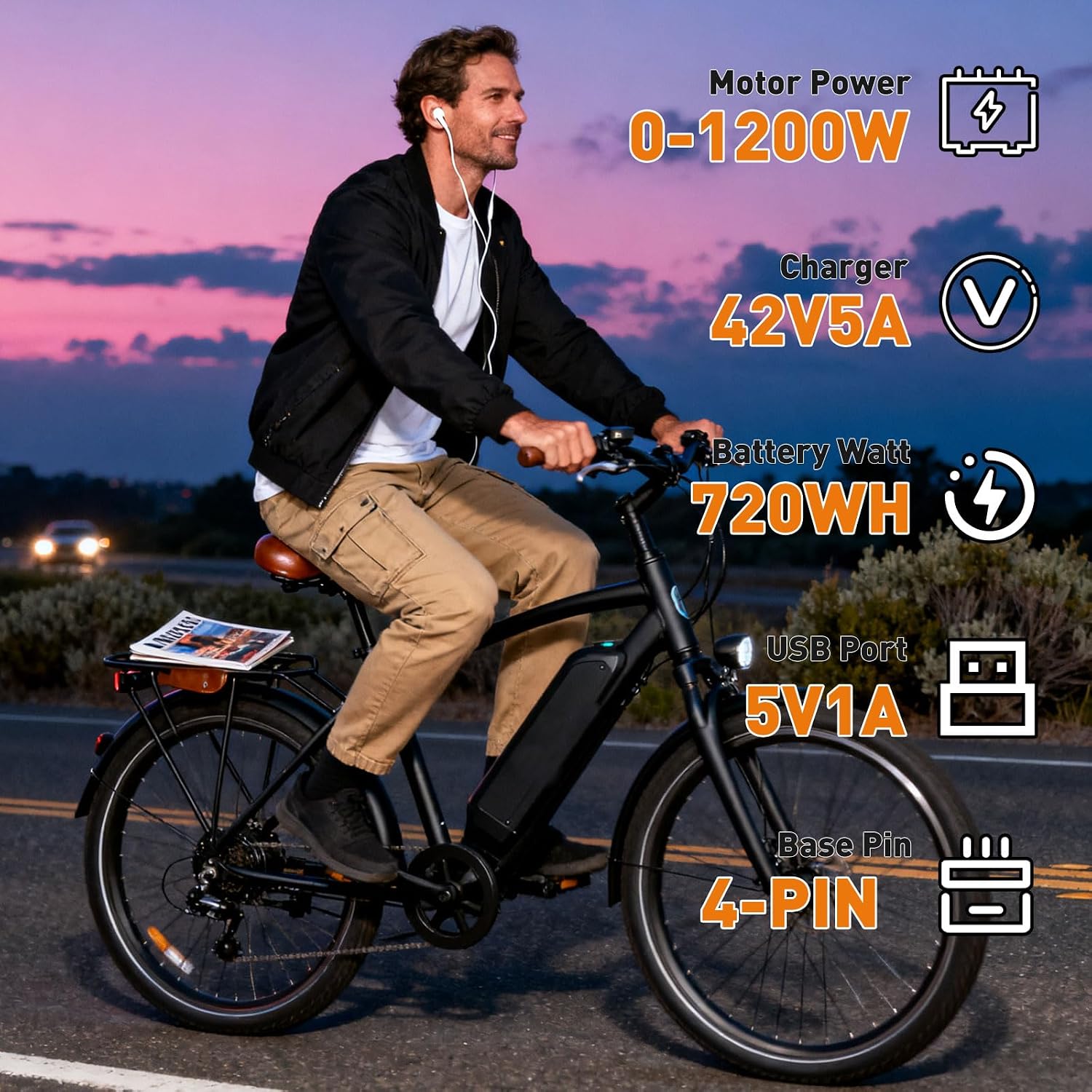
I'd plan around 1080W until a seller confirms the board size, because that figure keeps you safe under every number the page prints. A 750W or 1000W motor draws about 21A to 28A at 36V and fits either story with room to spare. The gallery's own BMS card lists six protections, overcharge, over-discharge, over-current, short circuit, over-temperature and overload, so the board exists and takes its job seriously. The question is only its amperage, and the label on the board that arrives settles it.
Weight, range, and a ten-hour charge
The printed weight closes cleanly, which deserves a note because so many listings in this market fail that check. The details table says 12 pounds, about 5.4 kilograms, for 720 watt-hours. Wikipedia's lithium-ion page puts standard cell chemistry in a band that leaves the bare cells of a 720Wh pack needing between 2.4 and 4.5 kilograms.
The printed weight leaves a kilogram or more for the case, the board and the wiring, which is exactly the honest direction. Weigh the box on arrival anyway, but nothing on this page asks you to disbelieve the scale.
The range claim decodes sensibly too. The bullet promises roughly 20 to 35 miles per charge in moderate temperatures, and 720Wh over that span works out to about 21 to 36 watt-hours per mile. That band covers everything from brisk throttle-only riding to careful mixed pedaling, so the claim is realistic if you plan on its lower half.
For mixed riding with real pedaling, our usual planning figure sits near 20 to 25 watt-hours per mile, which lands you at the bottom of their range or slightly past it.
Charging is the vaguest corner. The card shows an XLR charging port and the page never prints a charger amperage, and there is no in-box list to say whether a charger ships at all.
At a common 2A charger, 20 amp-hours needs at least ten hours. The Ecotric owner's seven-hour report suggests either a bigger brick or a partial top-up from a half-empty pack. Read the label on whatever arrives and plan an overnight charge either way.
Fitment decides this purchase
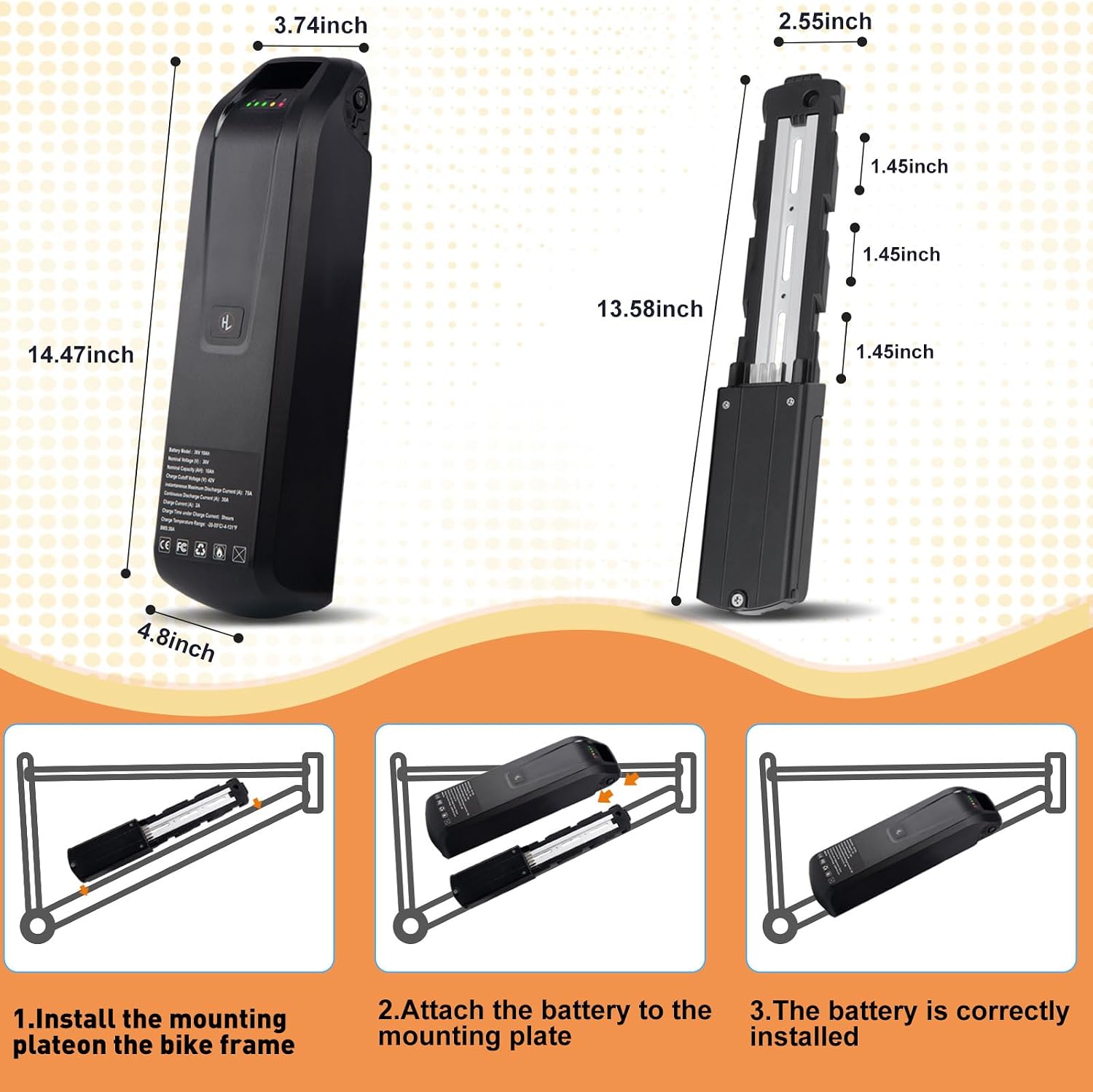
Everything practical about this family comes down to the base and the space behind it. The 4-pin base carries the power and communication pins, and the battery measures 14.47 by 3.74 by 4.8 inches with a 13.58 by 2.55 inch foot that bolts to a mounting plate on the frame.
If your bike's current pack is a Hailong-style shell with a 4-pin base, this drops straight on, which is what the Ecotric owner's report describes. If your bike speaks 5-pin, the same brand sells a 5-pin version we have reviewed, and forcing the wrong base is the exact mistake one October buyer made.
The convenience features are real and worth naming. The keyed safe lock holds the pack to the frame, the LED gauge decodes in bands from a single red at 20 percent up to one red, one orange and three green at full, and the USB port tops up a phone from the pack itself.
A power switch sits between the battery and the output so the pack can be parked without unplugging anything. None of that is fancy, but it is the full feature list a commuter actually touches, and the cards document each one.
The decision this shell forces is narrow and honest. If your bike takes a 4-pin Hailong-style pack, your controller is 36V, and your motor stays at or under 1000W, this listing fits on every printed figure with the 1080W ceiling as your safety margin. If any one of those three fails, the same family probably holds your rung: the 17.5Ah shell for tighter mounts, the smaller capacities for lighter bikes.
The 1500-cycle promise and the small print
The durability claim is the one number I'd discount. The bullet promises 1500-plus charge cycles, and Wikipedia's cycle durability figure for lithium-ion chemistry runs 400 to 1,200 cycles. The listing names no cell model and no test conditions, so the claim sits above the top of the standard band with nothing behind it.
Expect the low end of the standard band rather than the promise, and the pack still pays for itself.
The warranty story has the same split-personality problem as the power figures. The details table says a 1 Year warranty.
The support bullet says 3-month replacement coverage plus 12 months of technical support, which is a different thing. A year of warranty and a year of technical support are not the same promise, and neither is three months of either. Ask the seller which applies before you order, and let the return window be your real first-year warranty on any pack in this market.
On value, the pack sits close to the middle of the 324 batteries on our price-per-watt-hour table, and the specs box beside this review renders the live comparison as prices move. The 17.5Ah sibling costs less up front and lands a little higher per watt-hour, so the 20Ah rung is the family's better value if your frame accepts the deeper case.
Frequently Asked Questions
Will the UAZ 36V 20Ah fit my bike?
Three checks: your controller must be 36V, your current pack must use a 4-pin Hailong-style base or accept one, and your mounting space must clear 14.47 by 3.74 by 4.8 inches. One buyer in the pool missed the pin count and their bike needed 5 pins, so count the pins on your pack before ordering.
How long does the UAZ 36V 20Ah take to charge?
Plan on at least ten hours at a common 2A charger, longer from empty. The listing never prints its charger's amperage, and one owner has reported around seven hours, which suggests a larger charger or a partial top-up. Read the label on the brick that ships.
Why do the same reviews appear on the 17.5Ah listing?
Amazon pools reviews across variants of one parent listing, and this 4-pin family shares one pool of 15 ratings across its 20Ah, 17.5Ah and 48V rungs. The texts tell you about the family, not about one shell.
What happens if it arrives dead or wrong?
Two of the twelve texts describe exactly that: a pack that never took a charge and a wrong-item replacement with a slow refund. Both buyers went through returns. Check the pack and its pin count on arrival, test a full charge inside the return window, and keep the packaging until you have ridden on it.
Is the 1500-cycle claim believable?
Treat it as marketing. Standard lithium-ion cycle durability runs 400 to 1,200 cycles, the listing names no cell model, and no conditions are stated. Even at the bottom of the standard band, a 720Wh pack cycled a few hundred times covers years of commuting.