Replacing a bike's original battery is easy when you can still buy the original. It gets hard when the maker charges a premium for the replacement, keeps it out of stock, and leaves you shopping the aftermarket with a tape measure. That is the situation one buyer describes in the only substantial owner report on this listing, and it is the reason this pack exists at all.
The YLuBik 48V 15.6Ah Hailong battery sells at 199.99 with a 40A board, a 4-pin base and a five-star score carried on just four ratings.
This review reads that thin record against the printed page, because with a record this small the listing is most of the evidence. The page turns out to argue with itself about one number that matters, agree with itself about the ones that protect you, and explain the base connector better than most listings of this style bother to.
Two texts, and one of them earns its keep
The whole written record is two texts under four ratings, with two more ratings carrying no words. One owner has spent weeks searching for a battery that would slot into a Qlife Racer Plus 2.0 without changing the base, so the stock pack could still swap in, and reports spending about an hour comparing photos before buying.
The fit worked: the pack sits on the stock cradle, and the owner kept both batteries in rotation. The same text carries the economics that made the search worth it, because the bike maker's own 15Ah replacement sells for 500 and is rarely in stock.
The second text is a two-day arrival note with no purchase badge behind it. That is the entire record. Nobody states a range per charge, nobody has owned this pack through a season, and nobody has put the 800-cycle claim to any kind of test.
With counts this small, a five-star average is a fact about the first four buyers, not about the pack, and the page's deep sales rank in the powersports category says the buyer pool is still tiny.
Matching the base: the 4-pin question
This is the part the listing does well, and it is worth quoting the logic even though we will not quote the words. This battery style ships in two base flavors, 4-pin and 5-pin, and they do not interchange.
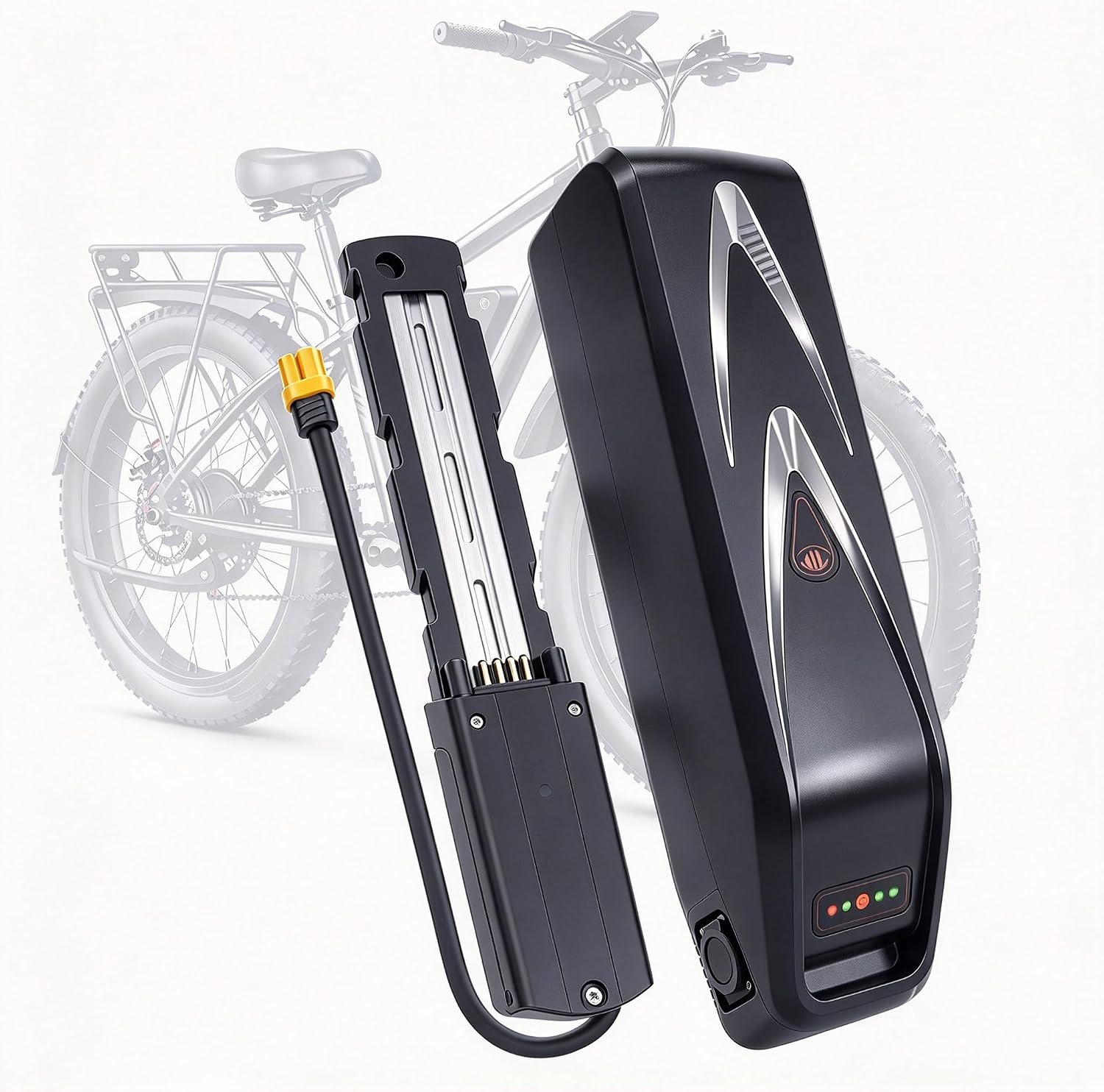
The bullet spells out that the original base on this design uses a 4-pin connector rather than a 5-pin one, gives the pack's footprint as 15.4 by 3.8 by 4.2 inches, and tells you the base comes pre-installed with an XT60 discharge lead.
The details row agrees with the bullet on size, printing 15.35 by 3.82 by 4.21 inches, so the two sources of dimensions on the page match. If you are replacing a dead or lost pack, measure the old one and count the pins before you shop, because a half-inch of length or one pin of difference is the line between a slot-in swap and a bracket you have to fabricate.
The Qlife owner's account is the proof this page's dimensions can be trusted on a real cradle.
Four weights on one page
The listing prints the pack's weight four times, and the numbers do not travel together. The bullet says 9.48 pounds.
The gallery's parameter card says 4.5 kilograms, which is 9.92 pounds. The details rows say Battery Weight 7.1 pounds and Item Weight 7.05 pounds. The bullet and the card sit about half a pound apart, while both details rows sit more than two pounds under them.
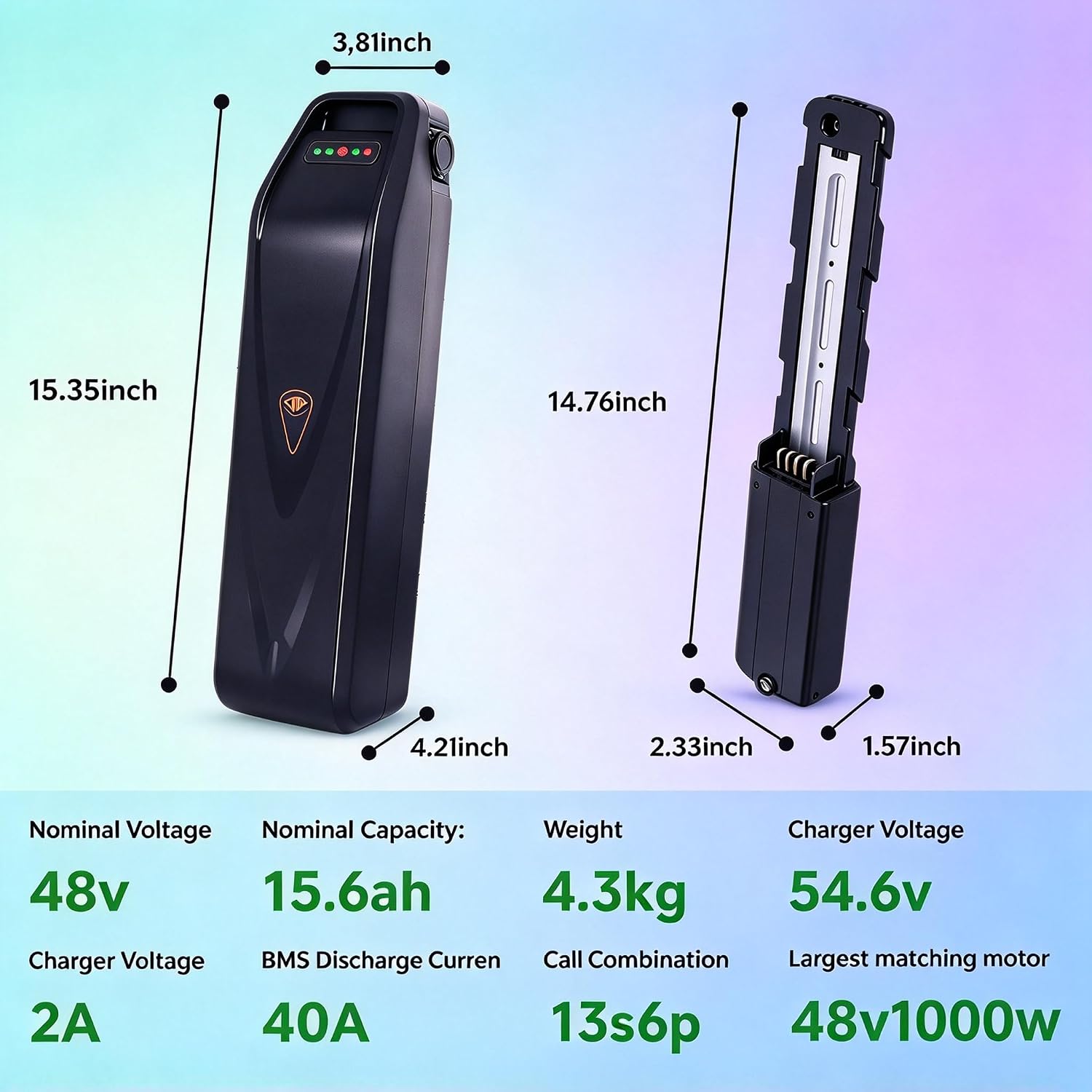
The arithmetic says which cluster is plausible. The pack's capacity is 748.8 watt-hours, from 48 volts times 15.6 amp-hours, and the standard specific-energy band for lithium-ion runs 0.16 to 0.30 kilowatt-hours per kilogram. At the bullet and card weight of about 4.3 to 4.5 kilograms, the pack lands at 0.17 kilowatt-hours per kilogram, mid-band and consistent with a 13S6P layout in a Hailong case.
At the details rows' 3.2 kilograms, it would need 0.23 kilowatt-hours per kilogram before any case, board or wiring, which is top-of-band chemistry in a budget shell. Plan around the heavier number, weigh the box on arrival, and treat the light rows as the kind of copy-paste drift this price class produces.
Power, charging, and the cycle claim
The board is 40A, printed in the title and on the parameter card, and the card names the largest matching motor as 1000W. The numbers hold together: 40 amps at 48 volts is a 1920W ceiling, so a 1000W motor at full load draws about 21 amps, comfortably inside the board.
The 13S6P layout means 13 cells in series and 6 wide, about 2.6 amp-hours per cell, and the charger's printed 54.6 volts is 13 times 4.2, so the cell count, the chemistry and the charger all agree with each other.
Charging gets no promise on the page, which turns out to be a virtue. The card prints a 2A charger, and 15.6 amp-hours at 2 amps is a 7.8-hour floor, so plan on an overnight charge and treat any same-evening full-charge claim from this class with suspicion.
The cycle claim of more than 800 cycles with over 80 percent capacity kept sits inside the 400 to 1,200 band that chemists accept for this chemistry, but it is a factory promise, and at this listing's sales depth no buyer has come close to testing it.
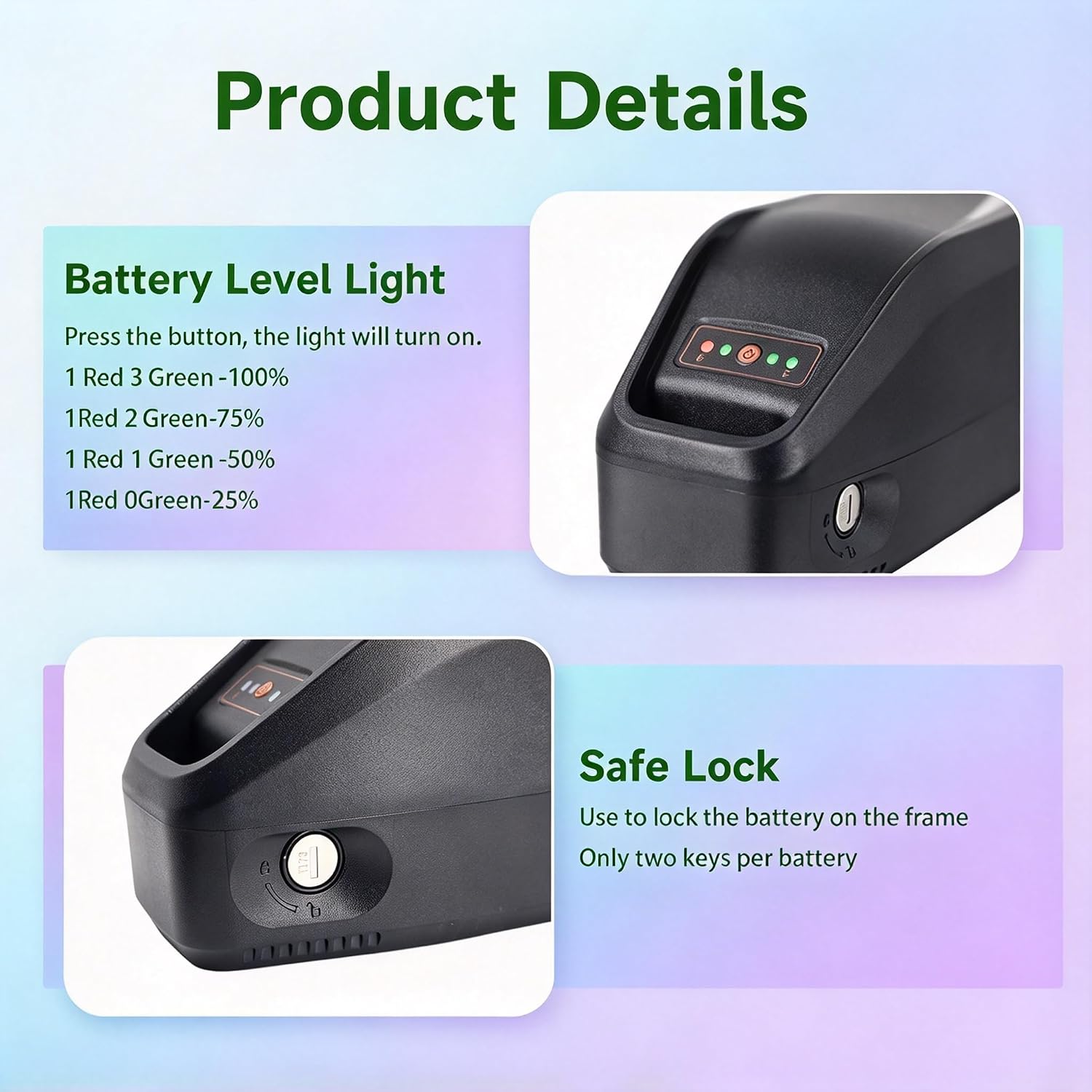
The LED gauge on the case reads out in four steps from one red and three green down to one red and none, and the pack locks with one of the two included keys.
At 199.99 for 748.8 watt-hours, this pack costs about 27 cents per watt-hour, close to the middle of the 324 packs we track, and the live position sits on the comparison table. It is the second YLuBik shell we have covered this month, alongside the larger YLuBik 48V 20Ah pack, and the two share the brand's habit of printing specs that mostly survive checking.
The three-month question
The warranty row reads 3 Months Manufacturer, which is the short end of a category where one year is common and the best listings print three years. A pack's most likely failure points show up early, so a three-month window does cover the dangerous first weeks, but it covers nothing about the capacity fade the cycle claim promises against.
The details table also carries the usual junk rows, including one that says 32 AAA batteries are required and another that names the pack both 15.6Ah and 18.2Ah on a single line. Neither inspires confidence in the row underneath them.
Frequently Asked Questions
Will it fit my bike without changing the mount?
Only if your original base is the 4-pin type and the old pack measured about 15.4 by 3.8 by 4.2 inches. Measure and count pins first. One owner has confirmed the fit on a Qlife Racer Plus 2.0 stock cradle, and that is the only confirmed bike so far.
How long does it take to charge?
Plan around 8 hours with the printed 2A charger, and expect a bit more with the taper near full. The listing makes no charge-time promise, so there is nothing printed to contradict the math.
Is the five-star record trustworthy?
It is four ratings and two texts, one of which is an arrival note. Read it as an early record that contains no failure reports yet, not as proof of long-term durability.
Who is this pack for?
Riders with a 4-pin Hailong-style bike, up to about 1000W, who need a stock-looking replacement and can accept a three-month warranty and a thin record. The printed numbers mostly hold together, and the one deep owner report is a fit success.