Big-capacity packs live or die on two questions a listing cannot settle by itself: whose cells are inside, and whether the printed numbers survive contact with a charger. This listing answers the first question in its title and leaves the second one to arithmetic.
The ZLSHELIBK 48V 21.2Ah battery sells at 299.99, ships with a 4A charger, and carries one of the smallest written records we have covered: five texts under eight ratings.
That small record is worth reading closely, because one of the five texts is different in kind from the rest. Four are short owner reports from buyers whose purchases show on the page.
The fifth is an unverified account saying the writer contacted Samsung and found no supply chain path from Samsung to the company that makes this pack. This review walks through that dispute, then through the charger math, the weight arithmetic and the certificate cards, because those are the places a factory-direct listing usually gives itself away.
A small record with one loud dispute
Four of the five texts are purchase-badged and short. One owner has put about 50 miles on an MX350 build across two charges, watching a bar drop on the throttle screen before plugging in, and calls the performance amazing. Another owner has replaced an original scooter battery with this pack, ridden close to 100 miles, charged it a few dozen times, and reports no drop in performance at all.
The two remaining texts are a one-line note that the seller helped with a mistake, and a two-word verdict. Nobody states a range per charge, nobody has owned one through a winter, and nobody has come close to the 1500W ceiling the title sells.
The fifth text is the newest one on the page, posted in October 2026, and it carries the only two-star score in the histogram. It is not purchase-badged. Its whole case is about the cell brand, which makes it the hinge this review turns on.
The Samsung question
The title reads Samsungcell, in one word, as a selling point. The details table names the manufacturer as Dongguan Batterysea Energy Co., Ltd, a Shenzhen-area pack maker that most buyers have never heard of. Those two facts sit together on every factory-direct listing that borrows a famous cell name, and they deserve unpacking rather than a shrug.
Samsung SDI is one of the largest cell manufacturers on earth, ranked among the top suppliers worldwide, and its cells reach pack builders through distribution agreements with real paperwork behind them.
A company buying genuine Samsung cells can usually name the cell model, the format and the supplier on request. This page does none of that. It never states the parallel count, never names a cell model, and the only cell information anywhere is the word Samsung in the title.
The challenge text says the writer contacted Samsung directly and found no supply chain source for this maker. Treat that with care, because it is unverified and it is an accusation, and a buyer's phone call to a cell giant is not a document we can check. What we can say is which side the burden sits on.
A cell-brand claim is easy for a seller to prove and hard for a buyer to disprove, so the useful move is to flip it: ask the seller, before you order, for the cell model number stamped on the wrap. The case arrives glued and sealed, so after delivery the claim stays a claim unless you cut the wrap open, and that settles the argument at the cost of the pack.
What the 13S decode adds
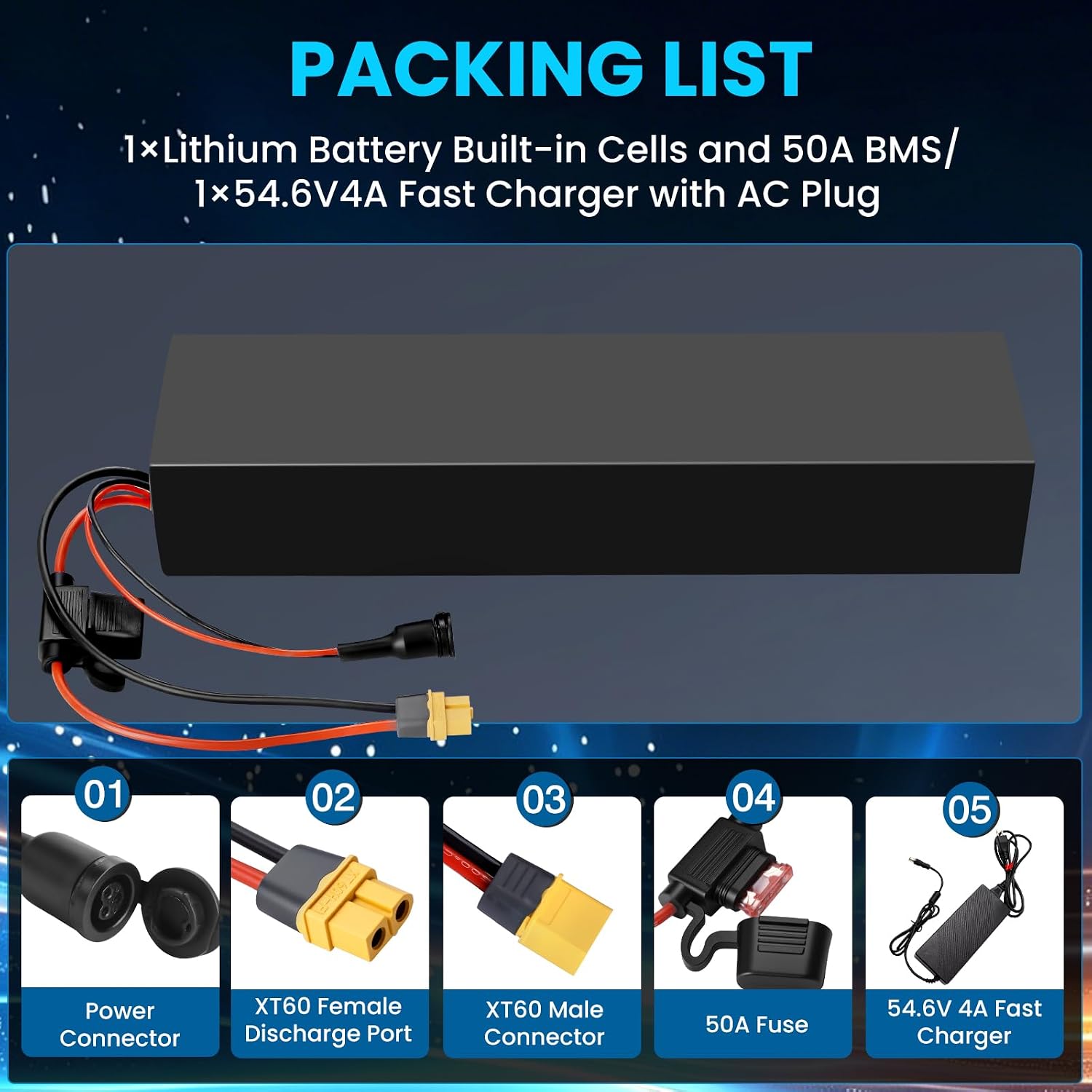
The charger answers one structural question. The box card lists a 54.6V charger, and 54.6 is 13 times 4.2, so the pack is 13 cells long.
Twenty-one point two amp-hours over 13 series groups means about 1.63 amp-hours per group, which fits cells of about 3.3 amp-hours run two in parallel. The page never confirms the layout. A genuine 21700-class Samsung cell would fit that arithmetic, and so would a cheaper cylinder, which is exactly why the model number matters more than the brand word.
The five-hour promise and the 4A charger
Both the bullet and the details row say the pack recharges in about 5 hours.
The box card says the charger runs 4 amps. Twenty-one point two amp-hours at 4 amps is 5.3 hours before any taper, and lithium charging slows near the top, so a real full charge runs longer than the floor, not shorter. The printed promise rounds below its own arithmetic, which is the optimistic direction sellers choose when nobody checks.
One owner has reported a related puzzle: the charger's indicator has not reached green after charging for a while, and the seller question was still open when we read the page. We do not know how that resolved, and the review will not pretend otherwise. If you buy this pack, time your first full charge against the 5.3-hour floor and see which side of it the charger lands on.
The weight arithmetic holds, barely
The bullet and the details table agree on 9.81 pounds, which is 4.45 kilograms. At the standard band for lithium-ion chemistry, Wikipedia's specific-energy range runs 0.16 to 0.30 kilowatt-hours per kilogram, so 1017.6 watt-hours of capacity needs between 3.4 and 6.4 kilograms of bare cells before the case, board, fuse and wiring add anything.
At 4.45 kilograms this pack lands at 0.229 kilowatt-hours per kilogram, near the top of the band, which leaves about a kilogram for everything that is not cells.
That is a tight reading, not an impossible one. Pack builders at the top of the band exist, and the figure at least agrees between the two places the page prints it. We have covered listings this month whose weight rows were off by a factor of three, and against that company this page looks honest.
Weigh the box on arrival anyway, because the arithmetic only tells you what the weight should be.
Certificates, water claims, and the fuse
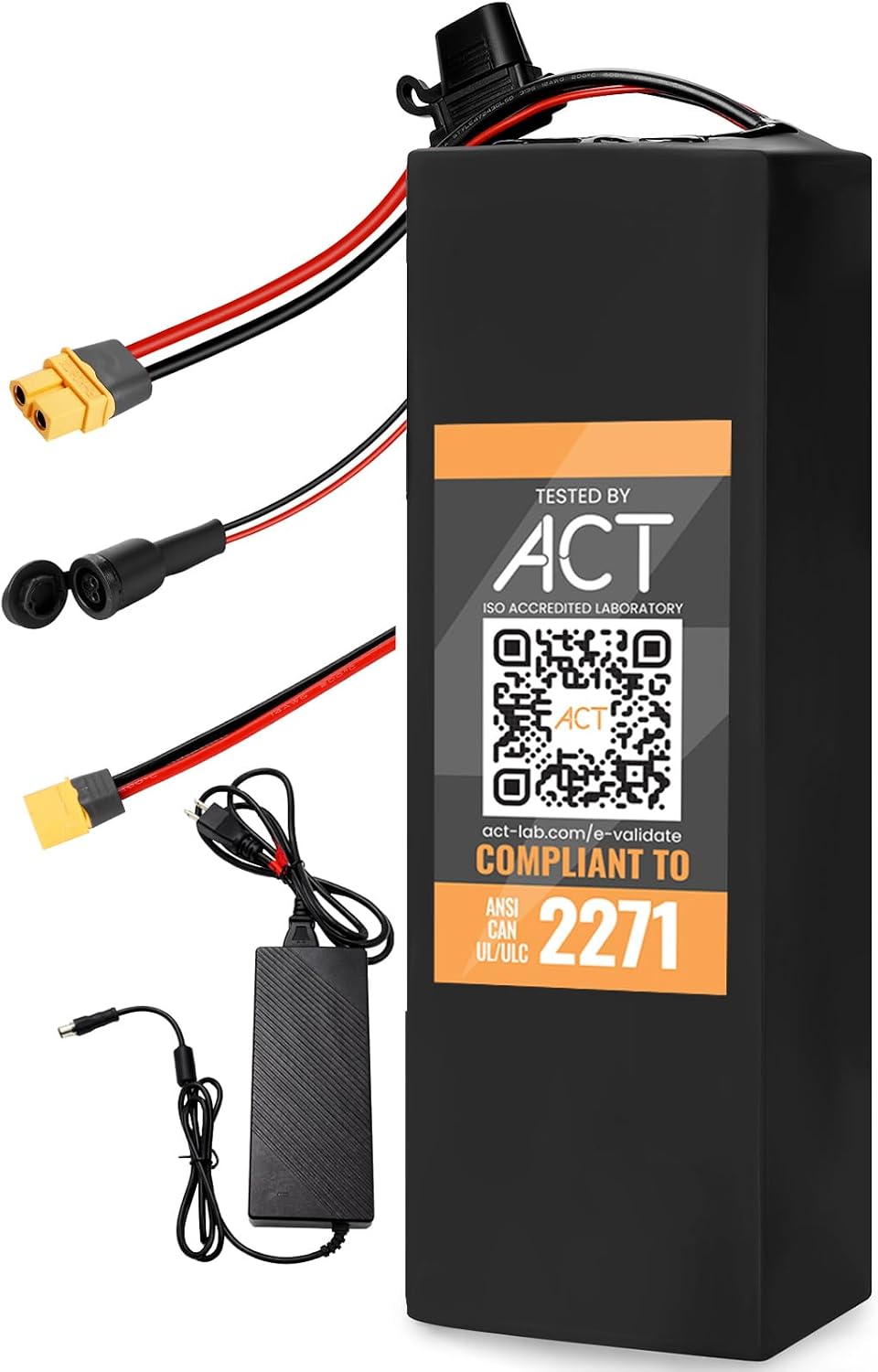
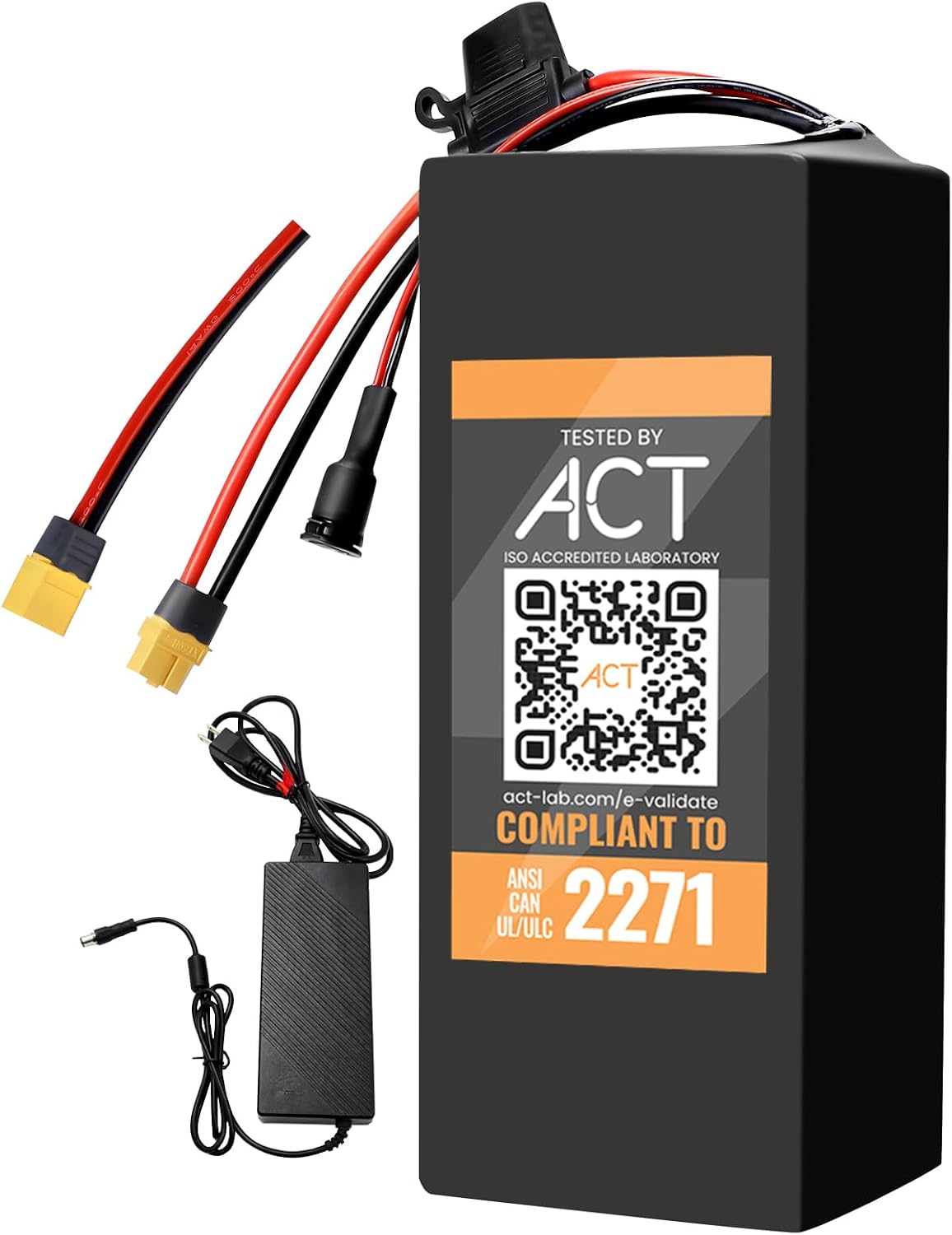
Two gallery cards carry ACT lab test records, one showing the lab's own compliance mark and another pointing to the lab's e-validate lookup with the 2271 standard printed alongside. That is more support than most listings offer for a UL claim, and the lookup path means you can check it yourself rather than trusting the picture.
The details row lists CE, FCC and UL as met standards, and the title's misspelling of certified does not change what the cards show. Treat the certificate as checkable and check it.
The water claim needs a colder eye. The bullet says IP67, which is the submersion class, and grounds it in sealed PVC soft layers.
A wrapped pack shrugs off rain and splash, which is what every rider actually needs, but the one-meter immersion test is a long way from a PVC wrap, and no buyer has tested it publicly. Keep this pack out of deep water whatever the print says.
The board arithmetic is the honest direction. Fifty amps at 48 volts supports 2400 watts, so the title's 1500W ceiling draws about 31 amps at full load, well inside the printed board, and the added 50A fuse gives the wiring a second line of defense. The cycle claim of over 1,000 sits inside the 400 to 1,200 band chemists accept, at the top edge.
At 299.99 for 1017.6 watt-hours, the pack costs about 29 cents per watt-hour, which puts it in the more expensive half of the 324 packs we track, and the live position sits on the comparison table.
This is not the first ZLSHELIBK pack we have covered, and the brand's older 48V 17.5Ah listing shows how much these pages change between generations. The ladder behind this one holds six rungs from 36V 10.6Ah up to this 21.2Ah shell, and a 48V 15.9Ah rung sits on the same ladder if your motor is smaller.
Frequently Asked Questions
Does it really use Samsung cells?
Nobody outside the seller can confirm it from the listing. The page names no cell model, no parallel count and no supplier paperwork, and one unverified text says the supply chain does not connect. Ask for the cell model in writing before you order.
How long does it actually take to charge?
Plan around 5.3 hours at the printed 4A rate, and expect longer with the taper near full. The 5-hour claim on the page rounds below its own floor.
Can I trust the UL 2271 certificate?
The gallery carries ACT lab cards with a lookup address, which is more than most listings show. Look the certificate up through the lab's own validation page rather than trusting the card picture.
Who is this pack for?
Riders running 1000W to 1500W scooters or builds who want a big pack and accept a young record, a one-year warranty, and a cell-brand claim they should verify in writing first. The owner reports so far are short but positive, and the dispute text is unverified.