1200Wh of LiFePO4 at a recorded 229 and 19 cents per Wh sat under the class floor, and the ASIN is now retired while the live family continues at 259 with the 50A variant. The recorded title carried a "40A/50A BMS" ambiguity that decides whether sustained 1500W pulls are safe, and decoding it is the article. 1500W-class builders who verify the board before they buy win here.
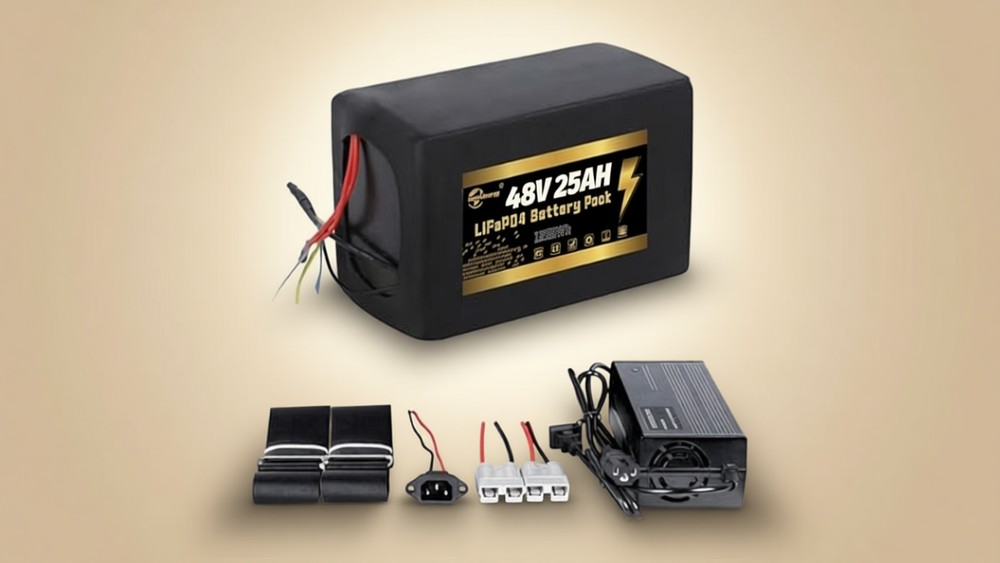
The 40A slash 50A question, decoded by the family
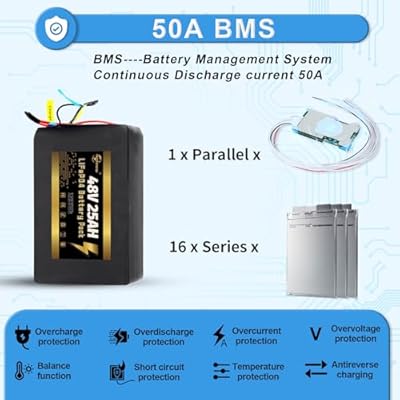
The retired listing said "40A/50A BMS" without saying which board sits inside the case. The live family line resolves it: the 40A board pairs with the 0-1200W motor range, and the 50A board pairs with 0-1500W. The arithmetic matters because the boards are not interchangeable for high-draw builds. Forty amps at 48V is about 1920W continuous, and the 50A board reaches about 2400W.
Pick the 40A board for a motor that demands sustained 1500W and the BMS will trip on the first long climb, because the board protects itself from a draw it cannot feed. That failure looks like a dead bike mid-ride, and it reads as a defect when it is actually a spec mismatch. The 50A variant carries the headroom that heavy builds need.
So the buying rule is one sentence: match the board to the sustained motor draw, not to the price. The 40A variant is fine for 1000-1200W builds and costs less. The 50A variant is the only honest choice at 1500W, and the live listing is the one that carries it.
The 16S1P voltage story and the range math
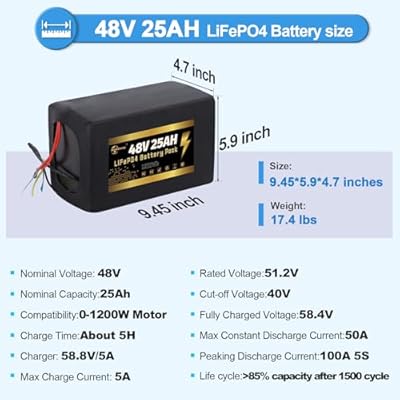
The pack is labeled 48V or 52V, and the internal 16S1P build explains both labels: sixteen cells in series hit 58.4V at full charge, then settle toward 3.35V per cell. Strict 48V controllers cap below that ceiling, so the high-voltage check comes before the purchase, not after the first fault.
The 1200Wh capacity yields about 1020 usable watt-hours at the 85% rule. Pedal assist at fifteen to twenty-five watt-hours per mile covers between forty-one and sixty-eight miles. Throttle-heavy riding at thirty to forty Wh per mile drops the band to twenty-six through thirty-four miles. Hills, load, and cold pull both numbers down.
Those bands put this pack in the weekly-charge class for most commuters. A ten-mile-each-way rider gets most of a working week from one overnight fill, and even a 25-mile-each-way commuter finishes a day without a midday top-off. The 16.75 pounds are the cost of that independence, and the external mount means the weight lands where your rack or bag puts it rather than inside the frame.
The chemistry claim deserves its nuance: 1500-plus cycles is credible for LiFePO4, but with no cell brand named, discount it toward twelve hundred. The external box weighs 16.75 pounds at 9.25 by 5.7 by 5.1 inches, so measure the bay before ordering. That weight is the toll, and the cycle count is the payoff.
The value case: 19 cents per Wh for LiFePO4
The retired listing's 229 put LiFePO4 at 19 cents per watt-hour, below the class floor, and the live 50A variant now lists at 259. The deal moved but the family continues, which is the better outcome than a full storefront exit. The verification steps carry over: board amperage in writing, the 58.4V controller check, and a return window that protects the first month.
The price move also tells you where this class is heading. LiFePO4 keeps getting cheaper as cell supply grows, and a 19-cent recorded price that looked like a one-off is now within a few dollars of the live listing. For buyers, that means the price gap between LiFePO4 and NMC is closing, and the cycle-life argument for LiFePO4 is getting cheaper every quarter. A pack bought today at 259 competes with NMC packs that cost the same and last half as long.
The owner record is thin on both sides of the retirement. The old pool is unverifiable, and the live variant shows eight ratings at 4.4, which is a start rather than a track record. You're betting on the chemistry, which is the most trustworthy part of the spec sheet, while the seller's history stays the open question.
There is a charging-culture note that protects the cycle claim. LiFePO4 tolerates sitting at full charge better than NMC, but weeks at the ceiling still age cells, and a 3.35V settle after charge is the chemistry behaving normally, not a defect. Charge to full the night before rides, store between sixty and eighty percent when the bike sits, and the 1500-cycle claim has a real chance. A pack cycled shallow and stored mid-band is the one that reaches its rated life.
Who should buy it, and who should spend differently
Buy it if your build runs 1200-1500W on an external mount, you want LiFePO4 cycle life at the 25Ah size, and you will verify the board amperage and the 58.4V cutoff before ordering.
Skip it if your frame bay is narrower than 9.3 inches, if you ride weekly and don't need 1200Wh, or if you need sustained 1500W and the listing you're looking at only states the 40A board. The BtrPower 48V 30Ah LiFePO4 decodes the same 16S1P family math, the BtrPower 48V 50Ah doubles the capacity, and the Hawkvium 52V 25Ah is the certified NMC alternative with a bigger BMS. Sort the whole field on the battery table and check the current 48V 25Ah LiFePO4 listings.
Frequently Asked Questions
Which BMS do I need?
The 40A board suits 1200W builds at about 1920W continuous. The 50A board handles sustained 1500W at about 2400W continuous, and it is the honest choice for high-draw builds.
Is this a 48V or 52V battery?
It's one 16S1P pack that reaches 58.4V at full charge, so both labels apply. Verify your controller accepts that voltage before ordering.
How much range will I get?
Between 41 and 68 miles on pedal assist, or 26 to 34 miles throttle-heavy, from the 85% usable rule and standard consumption bands.
How many cycles does the battery last?
The family claims 1500-plus, which the chemistry supports. With no cell brand named, discount toward twelve hundred for planning.
Where can I buy this pack now?
The live family line carries the 50A variant at 259. Check the board amperage in writing before you buy, because the two variants are not interchangeable for 1500W builds.
What charger does it use?
The family ships a charger matched to the 16S LiFePO4 stack, and the listing states the charge behavior in the voltage notes. Stick with the matched charger, and if you replace it, match both the voltage and the connector before you plug anything in. A charger built for NMC packs will undercharge this chemistry, and one built for a different series count can damage it.