Some listings earn trust with a deep record. This one asks you to buy on almost none of it, and it's worth understanding exactly what that means before you decide.
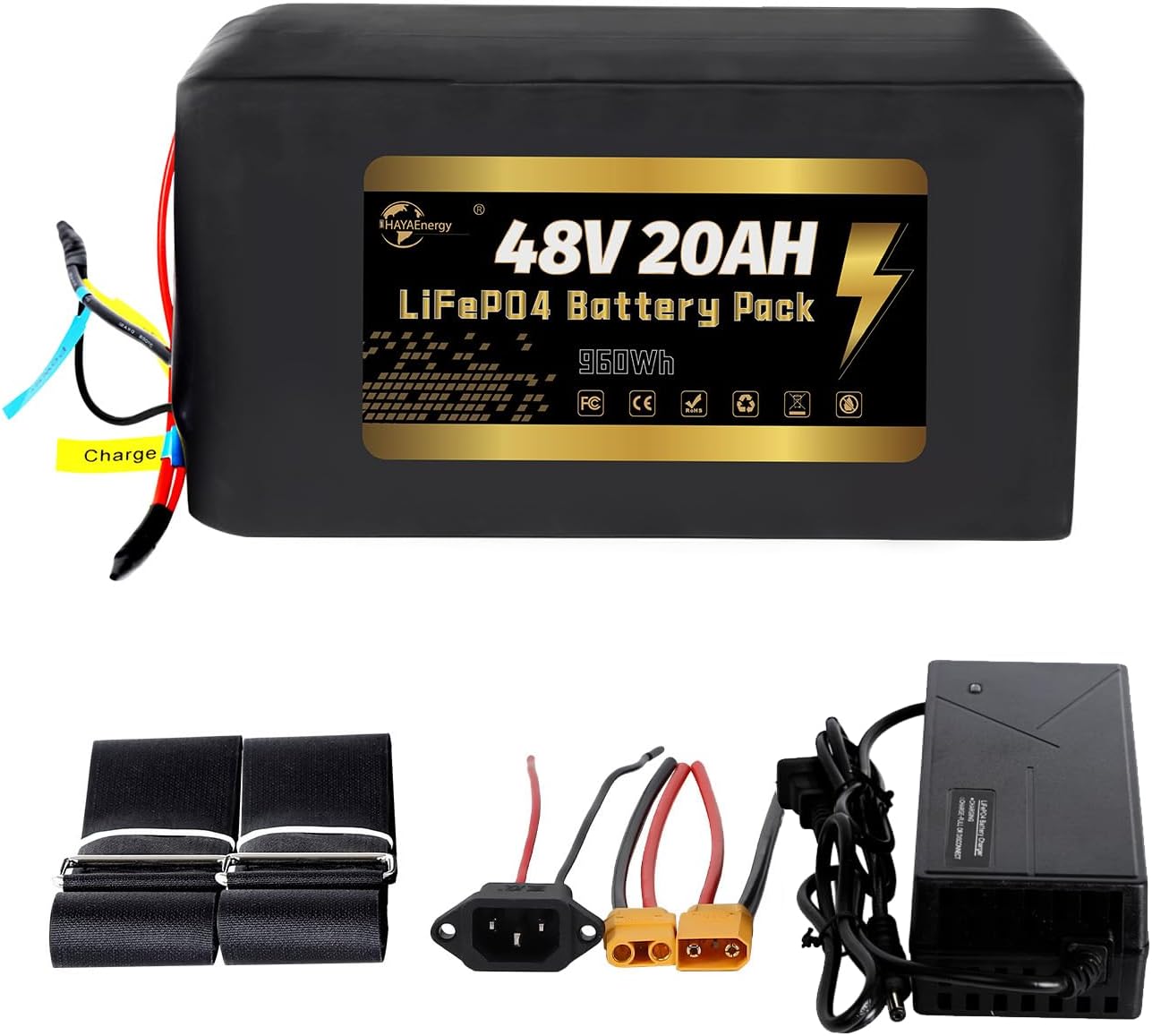
The HAYAEnergy 48V 20Ah LiFePO4 pack sells at 186.00, prints 5.0 stars from two global ratings, and carries no written reviews at all. Its whole public history is two wordless scores.
The hardware underneath is a 16S lithium iron phosphate pack with the charger and connectors in the box, and the arithmetic on its parameter card is mostly sound. This review separates what the page proves from what it merely claims, runs the two numbers that can be checked from a kitchen, and explains when a two-rating listing is a reasonable risk.
A Record Made of Two Ratings
Two five-star ratings and no text is not evidence of anything except that two people clicked five stars. It can't tell you whether the packs they received held their rated capacity, whether the chargers arrived intact, or how the seller handles the first problem.
What it can tell you is that nobody has come back to complain loudly enough to move the score, on a listing that has sold at least a few units.
That's a thin thing to lean on, so the rest of the record has to come from the page itself. The listing showed only 14 left in stock when I captured it, which means somebody is buying these. It also means the pack has been in the warehouse long enough to sell down from a fuller shelf, because Amazon doesn't stock 14 units of a brand-new listing.
Neither fact proves quality. Both facts make the two quiet ratings slightly more meaningful than they'd be on a page that went live yesterday.
The right comparison isn't other listings with hundreds of ratings. It's the twin listing of the same pack, which I decoded separately.
Same seller, word-for-word identical bullets, same box, 17 less. Its star record is a 4.5 value whose count never loaded for my scrape. Between the two pages, the honest summary is that nobody outside the factory knows how these packs perform yet.
What the Title and the Filing Say
The title leads with XT90, the connector type, and mentions the chemistry in the same breath. That's the most useful thing on the page, because the connector is the one spec a wrong guess can't undo.
XT90 plugs handle the 80A five-second peak this pack's BMS card claims with headroom that an XT60 would spend quickly, and the box includes two of them. If your bike runs something else, you're splicing or adapting on day one, so check before you order.
Then there's the filing. Amazon sorts this battery into Tools and Home Improvement, with a best-seller rank to match.
An ebike battery filed among power tools usually means the listing was created through a tools catalog template, and it tells you nothing about the product. The twin listing, same seller and same hardware, files under Sports and Outdoors where a battery belongs. Treat the category as noise in both directions.
The variant ladder is where this listing earns its keep over the twin. Each variant prints its charger amperage: 3A on the 36V and the 15Ah and 20Ah options, 5A on the 25Ah. The twin's labels name BMS amps instead, and its charger note appears on only one row.
A 5A charger on the 25Ah pack would cut its charge time substantially, and it hints the bigger variant ships a different brick. This page's 20Ah variant carries the 3A charger, which is the same one in the twin's box.
The Weight Math at 20 Amp-Hours
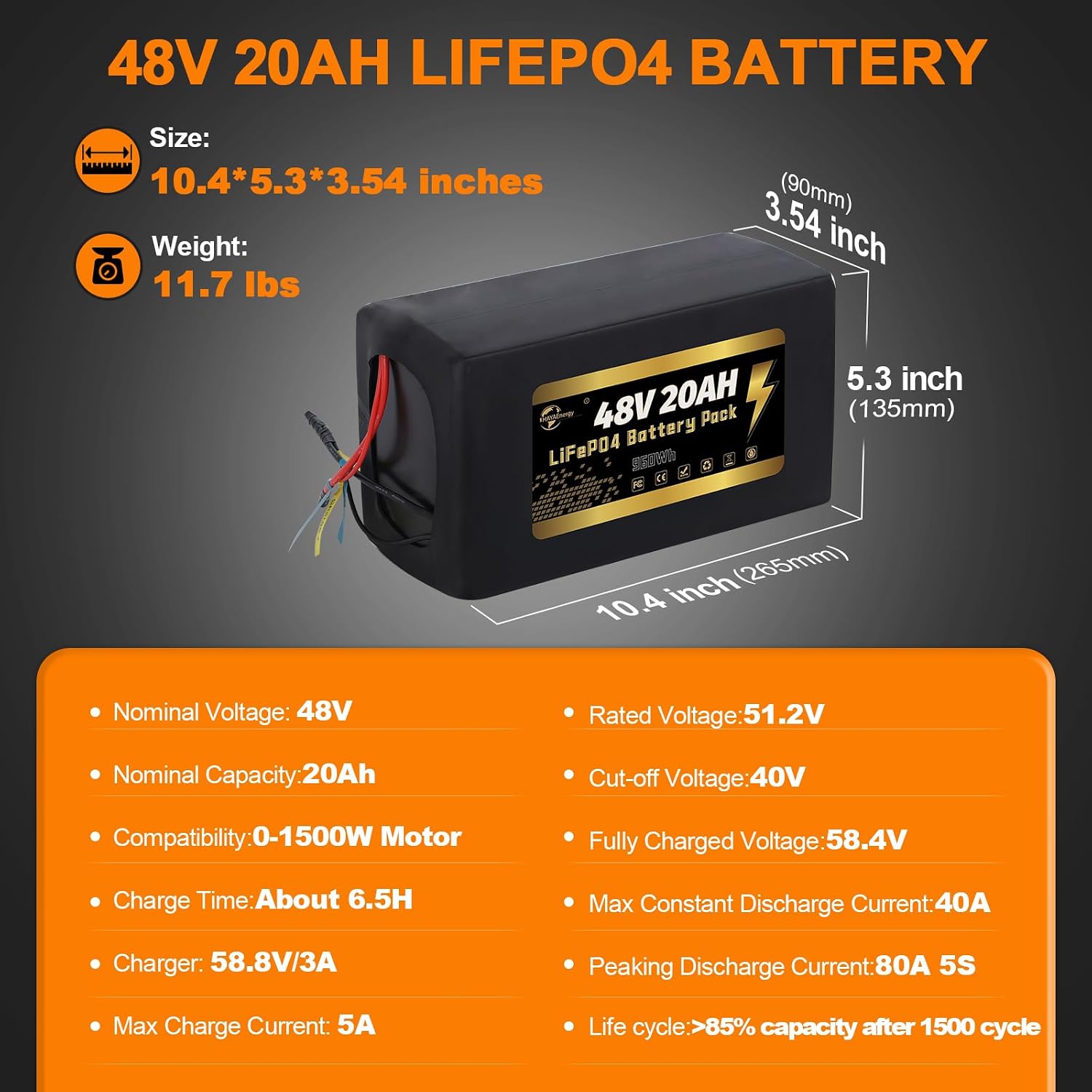
The bullets print the weight at about 11.7 pounds, 5.31kg, for a pack rated at 960 watt-hours. Divide one by the other and the printed figures claim 181 watt-hours per kilogram at the pack level. Wikipedia's lithium iron phosphate overview puts BYD's production LFP at 150 watt-hours per kilogram and notes that even CATL's claimed 205 is a cell-level figure from the largest manufacturer in the field.
A finished pack wraps those cells in a case, a BMS board and wiring that weigh something and store nothing, so a real pack lands below its own cells.
The claim isn't a rounding error. It sits about a fifth above the 150 watt-hours per kilogram that BYD's production batteries manage, and it comes close to CATL's claimed 205, a cell-level figure that carries no case, no board and no wiring.
The 15Ah sibling in this same brand family claims an even higher density at its own printed weight, which I covered in the 15Ah review. One printed weight being generous would be a typo. Two packs from the same line printing impossible densities is a pattern, and the honest reading is that the capacity figures aren't measured.
My advice on a two-rating listing with a weight problem is to let the scale decide. Weigh the pack when it arrives. A pack that comes in meaningfully heavier than printed has at least told you the truth about its contents, and one that matches the printed 5.31kg has told you something worse.
Either way, meter a real ride inside the three-month return window, because the capacity question is one only your own watt-hour meter settles.
Where the Card Is Straight With You
Give the parameter card its due, because most of it survives arithmetic. The voltage rows close exactly: sixteen cells in series give the 51.2V rated figure, the 58.4V full-charge figure, and the 40V cutoff. The 58.8V charger in the box matches that wiring.
The 16S1P configuration also explains why the pack answers to both 48V and 52V in the title, a labeling quirk the LFPNERYE 20Ah review decodes in full.
The power claims run in the honest direction, which is rarer than it should be. A 40A continuous board at 51.2V carries about 2,000W, and the card's own 0-1500W motor ceiling draws around 29A at that voltage. The board feeds the largest motor the listing claims with room to spare, instead of the common pattern where the BMS can't feed the motor in the title.
The range line under-promises too. The card says 25-plus miles without pedaling, and 960 watt-hours at a full-throttle 25 to 30 watt-hours per mile covers 32 to 38 miles before any pedal help. The cycle-life promise of better than 85 percent after 1,500 cycles sits well inside what this chemistry is generally credited with, so nothing there is being stretched.
The charge-time row is the one that slips. Twenty amp-hours at 3A works out to a 6.7-hour floor before the taper, and the card says about 6.5 hours. It's a small rounding against your own arithmetic, but plan on most of a day's end rather than an afternoon.
Ordering an Unproven Pack
On our battery table this row sits in the cheapest fifth of everything we track at 186.00, and the twin's row sits in the same band at 169.00.
The value is real on paper, and the paper is all it is until the record deepens or a scale says otherwise. If the price difference matters more to you than the labeling, the twin listing is the same hardware for less, with the same unproven record and a variant strip that makes the motor ceiling harder to read.
Order this one if you want the connector and the ceiling stated plainly and you're comfortable being close to the first person to find out how the pack holds up. The twelve-month warranty and the three-month return window are ordinary for the tier, and on this listing they're not fine print, they're the entire safety net. Buy with the return in mind, not as a final answer.
Frequently Asked Questions
Is a 5.0 rating from two ratings meaningful?
Not very. Two wordless five-star ratings can't describe capacity, durability or seller behavior, and the score can't survive contact with the first unhappy buyer. Read it as an absence of complaints so far, not as proof of quality, and lean on the page's own arithmetic plus your scale when the box arrives.
Which listing should I buy, this one or the cheaper twin?
Same seller, same hardware, same box. This one states the XT90 connector in the title and prints the 1500W ceiling on its card, and its variant labels surface the charger amperage.
The twin costs 17 less and files under a sensible category. If you need the labeling, pay the difference here. If you just want the cheapest 20Ah lithium iron phosphate pack on the shelf, the twin's listing has it.
Can I use a 54.6V charger from my old 48V battery?
No. This pack is 16S lithium iron phosphate, which charges at about 58.4V, and a 13S lithium-ion charger tops out at 54.6V. It will connect and fill nothing. Use the 58.8V 3A charger in the box, and check the output voltage printed on any spare before you plug it in.
What should I check when the box arrives?
Three things, in order. The weight against the printed 11.7 pounds, because that's the number the chemistry argues with.
The charger label against the 58.8V figure. Then a metered ride inside the three-month window, because the capacity question is the only one the listing leaves open. The listing is where the return clock starts.