A listing that sells the same pack under two voltage labels usually confuses buyers by accident. This one states the reason on the face of it.
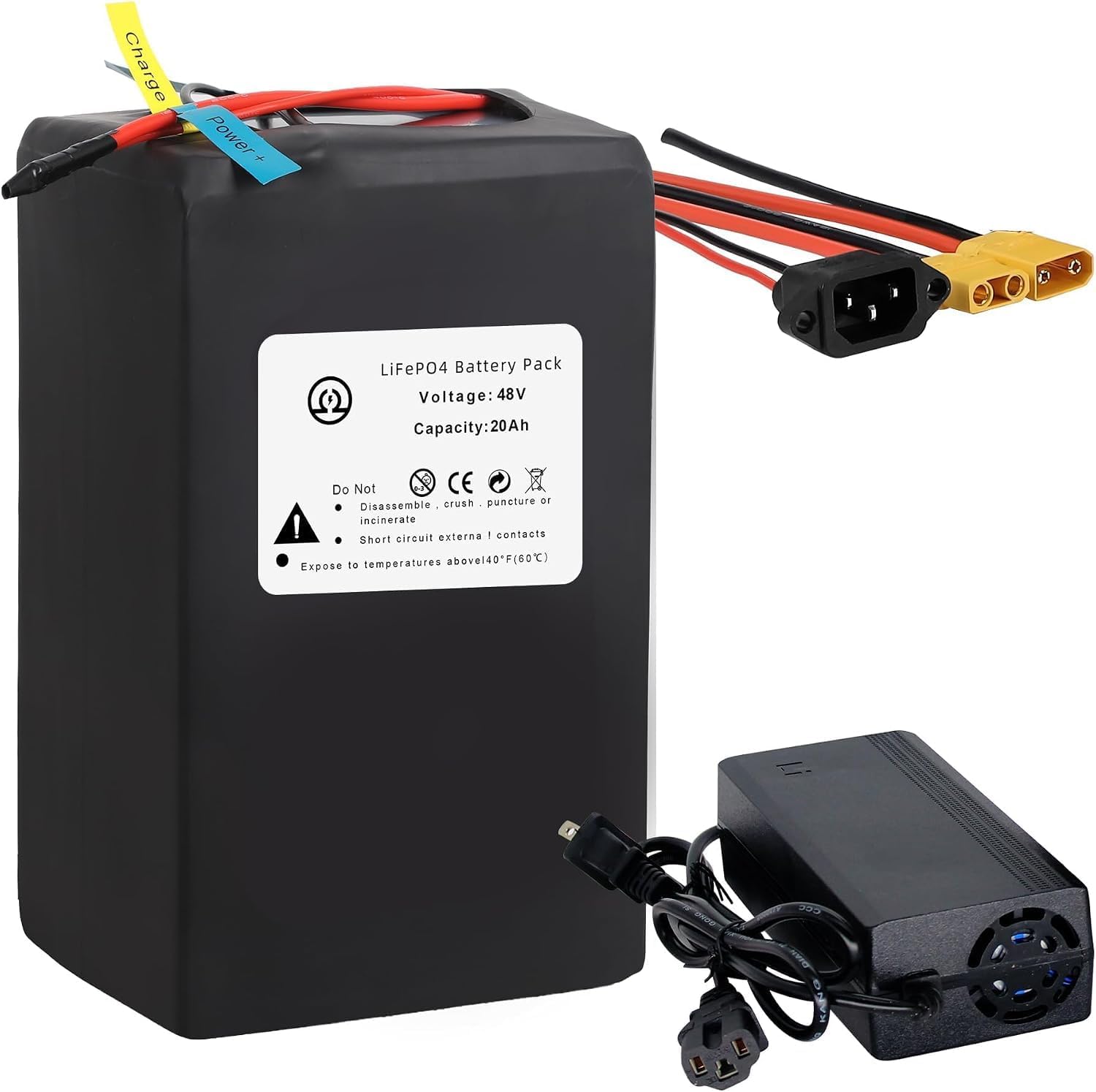
The LFPNERYE 48V 20Ah LiFePO4 battery sells at 169.00, ships with a 3A charger and a pair of XT90 connectors in the box, and prints a 5.0 star value whose count sits in page code my scrape never loaded, so I won't quote a number I can't see.
The title also carries a lowercase chemistry typo and a motor bracket it disagrees with elsewhere, which is ordinary for this tier. What isn't ordinary is the claim in the first bullet: a 48V 20Ah lithium iron phosphate pack equals a 52V 20Ah pack because both use the same 16S1P wiring. That claim is true, and understanding it is most of what you need to buy this pack well.
The Value Case, Stated Plainly
On our battery table this pack sits in the cheapest fifth of everything we track, at roughly 18 cents per watt-hour on the label math and about 16 and a half once you use the pack's own rated voltage. The live figure renders in the specs box beside this article, because the band moves on every data refresh while the page does not.
For lithium iron phosphate, which usually costs more per watt-hour than ordinary lithium-ion, the price is the strongest fact on the page.
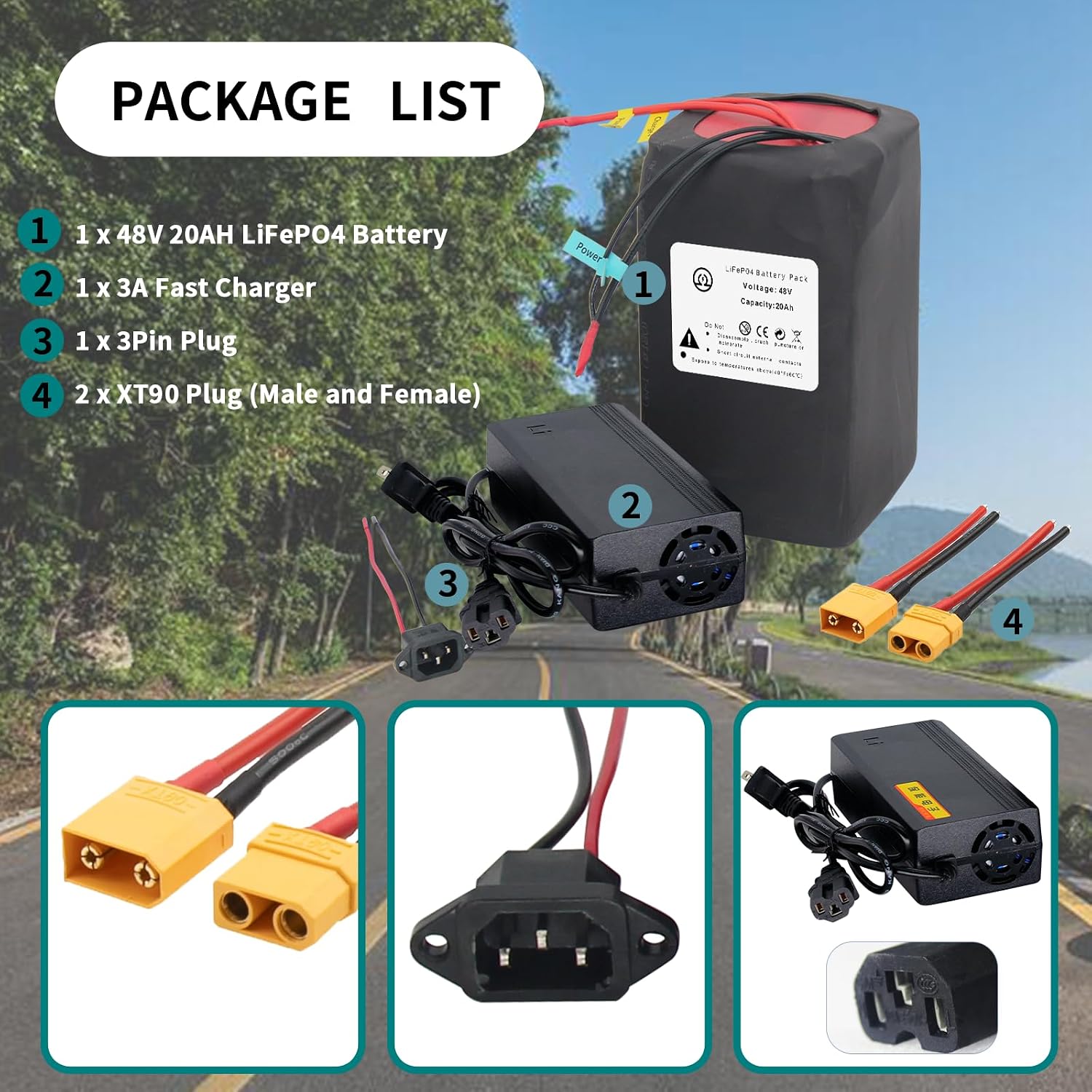
The box earns its keep too. The pack card lists the battery, a 3A fast charger, a three-pin plug and a male and female XT90 pair, so you don't need a second order before the first charge. The spec table's own Included Components row reads just battery, and the pack card is where the real box list lives.
The XT90 is a heavier connector than the XT60 most budget packs ship, which suits a board that claims 40 amps of continuous delivery, and it's worth checking what your bike's charge port accepts before you order rather than after. The manufacturer row behind the LFPNERYE name reads Guangdong TianChi New Energy Technology, a factory a buyer cannot easily look up, which is typical for this tier and one more reason the arithmetic matters more than the branding.
Power headroom is real. Forty amps at 51.2V is a bit over 2,000W sustained, which feeds the title's 1,500W ceiling with room to spare and even covers the 1,800W figure the suitability card prints. When a board out-rates the motor bracket above it, that is the honest direction, the opposite of the listings where the BMS cannot feed the motor in the title.
One Pack, Two Labels
The 16S1P line explains the double label, and it deserves the minute it takes to decode. Sixteen cells in series, none in parallel, means sixteen 3.2V lithium iron phosphate cells wired end to end, each one a 20Ah soft-pack unit.
Sixteen times 3.2 is the 51.2V rated figure. Sixteen times 3.65, the chemistry's full-charge voltage, is the 58.4V the card prints. The arithmetic closes with no gaps, which is rarer in this tier than it should be.
So why does one pack carry two labels? Ordinary 48V lithium-ion packs are thirteen cells in series, and 52V packs are fourteen. A sixteen-cell lithium iron phosphate string rates at 51.2V, which lands between those two camps, close enough to work with controllers meant for either.
The bullet's equals sign isn't marketing arithmetic, it's a genuine statement about where this chemistry sits, and it's the same reason the HAYAEnergy pack we decoded alongside this one titles itself 48V while its card says 51.2V.
The Charger Rule That Comes With It
The label math decides the charger, and the charger decides whether the pack ever fills. This one needs a charger that outputs around 58.4V, and the box ships a 3A unit for the job. Your old 54.6V charger from a 13S lithium-ion pack will click in happily and stop three volts short of a full charge, and a 48V lead-acid charger is wrong in the other direction.
Match the output voltage printed on the charger's label before the first use, not after the first disappointing ride.
The listing never prints a charge time at all, which is a small mercy compared with the invented figures this tier usually offers. The arithmetic gives the floor: 20 amp-hours at 3A is about 6.7 hours before the taper that slows the final stretch. Plan on an overnight charge and let the taper do its work.
The Cards Argue About Cycle Life
The gallery is where this listing stops agreeing with itself. The lifecycle card promises better than 80 percent capacity after 1,000 cycles, and the marketing card a few images later claims the pack can be recharged more than 1,500 times. Those are half a world apart, and the spec card is the one backed by numbers rather than slogans.
Both are conservative against what the chemistry actually does, because Wikipedia's lithium iron phosphate overview states a cycle-durability range of 2,500 to 9,000 cycles, so neither figure should worry you about longevity. Worry about them because a listing that argues with itself on its own card tends to argue about other things too.
The gallery proves that concern. Nine of the warning cards on this page describe packs you can't order from it: 60V and 72V variants, and 48V packs from 25 up to 50 amp-hours. Amazon pools images across a listing family, so match every number you care about against the variant strip under the price, which should read 48V/52V 20Ah with the 40A BMS, and not against the pictures.
Size needs the same care, because the page prints two of them. The bullets say 10.63 by 5.51 by 3.74 inches and the suitability card says 10.4 by 5.3 by 3.5. That is about a quarter inch per axis of disagreement, and the wrong end of it leaves a pack sitting loose in a strap mount or refusing to enter a hard case.
Measure your bay against the larger figure and you can't be burned by either print.
The Scale Check Before You Order
The weight is the one number left to test, and it fails the same test its sibling failed. The listing prints 11.68 pounds, which is 5.3kg, and the arithmetic says between 181 and 193 watt-hours per kilogram at the pack level depending on which voltage you use for the capacity.
Wikipedia states the cell-level range as 95 to 172 watt-hours per kilogram, with the next-generation claims reaching 180 to 205 still measured at the cell level before any case, BMS board or wiring adds mass that stores nothing. A finished pack cannot outrun its own cells, so one of the printed numbers is wrong, and capacity is the one that sells while weight is the one that ships.
The 25Ah LFPNERYE pack we reviewed in September runs into the same wall at its own printed weight, so this is now a brand pattern rather than a single listing's typo.
My advice is unchanged from that review. Plan around a pack that delivers meaningfully less than 20 amp-hours, weigh it the day it arrives, and meter a full ride while the three-month return window is open. The twelve-month service term behind it is ordinary for the tier.
Frequently Asked Questions
Is the 48V and 52V double label a trick?
No, and it's the most honest thing on the page. A sixteen-cell lithium iron phosphate string rates at 51.2V, which sits between the 13-cell and 14-cell lithium-ion conventions those labels come from. The same pack genuinely answers to both names, and the bullet that explains it with the 16S1P configuration is stating physics rather than inflating capacity.
Can I charge it with my old 48V lithium charger?
Almost certainly not. Chargers built for 13-cell lithium-ion packs stop at 54.6V, and this pack fills at 58.4V, so the old charger will connect and never complete a charge. Use the 3A charger in the box, or if you buy a spare, check the listing for the 58.8V-class output voltage on any charger's label before you pay for it.
Which size should I measure my battery bay against?
Use the larger of the two printed figures, 10.63 by 5.51 by 3.74 inches. The listing disagrees with itself by about a quarter inch per axis, and a bay cut to the smaller print risks refusing a pack that arrives at the larger measurement. Straps forgive a loose fit, hard cases do not.
What does the warranty actually cover?
The page promises three months of free returns and replacements plus twelve months of service, with support claiming answers within 48 hours. That is a standard term for this tier, neither generous nor alarming. The real protection is the return window, so run the weight check and a metered ride inside the first three months, while the pack can still go back.