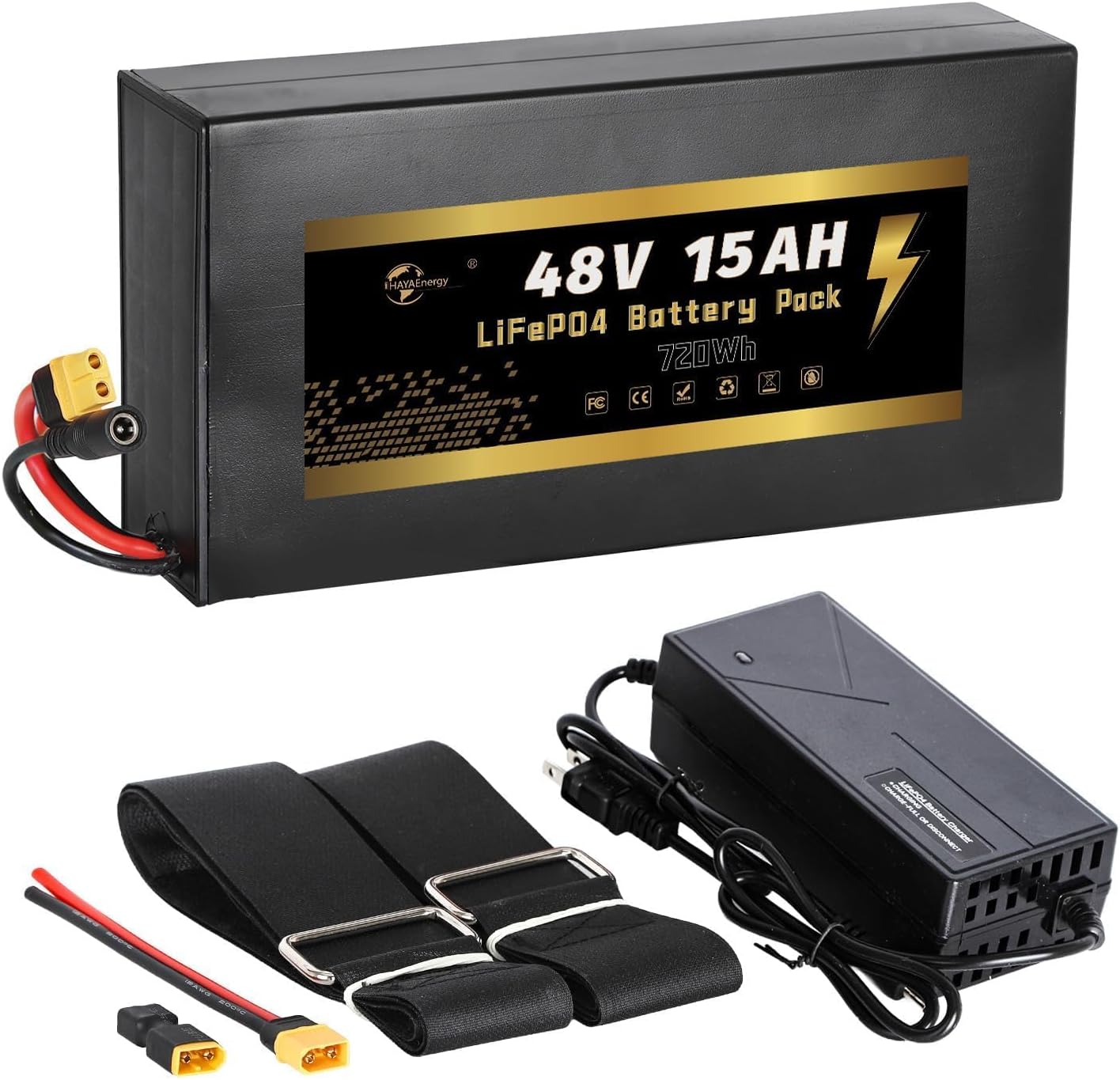
Most budget battery listings fall apart in three places at once, so a card that gets almost everything right is worth pausing on. The HAYAEnergy 48V 15Ah LiFePO4 pack sells at 129.00, ships with its charger and connectors already in the box, and prints a 4.0 star value on the page. The rating count sits in page code that never loaded for my scrape, so I won't quote it.
The title reads like a warehouse shelf: 36V, 48V, 52V, and five amp-hour ratings in one line. This page is the 48V 15Ah variant, and that's the version this review covers. What makes the listing interesting is not the soup but the parameter card, because nearly every number on it survives the arithmetic that kills most of its rivals.
Nearly every number. One does not, and it's the one you can check with a kitchen scale.
The Value Case, Stated Plainly
On our battery table this pack sits in the cheapest fifth of everything we track, at roughly 17 cents per watt-hour against a field whose middle sits well above that. The exact position changes on every data refresh, so the specs box beside this article carries the live figure, but the band has held since we added the row. For a lithium iron phosphate pack, which normally costs more per watt-hour than ordinary lithium-ion, that's genuinely good value on paper.
The box supports the value instead of nibbling at it. The pack card lists the battery, a 58.8V 3A charger, an XT60 male plug, an XT60-to-T adapter, two adjustable cable straps and a manual. You don't need a second order before the first charge, and the XT60-to-T adapter covers the connector most budget bikes and DIY builders actually use.
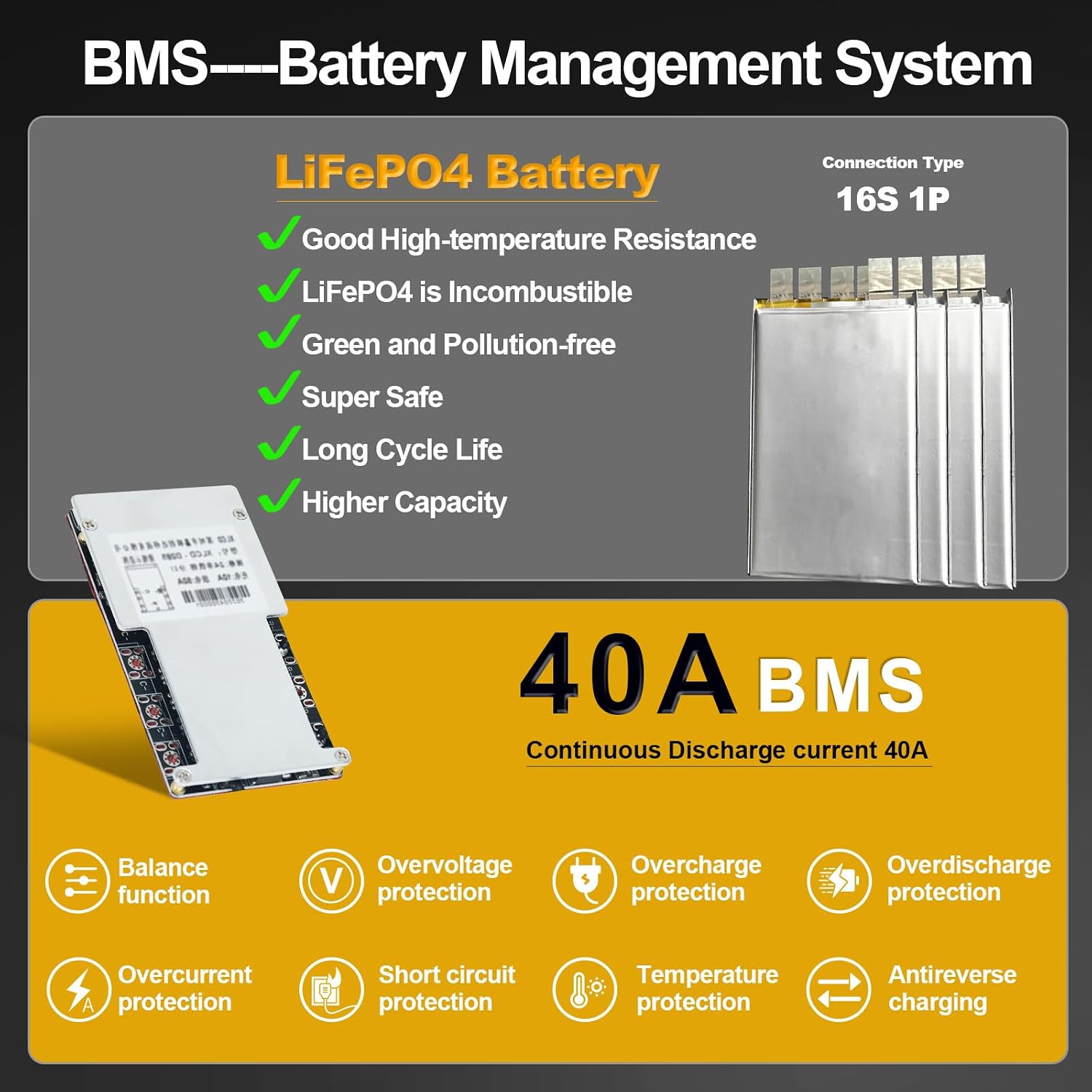
Power headroom is real too. The card and the bullets agree on a 40 amp continuous BMS with an 80 amp five-second peak, and at 51.2V rated that's a bit over 2,000W sustained. A 1,500W motor, the top of the listing's own bracket, draws about 29A at that voltage, so the board runs the motor with room to spare rather than at its ceiling.
Sixteen Cells in Series, Decoded
The configuration line, 16S1P, is the most informative thing on the page. Sixteen cells in series and none in parallel means sixteen 3.2V lithium iron phosphate cells, each a 15Ah soft-pack unit, wired end to end. Multiply it out and the voltages on the card stop being a list and become a system: 16 times 3.2V is the 51.2V rated figure, 16 times 3.65V is the 58.4V full-charge figure, and the 40V cutoff is 16 cells at 2.5V each. Every voltage row checks.
That single configuration also explains the title's confusion. A 16S lithium iron phosphate pack rates at 51.2V, which sits between the 48V label that 13S lithium-ion packs use and the 52V label that 14S packs use, so sellers sticker it both ways to catch both searches. The chemistry is one pack answering to two names, not two products.
The charger rule that follows matters more than anything else in this section. This pack needs a charger that outputs around 58.4V, and the one in the box prints 58.8V at 3A, which is correct. Your old 54.6V charger from a 13S lithium-ion pack will connect fine and fill nothing, because it tops out three volts short of where these cells live. Keep the included charger with the pack.
The Scale Test the Card Fails
The bullets print the weight at about 8.38 pounds, which is 3.8kg, and the parameter card repeats it. Run the capacity against that mass and the arithmetic says 202 watt-hours per kilogram at the pack level. That number is the problem, and Wikipedia's lithium iron phosphate overview states the physics plainly: cells of this chemistry hold 95 to 172 watt-hours per kilogram at the cell level, and the next-generation claims reaching 180 to 205 are cell-level figures from the biggest manufacturers in the industry. A finished pack adds the case, the BMS board, the wiring and the nickel, all of which weigh something and store nothing, so a pack-level figure can't reach what the cells alone barely claim.
One printed number is wrong, and the weight is almost certainly it, because capacity is what sells and weight is what ships. My advice is to plan around a pack that delivers meaningfully less than 15 amp-hours, to weigh it when it arrives, and to ride and meter it early while the three-month return window is still open. The twelve-month warranty behind it is ordinary for this tier.
The 25Ah LFPNERYE pack we decoded earlier this month runs into the same wall at its own printed weight, so this is becoming a pattern in the cheap lithium iron phosphate tier rather than one listing's typo. When two brands from different factories both claim pack-level densities their chemistry cannot deliver, the honest reading is that neither capacity figure has been measured honestly yet.
What Actually Checks Out
Give the card credit where the arithmetic holds, because it holds in places where this tier usually cheats. The charge time row says about 5 hours, and 15 amp-hours at the 3A charger works out to exactly 5.0 hours, so the figure is real rather than rounded down for the sales page. The power claims run in the honest direction: the board sustains more than the largest motor the listing says it fits, which is the opposite of the common pattern where the BMS cannot feed the motor in the title.
The range line is conservative too. At a full-throttle 25 to 30 watt-hours per mile, 768 watt-hours carries a rider about 25 to 30 miles without pedaling, yet the card promises only 15-plus miles. Under pedal assist, where most of the watt-hours go two to three times further, the honest expectation sits well above the printed claim. A listing that under-promises its range is rare enough to note.
The cycle-life promise is modest against the chemistry rather than brave. The card says better than 85 percent capacity after 1,500 cycles, and lithium iron phosphate is generally credited with 2,500 to 9,000 cycles before deep wear. Both this claim and the marketing around it sit inside what the chemistry actually does.
One brand note belongs here. The HAYAEnergy name appears on two listings we tracked earlier this year, a 48V 12Ah pack and a 36V 16Ah pack, and both of those pages are gone from the marketplace now. The 48V 25Ah HayaEnergy review covers the retired listing in that family. The brand continues on new shells like this one, which is normal for this tier, but it means the older record says nothing about the factory that built this pack.
Ordering on a Page With No Count
The page prints a 4.0 star value, and the count behind it renders in code that never loaded for my scrape, so I can't tell you whether that average stands on fifty ratings or five. I wouldn't treat it as either. What you can control is the variant, because the title's 36V-through-52V soup means the wrong click ships the wrong chemistry. Pick the 48V 15Ah option, then check the variant strip under the price, which should read 40A BMS, 0 to 1500W, 3A. The listing showed only 13 left in stock when I captured it, so the choice may not sit there long.
The gallery needs the same skepticism, because Amazon shares images across a listing family. Most cards on this page describe this pack, but one fragment describes a 36V variant, and a buyer skimming cards rather than reading rows could carry away specs for a pack they cannot order. Match every number you care about against the variant strip, not the pictures.
When the box arrives, check three things in this order. Weigh the pack and compare it to the printed 3.8kg, because a pack that comes in meaningfully heavier than printed has at least told you the truth about its contents. Check the charger's output label for the 58.8V figure before its first use. Then meter a full ride inside the return window, because the capacity question the scale raises is one only your own watt-hour meter can settle.
Frequently Asked Questions
Can I use my old 48V lithium charger on this pack?
Usually not. Most 48V lithium-ion packs are 13S chemistry that charges at 54.6V, and this pack is 16S lithium iron phosphate that charges at 58.4V. The old charger connects but never reaches full charge, and a half-charged pack quietly gives you less range on every ride. Use the 58.8V charger in the box, and if you buy a spare, match the output voltage on its label before you buy it.
How far will it actually go?
The honest math starts with how you ride. Full throttle runs 25 to 30 watt-hours per mile, which puts 768 watt-hours at roughly 25 to 30 miles. Moderate pedal assist can double that. The card's own 15-plus mile promise is the floor of the range, not the middle of it, which is a rare direction for a listing to lean.
Is lithium iron phosphate really safer?
The chemistry genuinely earns that reputation, and it's the one claim on this page I'd sign without arithmetic. These cells tolerate heat and abuse better than ordinary lithium-ion, and the BMS card on the listing shows the protections a buyer wants to see. Safer chemistry doesn't make the capacity claim true, though, so keep the two judgments separate.
What should I check when the box arrives?
Three things, in order. The weight against the printed 3.8kg, the charger label against the 58.8V figure, and a metered ride inside the return window. The listing gives you three months to return it, which is enough time to answer the only question the page leaves open.