Most shoppers meet this pack twice without knowing it. The HAYAEnergy 48V 20Ah LiFePO4 battery sells at 169.00 on this listing, and the same seller runs a second page for what looks like the same hardware at 186.00 under a different title. Both pages print a star value, both ship the same box, and they disagree about one thing that matters, which is how big a motor the pack can feed.
That disagreement is why this pack deserves a slower look than a budget listing usually gets. I pulled both pages apart, OCR'd the gallery cards, and ran every number that could be run against the others. This review covers what the two listings share, where this one argues with itself, and which of the two to order for which bike.
Two Listings, One Pack
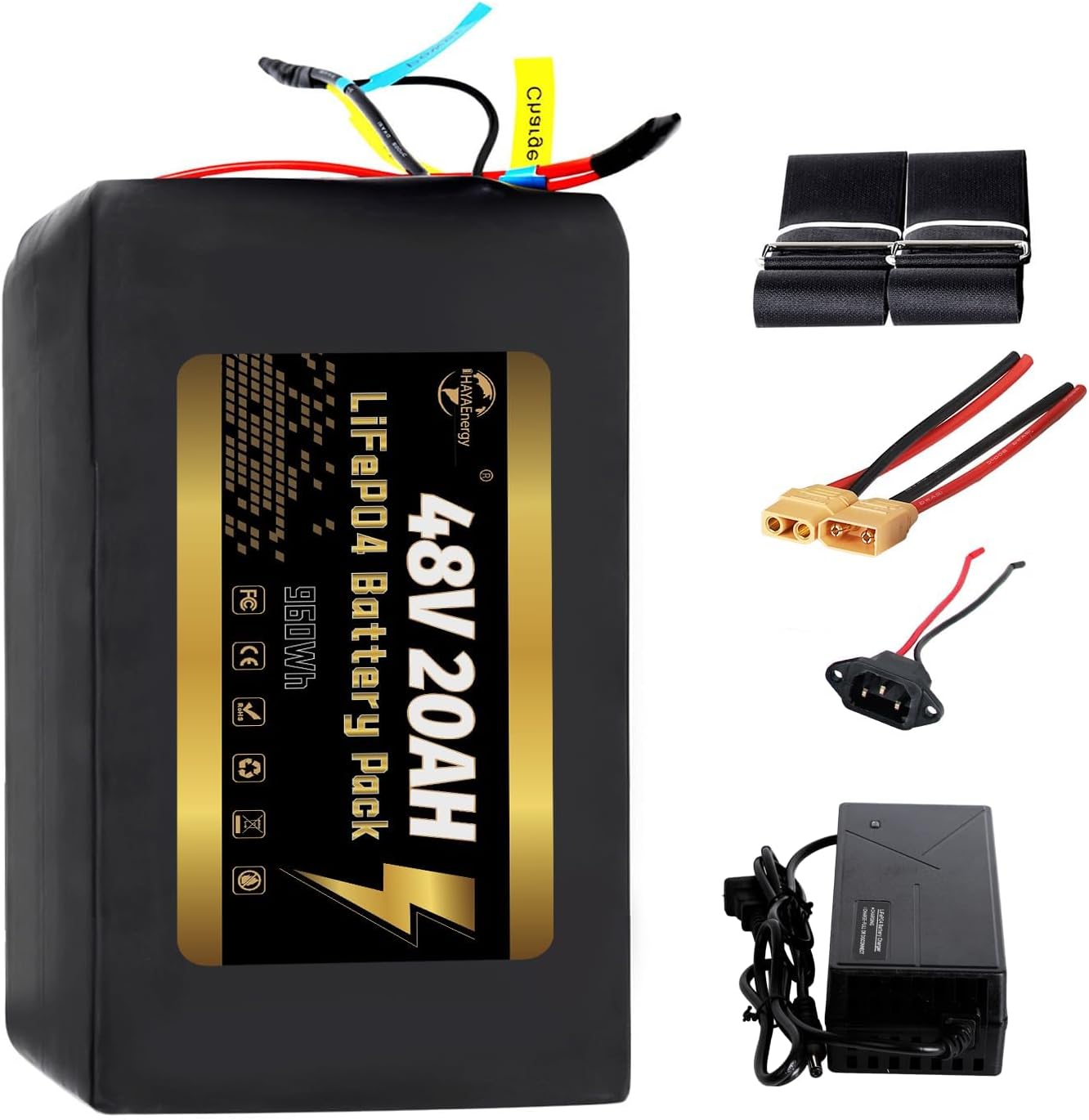
The two pages are one product wearing two titles. The five feature bullets match word for word, down to the typos. The pack list matches: battery, 3A fast charger, a pair of XT90 plugs, two cable straps, a 3-pin plug and a manual.
The gallery cards match on every row except one I'll come to. The seller line on both pages names the same storefront. What differs is the price, the title wording, the category Amazon files it under, and that one card row.
The title split is a marketing choice, not a product difference. The twin's title leads with the XT90 connector and a chemistry badge, while this one leads with a shelf of amp-hour options.
Yet the connector count in this page's own pack card says the same plugs ship in this box too. You are choosing between two labels on identical hardware, 17 apart on price.
The Motor Ceiling Argues Three Ways
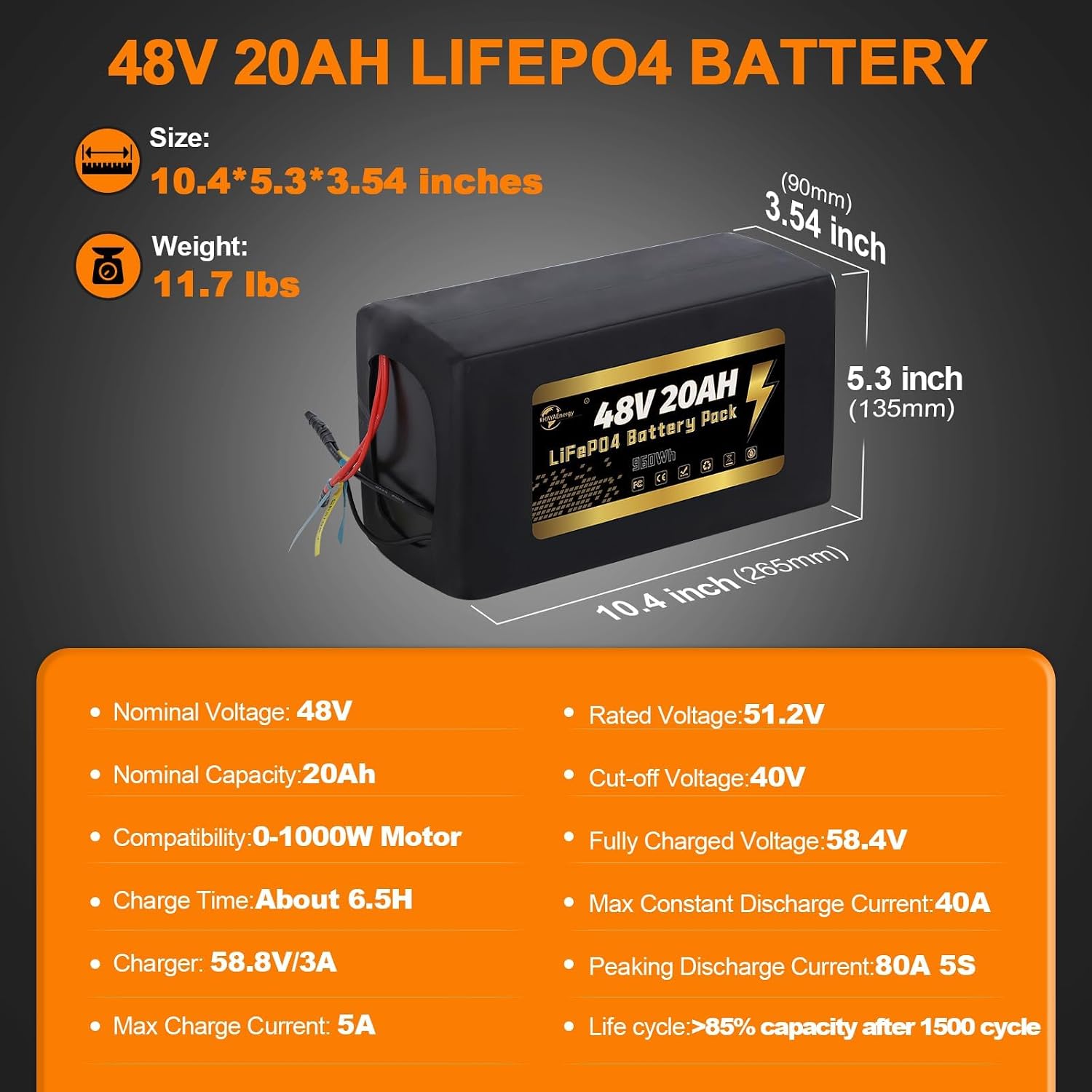
The title says this pack fits motors from 0 to 1500W. The first bullet narrows that to 250W through 1500W. The parameter card on this listing prints 0-1000W.
Three ceilings on one page, and the card is the odd one out, because the same card on the twin prints 0-1500W.
The variant strip resolves it, in an unsatisfying way. This listing carries two separate 20Ah variants, one labeled 0-1000W and one labeled 0-1500W with the 3A charger note. Both claims exist as real variants under one title, and the card rendered on the page matches the 1000W row.
So the honest reading is that this page loaded the conservative variant's card. Check the strip before you order, because the two rows may not cost the same.
The electrical math says the board isn't the constraint either way. A 40A continuous BMS at the pack's 51.2V rated voltage carries about 2,000W, and a 1500W motor draws around 29A at that voltage.
Either card ceiling sits inside what the board can feed. The disagreement is about marketing brackets, not about what the hardware can deliver.
What the Arithmetic Holds Up
The voltage rows all check, which puts this card ahead of most of its tier.
Sixteen cells in series give 51.2V rated, 58.4V fully charged, and a 40V cutoff, and those are exactly the printed figures. The 58.8V charger in the box is correct for this wiring. If you want the full cell-count decode and the rule about your old 54.6V charger, the 48V 15Ah sibling review covers it line by line, and the same rules apply here.
The charge-time row is the one figure that slipped. Twenty amp-hours at a 3A charger works out to a 6.7-hour floor before the taper phase, and the card promises about 6.5 hours. The sibling's card, on the smaller pack, was exact at five hours for fifteen amp-hours at the same 3A.
Rounding below your own floor is a small sin, but plan on an evening rather than an afternoon for a full charge.
The range promise leans the honest direction. The card says 25-plus miles without pedaling, and 960 watt-hours at a full-throttle 25 to 30 watt-hours per mile carries a rider 32 to 38 miles.
Under pedal assist the honest expectation sits well above that. A listing that under-promises its range is rare enough to note.
The cycle claim is modest against the chemistry rather than brave. Better than 85 percent capacity after 1,500 cycles sits comfortably inside what lithium iron phosphate generally delivers, which is thousands of cycles before deep wear.
The Weight Line the Chemistry Can't Carry
The bullets print the weight at about 11.7 pounds, which is 5.31kg, and the card repeats it. Run the capacity against that mass and the arithmetic says 181 watt-hours per kilogram at the pack level. Wikipedia's lithium iron phosphate overview gives the physics: BYD's LFP batteries manage 150 watt-hours per kilogram, and even CATL's claimed 205 is a cell-level figure from the biggest manufacturer in the industry.
A finished pack adds the case, the BMS board and the wiring, all of which weigh something and store nothing.
This is the same wall the 15Ah sibling runs into at its own printed weight, and the LFPNERYE 20Ah pack we decoded reaches it too.
When three cheap LiFePO4 listings all claim pack-level densities their chemistry can't deliver at pack level, the honest reading is that the capacity figures haven't been measured honestly yet. Weigh the pack when it arrives, and meter a real ride inside the three-month return window, because the scale and the meter are the only two instruments that settle this.
Which of the Two to Order
Same hardware, same box, so the decision comes down to labeling and price. Order this one if you want the lower price and you're willing to check the variant strip yourself for the motor ceiling and the connector. Order the XT90 twin if you'd rather have the connector stated in the title and the 1500W claim on the card, and you don't mind paying the difference.
The twin showed only 14 left in stock when I captured it, while this page showed no scarcity line.
Neither star record should move you much. This page prints a 4.5 star value whose count sits in page code that never loaded for my scrape, so I can't tell you what stands behind it. The twin prints 5.0 from two global ratings, which is a record of almost nothing.
On our battery table both rows sit in the cheapest fifth of everything we track at their respective prices, so the value case is real on paper. The unproven record and the weight question are the two reasons to buy with a return in mind rather than as a final answer.
One filing note for completeness. This listing sits in Sports and Outdoors, which is where a battery belongs.
The twin is filed under Tools and Home Improvement, which tells you nothing about the product and something about how loosely these listings get filed. Don't read the category as a signal in either direction.
Frequently Asked Questions
Are the two HAYAEnergy 20Ah listings the same battery?
As far as the pages can show, yes. The bullets match word for word, the pack lists match item for item, the gallery cards match except one compatibility row, and both name the same seller. The differences are price, title wording, the card's motor ceiling and Amazon's filing category.
What size motor can this pack actually run?
The electrical ceiling is high: the 40A board carries about 2,000W at the pack's rated voltage, so a 1500W motor draws well within it. The card on this page backs a 1000W motor, and the variant strip offers both a 1000W and a 1500W row. Match the strip to the variant you're ordering, and treat the card as the number the listing itself commits to.
Will my old 48V lithium charger work?
Almost certainly not. Most 48V lithium-ion packs are 13S chemistry that charges at 54.6V, and this pack is 16S lithium iron phosphate that needs about 58.4V. The old charger connects and fills nothing.
Use the 58.8V charger in the box, and check any spare charger's label for the output voltage before you buy it.
What should I check when the box arrives?
Four things, in order. The weight against the printed 11.7 pounds. The charger label against the 58.8V figure.
The plugs against your bike's connector, because the XT90 pair doesn't fit everything. Then a metered ride inside the three-month window, because the capacity question the weight raises is one only your own meter can answer. The listing is the place to start that clock.