Small 36V packs mostly serve three buyers: someone converting a Razor, someone powering a scooter, someone with a DIY project that needs light power for an afternoon. All three live or die on the same number, the current the battery's protection board will actually pass, and it is the one number this listing prints five different ways.
The DYMOZYNE 36V 12Ah also sells on two pages at once. This one wears a perfect five-star average earned by a single text about a toy quad. Its twin, same price and same factory, wears a 2.6 average with every failure report you would want to read before buying, including one owner who metered the board tripping at a fraction of its rating.
Neither score alone tells you what this pack is, so this review reads them together.
Below you will find the five BMS numbers and the five motor ceilings, the arithmetic that does hold, the record split across both listings, and the range a 432Wh pack honestly delivers.
The DYMOZYNE 36V 12Ah costs 99.99 as of this check, which puts it in the cheaper third of the 301 batteries on our comparison table by price per watt-hour, at about 23 cents.
The honest ceiling from the record is 550W-class motors and under, which is exactly the Razor and scooter work the pack's happy owners bought it for. If your build needs more than that, the money is better spent one tier up, and no BMS claim on either page should move you.
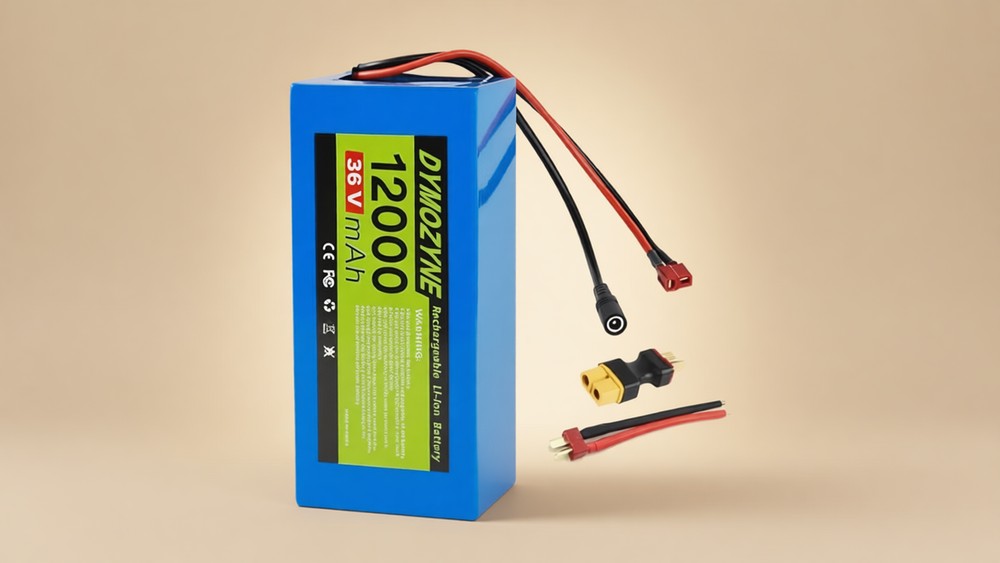
Five BMS numbers, and the meter picked the smallest
Start counting and the protection board's rating changes with every surface you read. The title says 20A BMS. The parameter card's identity block says 15 Amp max continuous, with 60+10 Amp peaks.
A second card, the comparison chart, prints Max Constant Discharge 30A with 60A peaks for 5 seconds. The twin listing's title says 30A BMS. And one owner, converting a Razor MX650 to lithium, put an ammeter on the pack and watched the board trip around 8 amps while feeding a 650W motor.
That last number is the only measured one, and it came from a purchase-badged buyer who has no reason to flatter either page. Eight amps at 36 volts is about 288 watts, two-fifths of the title's 20-amp figure and less than a third of the 30-amp claim.
A battery management system cuts supply when current passes its limit, so a board tripping early is doing its job. The question is which rating describes the board you get, and the listing gives you five answers and no way to pick.
The identity card's own numbers sharpen the doubt. A 15A continuous board caps this pack at about 540 watts, while the 30A reading on the neighboring card would allow about 1080. Those two figures sit on the same product page, printed by the same factory, and neither matches the title.
When a listing cannot keep its board straight, the meter is the only reviewer left standing.
Five motor ceilings, and the record rides under all of them
The motor claims multiply the same way. The title promises 100-2000W motors. Bullet one says up to 1500W.
Bullet two narrows to 100-1000W. The identity card lists 36V motors from 200W to 500W. The comparison card tops out at 0-550W.
Five ceilings, spread over a range that goes from honest to impossible, and a 2000W motor would need about 56 amps, nearly double even the fattest BMS claim on the page.
The owners have already voted with their builds. One has converted a 24V Razor quad to 36V and reports their kid loving the difference.
Another has fitted a Jetson scooter, with the sensible advice to measure the original battery first. Both of those sit inside the cards' 200-550W window, which is the smallest ceiling printed and the only one the record supports. The one owner who pushed past it, on a 650W MX650, got repeated trips and concluded the pack suits nothing bigger than about 100 watts of real draw.
If you are doing a Razor conversion yourself, our Razor MX650 lithium swap walks through what one pack swap actually involved, from connectors to the weight saved. For this DYMOZYNE, plan on 250 to 550W of motor and treat the title's 2000W as copy paste.
The arithmetic that holds
For all its board confusion, the pack's electrical arithmetic checks out. The card names the configuration, 10 cells in series and 4 in parallel.
Ten cells at 4.2 volts charge to 42 volts, which is the printed cutoff, and any charger you pair with a 36V pack must output 42V. The nominal figure closes too, 10 cells at 3.7 volts, with the card printing a rated 37V. Discharge stops at 28V, which is 10 cells at 2.8 and a sensible floor.
The weight closes as well. The bullet and the card both print 2.05 kg, and 432Wh divided by 2.05 kg gives about 0.21 kilowatt-hours per kilogram, mid-band for a complete pack once the case and board are inside. Nothing here asks you to believe in impossible cells.
Charging runs through the included charger at 2 to 5 amps per the card. Twelve amp-hours divided by 2 amps is a 6-hour floor, and the card's own claim of about 5 to 6 hours closes only at that 2-amp end, since 5 hours would need about 2.4 amps.
Expect an overnight charge and treat any promise of faster as a marketing card talking to itself, which this listing does elsewhere too.
Two listings, two scores, one pack
The record split is the strangest thing about this pack. This page shows 5.0 from four ratings with one written text, the Razor quad conversion, and nothing else. The twin, at the same 99.99 under the same DYMOZYNE name, shows 2.6 from seven ratings with five texts, and every one of them is purchase-badged, the two one-stars included.
The praise lives on one ASIN and the evidence lives on the other, and a buyer who reads only the page they land on gets a flattering lie or a bleak one.
The twin's criticism clusters in two places. One buyer has described a pack that arrived slow and then just shut off, and another has reported slow delivery, no seller response, and build quality below a rival pack they own. Both one-stars sit in a histogram where about a third of all ratings are one-star, on a page whose title claims a different BMS rating than this one.
Between the two listings, the only consistent story is a small pack that works for small builds and a seller whose support and specifications you should not lean on.
The factory ties it together. The manufacturer of record on both pages is Shenzhen Lian Pai Yuan Technology, the same line behind the BSTBAT 52V packs and the DYMOZYNE 48V builds we have reviewed, one factory behind two brand names across the six listings of theirs this site has read.
The twin even tells DIY buyers to check the voltage of their controller at 48v, on a 36V battery listing, template copy pasted past its own meaning.
Waterproof wording, cycle counts, and range from 432Wh
The title says Waterproof Hard Shell, and the bullet underneath says the case resists daily splashing, impact and extrusion.
No IP code appears on either listing, and the twin weakens the claim further with a sealed PVC case, so the factory cannot even keep the shell straight. Splash-proof is the defensible reading, keep it out of deep puddles and away from pressure washers, and treat the title's single word as marketing until a wet ride proves otherwise.
The cycle claims disagree with each other too. The bullet promises up to 1000 cycles, while the comparison card says more than 85 percent capacity after 1500 cycles.
The consumer norm for li-ion runs 300 to 500 cycles, stretched toward 600 at full depth of discharge, so both printed figures sit at the optimistic edge and the larger one asks for shallow discharges nobody does. Charge between rides and the odds improve either way.
Range is the simple part. Leave a margin at the bottom of the charge and 432Wh gives about 367 usable watt-hours. At a light pedal-assist draw of 20 watt-hours per mile that is about 18 miles.
A throttle-driven scooter at 25 runs about 15, and near full throttle it is about 10. That suits a short commute charged nightly or a kid's converted quad, which is what the record actually shows. At about 23 cents per watt-hour the price is fair for the size class, and you can check the live position on our table against the 36V silver fish packs nearby.


Frequently asked questions
Can this pack run a 750W motor?
I would not plan on it. The measured report has the board tripping around 8 amps on a 650W conversion, and even the largest printed rating only allows about 1080 watts continuous. Stay in the 250 to 550W window the identity card and the successful builds share.
How far can I go on a single charge?
Plan on about 18 miles with light pedaling, about 15 on a throttle scooter, and about 10 near full throttle, from roughly 367 usable watt-hours.
How long does it take to charge?
The card prints a 2 to 5 amp charger and about 5 to 6 hours. At the 2-amp end that closes, since 12 amp-hours at 2 amps is a 6-hour floor, so figure on overnight.
Is the pack truly waterproof?
The title says so, but the bullet walks it back to splashing, the twin lists a PVC case, and no IP code appears anywhere. Treat it as splash-proof.
Can I use it for DIY projects besides bikes?
The XT60 and T-plug pair covers custom builds, scooters and small conversions, and one owner has run a 24V Razor quad converted to 36V on it. Match the pack's voltage to your project, use a 42V charger, and keep the motor draw inside the 550W window the record supports.