Lithium iron phosphate packs usually cost more per watt-hour than ordinary lithium-ion, because you are paying for cycle life instead of energy density. That is what makes this BtrPower 48V 30Ah pack worth a close look: on price per watt-hour it sits in the cheapest fifth of everything we track, and the label claims the expensive chemistry anyway.
Listings that claim LiFePO4 at NMC prices are usually mislabeled, and I have caught that exact fault on other packs. This one is different, and the difference is printable: the page's own voltages close the phosphate arithmetic to the volt. What the page never does is tell you what the pack weighs, and for a 30-amp-hour phosphate pack, that omission is the whole risk. The ratings stand at 4.6 from 6 as I write this, a record the seller's whole ladder shares, and the written reviews behind it were not reachable while I worked. Read this as a listing decode rather than an owner report.
The chemistry math actually closes
The parameter card says the pack is 16 cells in series, one in parallel, 3.2V nominal per cell. Sixteen times 3.2V is 51.2V, which is what a "48V" phosphate pack really is. The same card gives a charge window that tops out at 58.4V, and 16 times 3.65V, the maximum charge voltage Wikipedia lists for this chemistry, is exactly 58.4V. Even the card's 99-percent floor of 53.6V works out to 16 cells at 3.35V. Three independent numbers, one arithmetic, no contradictions.
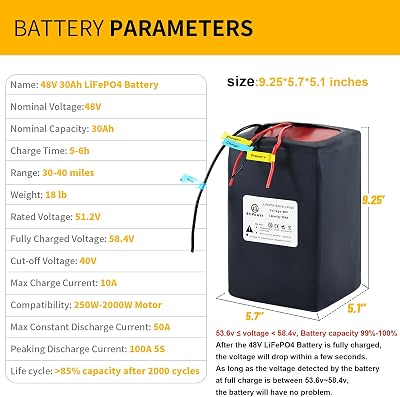
Compare that with the VATOSO 40A pack we decoded the same day, whose label claims phosphate chemistry while its printed voltages are exact 13-series ordinary lithium-ion math. One of these two sellers understands what they are shipping. On the printed evidence, it is this one. It also means the practical rule is simple: charge this pack only with the included 5A charger or another 58.4V phosphate charger, and never with the 54.6V equipment sold for 13-series packs.
What 50A buys, and what the range claim admits
The 50A BMS at 48V tops out at 2,400W. The title says the pack suits motors from 250W to 2000W, and a 2000W motor draws about 42A, comfortably inside the board. The card even states the controller rule outright: rated current of 50A or less, voltage 48V or 52V. Listings in this price band usually leave you to guess whether the BMS and the motor claim agree. Here they do, with about 400W of headroom.
The range claim is the rare honest direction. The card promises 30 to 40 miles without pedaling. On 1,440 watt-hours, 40 miles works out to 36 watt-hours per mile, and full-throttle riding typically sits nearer 20 to 30. In other words the claim assumes the pack will be ridden hard, and a gentler throttle should stretch past it. Most listings in this category do the opposite, quoting a pedal-assist figure as if it were a throttle figure. The card also claims more than 1,500 recharge cycles, which sits below the 2,500 to 9,000 cycle band Wikipedia gives for the chemistry. A cycle-life claim that undersells the chemistry is the kind of conservatism I trust more than a big number.
The weigh-on-arrival problem
Nothing on this page states the pack's weight. The parameter card has a line for it, and the value is missing. That matters here more than usual, because of one line on the BMS card: 16 in series, one in parallel.
One parallel group means each series string is a single cell rated 30 amp-hours. Large prismatic phosphate cells in that capacity do exist, so the claim is not impossible. But the common DIY format, the 6-amp-hour 32700 cell, would need five parallel groups to reach 30Ah, and a pack built that way would not say 1P. A 16S1P pack of genuine 30Ah prismatic cells, plus case and BMS, for 1,440 watt-hours of capacity is a heavy object, likely more than 9 kilograms at the densities this chemistry runs. The box is listed at 9.25 by 5.7 by 5.1 inches, which is a plausible footprint for it.
When a listing prints every number except the one that would confirm the cell claim, the scale decides the dispute. Weigh it on arrival, and if it comes in far lighter than that, meter the capacity before your return window closes.
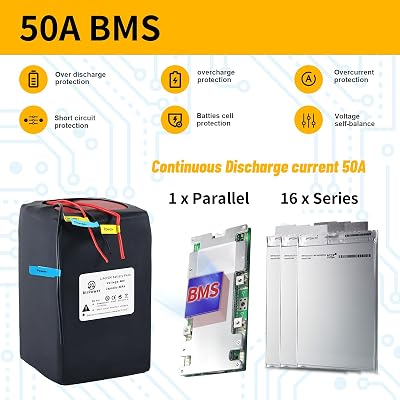
Charging takes at least 6 hours, from 30 amp-hours at the 5A charger, before the taper that slows the final stretch. The connections are split by function, which the card shows clearly: a 3-pin plug for charging and Anderson plugs for the motor. Anderson connectors are bolted for high current rather than friction-fit, which suits a pack claiming 50A continuous, though you will need the matching connector on your controller side if your bike did not come with one.
Template paperwork and a record the whole ladder shares
The details table prints a 12-month warranty. Bullet four prints two tiers at once: 3 months free return and replacements, then 12-month service. No terms are defined anywhere, and the Included Components row reads a bare 1 while the first bullet lists five items in the box: battery, 5A charger, 3-pin connector, two Anderson plugs, manual. None of this is a red flag on its own. Taken together it is the paperwork of a listing assembled from a template, and it means any claim beyond the first 3 months runs on the seller's goodwill rather than a defined policy.
The listing is also filed under Household Batteries, with a rank near the top six thousand of that category, rather than among bike components. That filing matches a pack sold half for e-bikes and half for scooters, tricycles and do-it-yourself projects, and the title names all four. If your build needs a clean warranty document, this is not the listing that provides one.
The 4.6 from 6 ratings on this page is not this pack's record alone. The 36V 25Ah sibling shell, a different voltage and capacity sold on its own listing, prints the identical 4.6 from 6 and the identical sales-rank figure. Amazon pools ratings across the variants of one parent listing, so those 6 ratings could sit on any shell in the ladder, which runs from 20 to 50 amp-hours at 48V and 52V. The store ladder in the last bullet even advertises 36V through 72V shells.
Practical consequence: the star value is evidence about the seller's ladder, not about the 30Ah shell you would be ordering. Nobody has published a capacity meter reading or a weight for this specific pack, and with the written reviews unreachable I cannot quote an owner either. The 25Ah shell on the same parent ladder prints a weight that cannot close for its capacity, which makes this pack's missing weight figure look almost cooperative.
The older BtrPower 30Ah phosphate shell we carry in the table has its own record if you want a second data point on the brand. Our full battery table sorts all of them by price per watt-hour, and the specs box beside this review renders the live figures.
Frequently Asked Questions
Is this really LiFePO4?
The printed voltages say yes. Sixteen cells in series at 3.2V nominal, a 58.4V charge ceiling and a 53.6V near-full floor all match the chemistry's real arithmetic, unlike packs whose labels claim phosphate while charging at 54.6V. Use only 58.4V-class phosphate chargers on it.
What motors can it run?
Plan around the stated 2000W ceiling, which draws about 42A at 48V and stays inside the 50A BMS. The card requires your controller to be 48V or 52V and rated at 50A or less.
How long does it take to charge?
Plan on at least 6 hours with the included 5A charger, longer for the final taper. Do not substitute a 54.6V charger from an ordinary 13-series lithium pack.
What is missing from the listing?
The weight. A 16S1P pack at this capacity should be heavy, the card has a weight line with no value printed, and no owner report fills the gap. Weigh the box on arrival and meter the capacity before the return window closes.
The scale decides this one
The chemistry story is the strongest printed case in this price band: real phosphate math, an honest range floor, a conservative cycle claim and a BMS that covers the motor claim with room to spare. The price per watt-hour sits in the cheapest fifth of our whole table, which for a genuine phosphate pack is unusual enough to be the headline. What stands between you and that deal is one unprinted number and a template-level warranty. Order it if your controller speaks Anderson and your case fits 9.25 by 5.7 by 5.1 inches, keep the delivery scale handy, and let the pack's actual weight confirm the 30Ah claim before the return window shuts.