Most riders shopping a second 48V pack already know their two numbers: how many watt-hours they want and how many amps their controller can pull. The listing for this VATOSO 48V 20Ah battery answers both questions three times, and the three answers do not agree. That matters more here than it does on most listings, because the difference between the answers is the difference between a 750W commuter pack and something that can feed a 1500W build.
I will walk through what the page actually commits to, what the printed voltages tell you about the cells inside, and where the charge-time math breaks down. The ratings sit at 4.3 from 19 as I write this, but the written reviews behind them would not load while I worked, so this piece reads the listing rather than the owners. Treat it as a page decode, not a durability verdict.
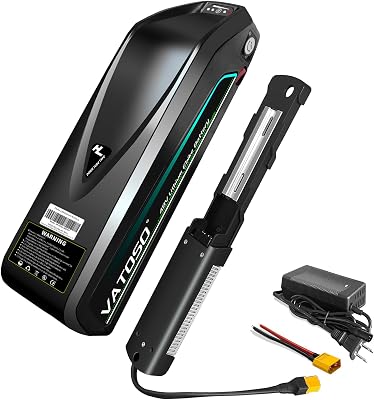
Three motor ceilings on one page
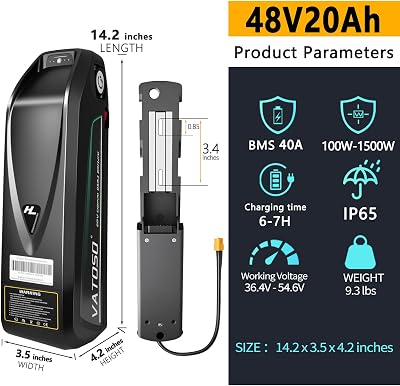
The title says the pack suits motors from 100W to 1500W. The parameter card repeats 100W-1500W. Then bullet one says 100-1900W. A 40A BMS at 48V tops out at 1,920W, so the bullet's 1900W figure sits just inside the board's own limit, and the 1500W figure would draw about 31A. All three numbers can be true at once. The board never said 1900W, but it does not forbid it either.
The honest planning number is the one the title and the card agree on: 1500W. A 1500W motor at full draw wants about 31A, which leaves comfortable headroom under the 40A board. If your controller can actually pull the near-40A the bullet hints at, you are running a motor the rest of the listing never claims. Buy this pack for what the title says, not for what the bullet daydreams.
That ceiling also tells you who should not buy it. A 2000W or 3000W build needs more than 40A at 48V, and no bullet on this page will save you from that arithmetic. Our 48V comparison table sorts every pack we track by price per watt-hour, and the specs box beside this one renders the live figures.
The label says one chemistry, the voltages say another
The warning label photographed on the listing reads LiFePO4 Battery Pack, 48V, 20Ah. The title and bullets say lithium and leave it there. The printed working voltage settles the question, and not in the label's favor.
Real lithium iron phosphate runs at 3.2V per cell, and a 16-cell series string, the standard way to build a "48V" LiFePO4 pack, charges at 58.4V. This pack's card says it works between 36.4V and 54.6V. Those are exactly 13 cells at 2.8V and 13 cells at 4.2V, which is the math of ordinary NMC-style lithium-ion, not phosphate chemistry. Wikipedia's LiFePO4 page puts the maximum charge per phosphate cell at 3.65V, and 13 times 3.65 does not reach 54.6V.
What should a buyer do with that? Not much changes day to day. Use the included charger, which the listing describes as standard 54.6V equipment, and never substitute a charger sold for LiFePO4 packs, because a 58.4V phosphate charger on a 13S pack would be a genuine hazard. The label is the seller's typo, most likely, and the voltages are the truth. But it is worth knowing before you buy, because a seller who mislabels the chemistry on the warning card is a seller whose capacity figures you should meter on arrival.
The weight gives that capacity figure some credit, but only just. The card prints 9.3 pounds, which is 4.2kg for 960 watt-hours. At the cell densities this chemistry class runs, 960 watt-hours needs somewhere between 3.2 and 6 kilograms of bare cells before packaging. A 4.2kg total only closes if the cells sit at the dense end of that band, and it leaves under a kilo for the case, the BMS and the wiring. I would put the pack on a scale before the first ride, but nothing here is impossible the way some printed weights in this category are.
What 40A over the covered sibling actually buys
VATOSO already sells a 48V 20Ah pack we have reviewed separately, and that listing is still live. The two shells are close enough that you should not confuse them. The covered one runs a 30A board with a T-plug. This one runs 40A with an XT60, adds a mounting base in the box, and costs meaningfully more.
The 10 extra amps are worth about 480W of ceiling. If your motor is 750W or 1000W, the 30A board already covers it with room to spare, and the cheaper shell is the better buy. The 40A board starts to matter around 1300W, where a 30A board at 48V caps you at 1440W with nothing left for surge. Between 1300W and 1500W, this is the VATOSO shell to pick.
The brand also sells a 48V 25Ah ladder sibling for more money, and a BtrPower 16-series phosphate pack we reviewed the same week if real LiFePO4 math is what you are after. Nobody at VATOSO names a single bike brand on this page. The bullet says it fits most 48V systems, which puts the fitment work on you: match the connector, match the mount, match the size.
Charging math that does not close
The parameter card claims a charge time of 6 to 7 hours. The title says the box includes a 2A charger. Twenty amp-hours at 2A is 10 hours before the taper that slows the last stretch. The card's own figure would need a charger nearer 3A, and nothing on the page claims one.
One of the two numbers is wrong, and it matters for how you plan a ride day. Ten hours is an overnight charge, full stop. If you commute on this pack, you charge it while you sleep, and you do not top up over lunch. If the seller has quietly upgraded the charger to 3A, the card is right and the title is stale. Either way, plan around 10 hours until a meter proves otherwise, because planning around 6 is how people end up with a half pack at 6am.
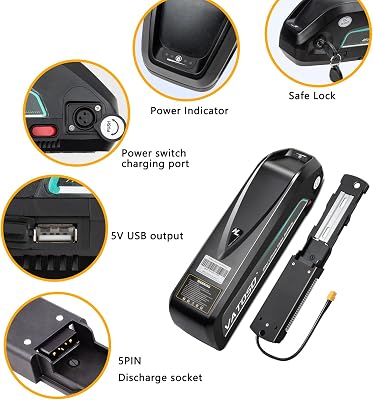
The card also lists things the bullets never mention: a 5V USB output, a power switch, a safe lock, and a 5-pin discharge socket. The package card shows the XT60 connector as the battery power interface, which conflicts with that 5-pin discharge port. If your bike charges through its discharge port or runs an XT60, ask the seller which port carries motor current before you order. The physical size, 14.2 by 3.5 by 4.2 inches, also appears only on the card, so measure your case against those numbers.
Frequently Asked Questions
Is this battery actually LiFePO4?
Almost certainly not, despite the label. The printed charge window, 36.4V to 54.6V, is 13-series math for ordinary lithium-ion cells. A true 16-series LiFePO4 pack charges at 58.4V. Treat it as a 13S lithium pack and use the included 54.6V charger only.
What size motor can it run?
Plan around 1500W, which the title and the parameter card both state. A 1500W motor draws about 31A at 48V, well inside the 40A BMS. The bullet's 1900W hint leaves almost no headroom and I would not plan around it.
How long does charging take?
Plan on 10 hours with the included 2A charger. The card's 6-7 hour figure does not close against the title's own 2A claim, and 10 hours is the safe planning number.
Will it fit my bike?
The card gives 14.2 by 3.5 by 4.2 inches and 9.3 pounds. Measure your battery case against those numbers before ordering, because the listing names no bike brands and no mounting standard beyond the included base.
The decision comes down to amps and connector
If your controller draws more than about 27A, the 30A covered sibling caps you and this 40A shell is the VATOSO pack to buy. If you run a 750W motor, the cheaper shell does the same job for less money and has a longer owner record behind it. On price per watt-hour this pack sits in the cheaper third of everything we track, which is a fair deal for 960Wh, but the deal is only good if the amps are ones your bike can actually use. Meter the capacity on arrival, weigh the box against the printed 9.3 pounds, and keep the 54.6V charger as the only charger that ever touches it.