Lithium iron phosphate is the chemistry you buy for cycle life, and it usually costs more per watt-hour than the ordinary lithium-ion inside most e-bike packs. That is what makes this BtrPower 48V 25Ah pack worth a close look: on our price-per-watt-hour table it sits in the cheapest third of everything we track, and the label claims the long-life chemistry anyway.
The printed evidence cuts both ways. The listing's voltage chart closes the phosphate arithmetic to the volt, which most budget packs never manage. The same page also carries three motor claims that disagree with each other, a weight figure that cannot be true for the capacity beside it, and a rating record the seller's entire ladder shares.
I will decode the chart first, settle the motor question with the board's own math, weigh the weight claim, and finish with what the record can and cannot tell you before you order.
The voltage chart tells you what you are really buying
The state-of-charge card is the most useful single thing on the page. It prints a full chart: between 53.6V and 58.4V the pack sits at 99 to 100 percent, 52.8V reads about 70 percent, and anything under 50V is effectively empty. Those numbers are not invented.
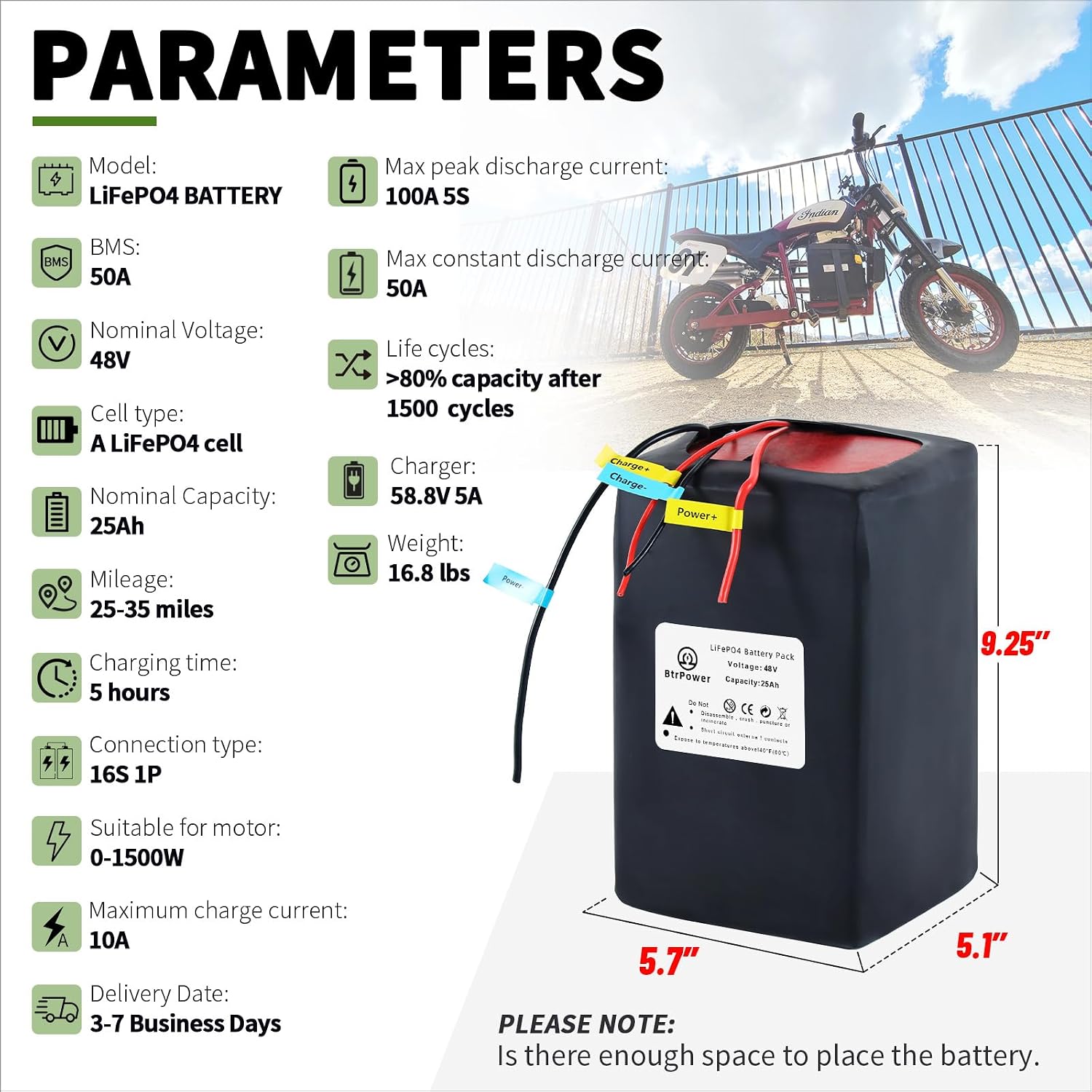
Sixteen phosphate cells in series at 3.2V nominal come to 51.2V, sixteen at the 3.65V maximum charge voltage Wikipedia lists for this chemistry come to exactly 58.4V, and the chart's near-full floor works out to sixteen cells at 3.35V. The parameter card even states the connection outright: 16 in series, 1 in parallel.
That arithmetic settles the chemistry question the honest way. Packs that claim phosphate and then charge at 54.6V are usually ordinary 13-series lithium wearing the wrong label, a fault I have caught on other listings. This one cannot be charged by a 54.6V charger at all, so the included 5A charger, or any other 58.4V-class phosphate charger, is not a suggestion. It is the only equipment that works.
The chart also explains the double 48V/52V labeling. A 16-series phosphate pack rests at 51.2V, which sellers round down to 48V for the motor market and up to 52V for the controller market, and controllers that accept either voltage handle both readings.
Charging time holds up too: the card claims about 5 hours, and 25 amp-hours at the 5A charger is a 5-hour floor before the taper that slows the final stretch.
Three motor claims, one 50-amp board
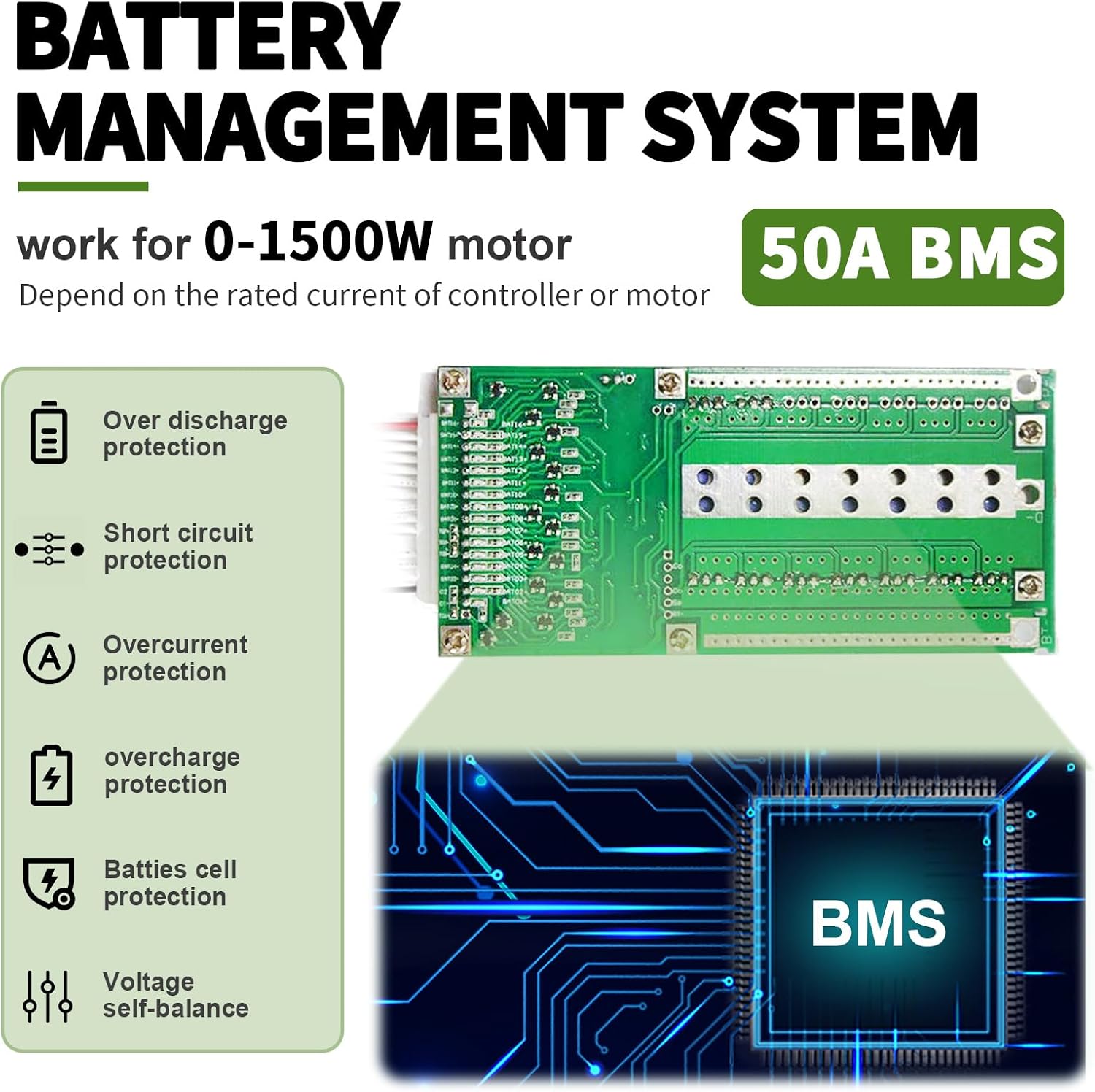
Now the argument. The bullet text says the 50A BMS supports motors from 250W to 3000W.
The parameter card and the variant ladder both say 0 to 1500W. The board's own math says a 50A limit at 48V tops out at 2,400W. Those are three different answers to one question.
The card wins, and not just because it appears twice. A 1500W motor draws about 31A at 48V, which sits inside the 50A board with real headroom. The 3000W figure would need 62.5A, more than the board can deliver, so it is copywriting rather than a specification.
The equipment card even states the matching rule: your controller should be rated 48V or 52V and no more than 50A. Plan around 1500W and the numbers agree with each other. Plan around 3000W and the listing has already contradicted itself.
The peak figure deserves a word too. The card allows 100A momentary discharge, which covers the startup surge a hub motor asks for when you launch from a stop. That is normal for a 50A continuous board, and it is one of the few claims on the page where the printed number and the chemistry's behavior line up without argument.
The printed weight does not add up
Here is the number I would not take to the bank. The parameter card prints 16.8 pounds, which is 7.6 kilograms. The pack claims 1,200 watt-hours.
Phosphate cells run 95 to 172 watt-hours per kilogram at the cell level, so 1,200 watt-hours of bare chemistry weighs between 7 and 12.6 kilograms before you add a single gram of case, BMS board, nickel strip or Anderson connector. A finished pack always lands below cell-level density, which means the printed 7.6 kilograms needs cells at the very top of the band and packaging that weighs almost nothing.
Compare that with the 30Ah sibling shell we decoded the same day, which prints no weight anywhere. Both approaches leave you with the same homework, but this one is worse in a way: a number that is printed and wrong is a stronger signal than a number that is missing.
The 16S1P line means each series string is a single 25Ah cell, and large prismatic phosphate cells in that size do exist, so the claim is not impossible. It is just on the wrong side of plausible. Weigh the box on arrival, and if it comes in far under 10 kilograms, meter the capacity before your return window closes.
One record shared by the whole ladder, and a bigger sibling at the same price
The 4.2 from 13 ratings on this page is not this shell's record alone. The 30Ah sibling on its own listing prints a rating record from the same pool, and the 15Ah shell we rebuilt earlier in October belongs to the ladder too.
Amazon pools ratings across the variants of one parent listing, and this parent runs from 36V to 72V with capacities from 15 to 80 amp-hours. Those 13 ratings could sit on any shell in the store, so read the star value as evidence about BtrPower's ladder, not about the 25Ah pack you would be ordering.
The written reviews behind the record were not reachable while I worked, so nobody I can quote has metered this specific pack.
The value story is real but it has a twist. At about 22 cents per watt-hour this shell sits in the cheapest third of our full battery table, and for a genuine phosphate pack that is unusual, because the chemistry normally trades you a higher price for the cycle life.
The twist is the sibling: the 30Ah shell costs the same as this one, and it gives you five more amp-hours for the money. Same case size, same 50A board, same chemistry math. Unless the 30Ah is out of stock when you order, the bigger pack is the better buy, and the specs box beside this review renders the live figures for both.
Frequently Asked Questions
Is it really lithium iron phosphate?
The printed voltages say yes. Sixteen cells in series at 3.2V nominal, a 58.4V charge ceiling and a 53.6V near-full floor all match the chemistry's real arithmetic. Use only 58.4V-class phosphate chargers, never the 54.6V charger from an ordinary 13-series pack.
What size motor can it run?
Plan around the card's 1500W ceiling, which draws about 31A at 48V and stays well inside the 50A BMS. The 3000W figure in the bullet text exceeds the board's own 2,400W limit and should not be used for planning.
How long does charging take?
The card's 5-hour claim matches the floor: 25 amp-hours at the 5A charger, plus extra for the taper. Do not substitute a 54.6V lithium charger, which can never bring a 16-series phosphate pack to full.
Can I trust the listed weight?
No. The printed 7.6 kilograms sits below what 1,200 watt-hours of phosphate chemistry plus a case should weigh. Treat it as a marketing figure, weigh the box on arrival, and meter the capacity before the return window closes.
The bigger sibling wins at the same price
The chemistry story here is genuinely good: a voltage chart that closes to the volt, a conservative cycle claim, a charge-time figure that matches its own arithmetic and a price per watt-hour in the cheapest third of the table.
What holds it back is everything around the chemistry, a motor claim the page itself outvotes, a weight that argues against the capacity, and a rating record spread across a ladder of shells. Order the 30Ah shell first if your case fits either, take this 25Ah when stock or timing forces the choice, and keep the delivery scale handy either way.