Phosphate chemistry is the long-life answer in the e-bike battery market, and it rarely comes cheap, which is why one of the cheapest 48V phosphate shells we track deserves a close look before you click order. The listing for this BtrPower 48V 20Ah battery sells a 16-series phosphate pack with a 40A board, a 3A charger in the box and a price per watt-hour in the cheapest fifth of everything on our table.
The page gives with one hand and hides with the other. The voltage arithmetic closes to the volt, the best sign that a phosphate label is real. The same page states the motor ceiling three different ways, claims a charge time its own charger cannot deliver, and never prints the pack's weight at all. The written record is one five-word review. I worked through every printed number, so you know which ones to trust and which ones to test on arrival.
Three motor ceilings, one 40-amp board
Count them with me. The specification table lists maximum power at 1000 watts, and it says so twice, once as output wattage. Both bullets and the parameter card put the motor ceiling at 0 to 1500W. The variant row calls this shell 250 to 2000W. Three different ceilings, printed six times, and the page never says which one to plan around.
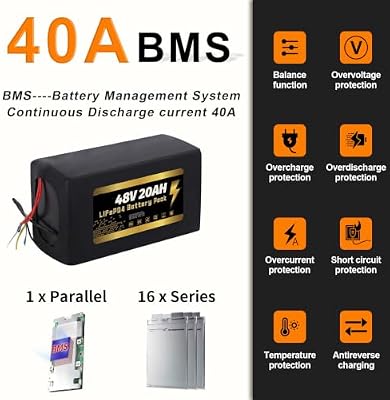
The board's own math sorts them. A 40A limit at the pack's 51.2V nominal tops out near 2,048W, so every printed figure fits inside the hardware, and the page is arguing about copywriting rather than physics. For planning, the 1500W figure that appears twice is the honest one: a 1500W motor draws about 29A at 51.2V, inside the board with room for the startup surge, which the card says reaches 80A for five seconds. The 1000W table figure draws about 20A and leaves even more headroom. The 2000W variant-row figure would pull about 39A continuously, which sits inside 40A with nothing left, so I would not plan around it.
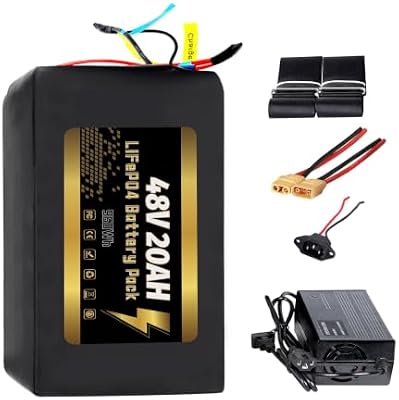
One practical note hides in the box list: the pack ships with XT90 connectors, the heavy-duty plug in this market, and a 3-pin auxiliary plug beside it. Match the XT90 against your bike's connector before ordering, because adapters are cheap but return shipping is not.
The phosphate arithmetic closes, and the charger number stretches it
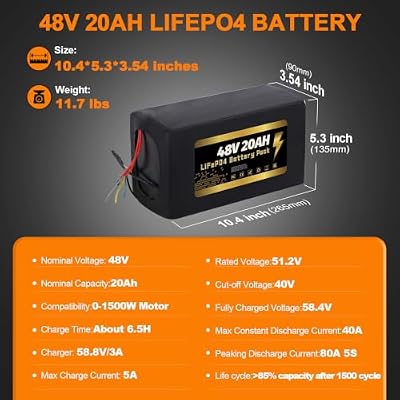
The good news first. The card's voltage ladder is exactly right for a 16-series phosphate pack: 51.2V nominal is sixteen cells at 3.2V, 58.4V full is sixteen at the 3.65V maximum the chemistry allows, and the 40V cutoff is sixteen at 2.5V. The BMS card even draws the layout, sixteen cells in series and one in parallel. Fake phosphate labels usually betray themselves at 54.6V, the charger voltage of an ordinary 13-series lithium pack, and there is no 54.6V anywhere on this page.
Then the stretch. The card prints the charger at 58.8V, while the bullet's own chart ends its full-charge band at 58.4V. That is a 0.4V disagreement between two claims on the same page, small but real, and it repeats a habit this family has: we caught the 25Ah shell's chart forcing the 58.4V rule while this card edges past it. The practical reading stands either way. The matched charger comes in the box, so use it, and never substitute the 54.6V charger from an ordinary lithium pack, which can never bring a 16-series phosphate pack to full.
The charge-time claim misses in the other direction. The card says about 6.5 hours, and 20 amp-hours at the 3A charger in the box needs 6.7 hours before the taper that slows the final stretch. The claim rounds below its own floor, the same small fault we counted on two other listings this month. Expect closer to seven and a half hours in practice, and treat the printed 6.5 as optimism rather than a spec.
No weight anywhere on the page
Here is what the listing leaves out, and it is the one number a buyer cannot check any other way. The specification table, the bullets and the parameter card print no weight for this pack at all.
The chemistry sets the floor, and Wikipedia's phosphate page states it plainly: 95 to 172 watt-hours per kilogram at the cell level. So 960 watt-hours of bare cells weighs between 5.6 and 10.1 kilograms before the case, board and wiring add their share. A genuine 20Ah phosphate pack of this shape should land somewhere in the mid-single-digit kilograms, and the seller asking you to order one blind is asking you to trust a capacity claim nobody on the page has to defend.
The contrast inside the family is instructive. The 25Ah sibling prints a weight that cannot be true for its capacity, which we flagged as the stronger signal, because a number that is printed and wrong tells you the listing does not check itself. This shell prints nothing, which leaves you with the same homework by a quieter road. Weigh the box on arrival, and if it feels dramatically lighter than the mid-single-digit kilograms the chemistry demands, meter the pack before your return window closes.
The record you cannot read, and the family you can
The rating record here is two global ratings and one written review, and the written review says, in full, that the pack fits the buyer's device well. The text carries no purchase badge, no bike model, no mileage and no capacity check. This shell's title also sells the same hardware from 15 to 50 amp-hours, so those two ratings belong to the whole variant ladder rather than to the 20Ah box you would receive.
What you can read is the family's decoded behavior, because we have been through this ladder shell by shell. The 30Ah sibling is the value pick at about 18 cents per watt-hour, and the 25Ah shell lands near 21.6. This 20Ah pack works out to about 20.6 cents per watt-hour, in the cheapest fifth of our full battery table, which makes it the cheapest way through the family's door rather than the best value per unit of capacity.
The cycle claim deserves its own sentence. The card promises more than 85 percent capacity after 1500 cycles, which sits below the 2,500 to 9,000 cycle range Wikipedia reports for real phosphate cells. That is a conservative promise, and conservatism is the right direction, but nothing on this page proves the pack reaches either number. The manufacturer of record is Shenzhen Lian Pai Yuan Technology, a factory name that has shown up behind other budget shells we track, which is context rather than a verdict.
Frequently Asked Questions
Is it really lithium iron phosphate?
The voltages say yes. Sixteen cells at 3.2V nominal, a 58.4V full charge and a 40V cutoff match the chemistry's arithmetic to the volt, and no 54.6V figure appears anywhere on the page. Use only the matched 58.8V-class charger from the box.
What size motor can it run?
Plan around 1500W, the figure the bullets and the card agree on. That draws about 29A at 51.2V and stays inside the 40A board with surge room. The 2000W variant-row figure would pull about 39A continuously and leaves nothing for startup.
How long does charging take?
Plan on about seven and a half hours with the included 3A charger, not the card's 6.5. Twenty amp-hours at 3A is a 6.7-hour floor before the taper, so the printed claim rounds below its own math.
How do I check the capacity claim?
Weigh the box first. The chemistry demands mid-single-digit kilograms for 960 watt-hours before packaging, and the listing prints no weight to hold it to. Then meter a full charge-discharge cycle inside the return window if the scale gives you doubt.
The cheapest door into the family, with homework attached
This 20Ah shell carries the family's best trait, a voltage ladder that closes to the volt, at a lower price than either the 25Ah or the 30Ah sibling, and it adds a complete box list with the matched charger and the heavy-duty connector included. It also carries the family's habits: a motor ceiling stated three ways, a charge claim that rounds below its own floor, and now a missing weight where the 25Ah shell printed a wrong one. Order it as the cheapest entry into genuine 16-series phosphate, cross-check your connector against the XT90 first, and let the delivery scale settle the capacity question the listing would not.