Bafang motors carry a reputation that stretches across the conversion-kit world, and the company now sells batteries under the same name. The Polly pack is one of them. It targets exactly the buyer who's just finished a kit build and needs something to hang on a downtube.
The motor name is famous. The battery record isn't.
One claim on this listing decides how much trust to hand it. The variant selector labels every rung Samsung Cells, and that's the only place a cell brand appears anywhere on the page. The spec table says Lithium and stops.
This article reads the listing, the gallery cards, and the seven written texts in a record of 19 ratings. The arithmetic gets checked the same way we check every pack we cover.
The BAFANG 48V 20Ah Polly battery sells at 330.00, which works out at about 34 cents per watt-hour for the 960 watt-hour rung. The title still advertises a 13-amp-hour choice that the live ladder no longer lists, so confirm the rung before you buy. The figure our table tracks for this listing renders in the specs box below, and our comparison table is where the rungs compare directly.
The cell claim lives in the label, not the spec table
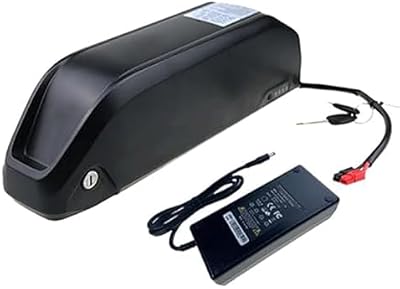
The variant ladder carries three rungs: a 48V 17.5-amp-hour pack rated for motors up to 1500 watts, a 52V 20-amp-hour pack, and this 48V 20-amp-hour pack, both rated to 1600 watts. Every rung carries the words Samsung Cells in its label. Then the details table says Battery Cell Composition: Lithium, and gives no brand, no model, and no cell count anywhere else.
A buyer who asked this exact question in February 2024 has left the most-thanked critical text in the record. The text has asked for the cell brand and the number of cells, called the pack a no-name battery, and noted that the charger works well.
The listing has never answered. A variant tag is marketing copy, not evidence, and a cell brand you can verify looks like a date code on a photo of an opened pack. This listing doesn't offer anything like that.
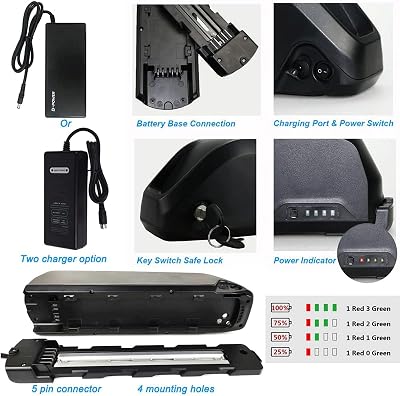
The same text has wondered whether a USB port hides somewhere on the case. The gallery detail card shows a charging port, a power switch, a key switch, and a safe lock, and nothing labeled USB. Treat the port as absent.
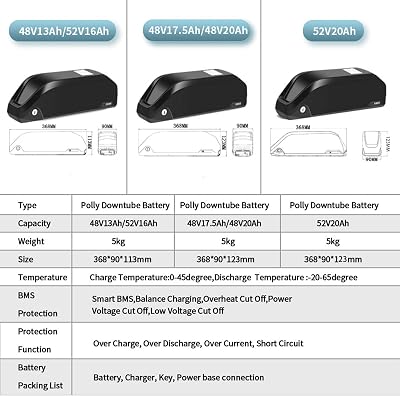
The capacity row in the spec table reads 20 amp-hours, which is right for this rung and wrong for the siblings that share the page. Small thing, but it tells you the details table was written for one rung and pasted across the family.
What the kit-builder's record adds
One owner has built a custom ebike around a Bafang kit, ordered this pack for it, and has put some miles on with no issues so far. The bike is a hunting rig that gets tossed around, and the text has found the factory mount to be the weak point: an aftermarket mount holds the battery much more securely than the one in the box.
The hardware matches the story. The pack seats on a base connection with 4 mounting holes, locks with a key switch and a separate safe lock, and connects through a 5-pin connector. If your build sees trail vibration, the record's one long-term owner has already told you which part to upgrade, and it's not the battery.
If you're still choosing the motor side of that build, our BAFANG BBS-HD kit review covers the mid-drive option and its own owner record.
Three motor claims and one BMS number
The title sells the pack for 500W, 750W, 1000W and 1500W motors. The variant ladder rates this rung for 0 to 1600 watts.
The bullet narrows it again: a 48V pack suits 500W to 1000W motors, and 52V suits 1000W. Three numbers, no agreement.
The details table settles it the honest way. The amperage row reads 20 amps, and 20 amps at 48 volts is a 960-watt ceiling.
The 52V rung would cap at 1040 watts. A 1500-watt motor can be wired to this pack and it will spin, but the BMS will never let the pack deliver 1500 watts. The bullet's 500W-to-1000W band is the claim the hardware actually meets, and anyone planning around the bigger numbers should plan around 960 watts instead.
The weight closes. The card says 5 kilograms and the details table says 11.02 pounds, which is the same thing, and 960 watt-hours at 5 kilograms is about 0.19 kilowatt-hours per kilogram at pack level. That is the high end of what packs in this class weigh, and it leaves little room for the case, BMS and wiring to be heavy.
The card then lists the same 5 kilograms for the smaller rungs, which cannot be true across rungs of different capacity, so read the weight as this rung's number only.
The size deserves a tape measure before you order. The card says 368 by 90 by 123 millimeters, which matches the details table's 14.49 by 3.54 by 4.84 inches. A gallery drawing of the same case shows 34 by 6.5 by 5.9 centimeters.
The card and the table agree with each other and the drawing disagrees with both, so measure your mount and trust the tape over the drawing.
The charger question, three answers
The title says with Charger and Key. The packing-list card says Battery, Charger, Key, Power base connection.
The Included Components row says Lock, and nothing else. Two answers point to a charger in the box and one doesn't.
The February 2024 text has confirmed the practical side: the charger works well. That's one owner, and the row that lists a lock alone is still a row the seller wrote. If the charger is the reason you're shopping, ask before you order rather than assume either way.
The listing never states a charge current, so no honest charge-time math exists. Any hour figure would be invented. What the listing does give is the indicator: one red and three green lights together means the charge is complete, and one red with two or one green means it's still going.
One April 2025 text has found a lockout of a different kind. The owner's previous lookalike pack charged from a solar panel, and this one refuses it, so wall charging is the only path.
The listing says nothing about solar input either way. That is the owner's report, not a documented spec, and it matters most to off-grid builders who were counting on panel charging.
One August 2024 buyer reported the pack arrived about 75 percent charged after shipping from California, which matches the partial-charge shipping practice used across the industry. The card gives a charge window of 0 to 45 degrees and a discharge window of -20 to 65, which sits in line with standard guidance on heat and lithium-ion aging.
The range texts, decoded
Two texts in the record make range claims. A March 2026 five-star text says the battery holds a charge for 70 miles, and it carries no purchase badge. An October 2024 text says 65 miles in one session with 40 percent left over.
Decode both and they describe assist-mode riding. Sixty-five miles on 60 percent of 960 watt-hours is about 9 watt-hours per mile.
Seventy miles from a full charge is about 14. Both figures are normal for light pedal assist on gentle ground, and neither text names the assist level, the terrain, or the rider.
Plan on the site-wide figure instead. At a realistic 20 to 25 watt-hours per mile, 960 watt-hours carries you about 38 to 48 miles, and heavy throttle use sits at the bottom of that band. When a listing or a review promises more, check what mode the number came from before you plan a route around it.
Frequently asked questions
Does the BAFANG Polly pack include a charger?
The evidence leans yes and the listing argues with itself. The title says charger, the packing-list card names a charger, and one owner has confirmed the charger works well.
The Included Components row lists a lock and nothing else. If the charger is the part you need, ask the seller, because the details row will not settle it.
Can it run a 1500W motor?
The title and the ladder say yes, the amperage row says no. Twenty amps at 48 volts is a 960-watt ceiling, and no wiring changes that. A 1500-watt motor paired with this pack is a motor running at about two-thirds of its rating.
How far does it go on a charge?
About 38 to 48 miles at the 20 to 25 watt-hours per mile this site plans around. The review texts that claim 65 and 70 miles describe light pedal assist, about 9 to 14 watt-hours per mile once you do the arithmetic.
Who should buy this pack, and who should look elsewhere?
Kit builders who need a 368-millimeter downtube shell with a 5-pin connector and a base-mount battery are the target buyer, and the one long-term owner record is a good sign for that use.
Buyers shopping on price per watt-hour should compare the 48V 20Ah Unit Pack Power pack we reviewed, which sells in the same 960-watt-hour class with a similar cell claim you cannot check, and our comparison table for the live figures. The 52-volt rung of this family sells on the same listing if your build runs 52 volts, and we have covered that rung separately in the 52-volt Polly review.