Converting a bike with a mid-drive motor used to be a decision you made once and never thought about again. You picked a Bafang, you bolted it in, and every kit spoke the same simple language to your display and battery. That era is ending, and it is ending in a way no product page explains.
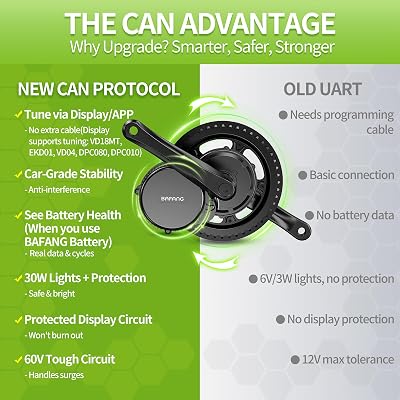
Bafang now ships two communication systems across its mid-drive lines. UART, the older one, is the open standard a decade of tuning tools was built around.
CAN, the newer one, comes from the car industry, and most hobby software cannot touch it. Which one is inside the box you receive depends on when it was made, and the listings have not caught up with their own factories.
That is the situation this kit sits in. The page title promises the open system, and two of the seven people who wrote about it say the CAN version arrived instead. What follows walks through what the owners actually received, what the installation really costs in time and extra parts, and where this kit lands on price against the 191 conversion kits we track.
The UART promise meets the CAN lottery
The headline feature on this listing is a protocol you cannot see. Bullet one sells an "open system": classic UART, third-party firmware, tuning tools spread across the communities, and DIY riders setting their own assist levels, speed limits and current limits. For a certain kind of buyer that promise is the whole reason to pick a Bafang mid-drive over a sealed hub motor.
The record says the promise is a lottery. One owner, someone who has installed four BBS02 kits in their time, counted this one as the first to arrive speaking CAN bus rather than UART.
Another went further and rated the kit two stars for exactly that reason: the model they received "used the CAN protocol, it's impossible to program", they could not even make the startup quicker, and they called the money wasted.
A third owner sidestepped the problem by buying the bridge from the seller, who added a bus cable so their older components could talk to the kit. That owner has described the fitting problem in their own words: working between Bafang's hub motors, its older mid-drives, and the protocols on the new lines.
CAN itself is not exotic. It is a message-based bus standard designed at Bosch starting in 1983 and released to the car industry in 1986, built so several controllers can share one wiring run (Wikipedia). Cars use it to cut copper, and Bafang uses it for the same reason you would expect, cleaner manufacturing at volume.
The side effect for a hobbyist is that the open tuning ecosystem grew up around UART, and most of those tools cannot reach a CAN unit.
So before you buy, the question that matters more than watts is which firmware generation the box in the warehouse speaks. Ask the seller, and ask for the answer in writing.
What the install actually takes
The listing promises installation in 2 to 3 hours with basic tools. The most-voted owner account, the one with the most helpful votes of the seven, opens with the kit working and closes with a shopping list.
The instructions they called garbage, and they went to YouTube and Google more than once to piece together both the assembly and the day-to-day operation. Their notes are worth more than the listing's estimate, because they are the parts nobody puts on a spec sheet.
If your bike has cable brakes and you use the kit's replacement handles, plan on a fresh brake cable, because an old one's end is usually scrunched past re-threading.
A chain breaker belongs on the shopping list too. The kit does include a crank puller and a bottom bracket removal tool, which one owner appreciated, but an old-standard bottom bracket sent them to a bike shop anyway. Mounting a battery rack on new screw holes calls for rivnuts, because a frame's wall is too thin for a tapped hole and will strip.
Their later addition is the one I would underline for anyone keeping a bike long term: a shop recommended an offset chainring of around 8mm, because in the lowest gears the chain runs at a sideways angle to the front ring and chews both chain and sprockets. They found 11mm on Amazon, with the warning that too much offset can rub the frame.
Against all that, a second owner called the install simple: colour-coded cables, the specialty crank tools in the box, and only the speed sensor alignment described as fiddly. Both accounts can be true at once. A recent frame with a standard bracket and disc brakes is the 2-to-3-hour case.
Anything older turns into a parts hunt, and the instructions will not carry you through it.
What the money buys on our table
At 357.99 when checked, this kit sits among the most expensive of the 191 conversion kits we track, and the comparison table shows its live position against everything cheaper. That is the honest framing: this is not a value pick, and nothing on the page pretends otherwise.
What the price buys is a mid-drive layout, where the motor turns the cranks instead of the wheel, so the bike's own gears multiply the motor the same way they multiply your legs.
The listing quotes 120 Nm at the 750W setting and 160 Nm at 1000W, with claimed top speeds of 55 and 60 km/h. No owner has put a number against those claims, so they stay the listing's words, not ours.
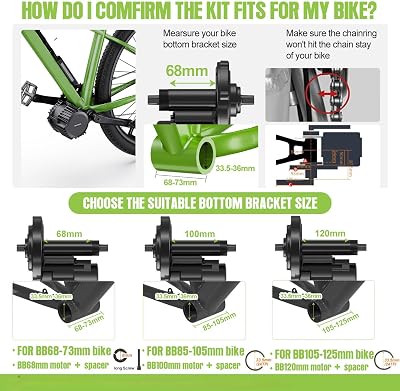
The fit rules are narrower than a hub kit's: a JIS bottom bracket between 68 and 73mm with an inner diameter of 33.5 to 36mm, a chain drive with disc or V-brakes, and no carbon frames or coaster brakes.
The spec table's own row says 48 volts and 750 watts, which reads oddly against the 1000W headline, so ask the seller which rating applies before you size the battery. There is also a Single Motor option that omits the chainring, crankset and speed sensor, and the listing itself begs you not to order it by mistake.
The seller carries the after-sale load
Here is the part of the record I did not expect: three of the seven owners, unprompted, wrote about the seller rather than the motor. A wrong battery in one order was swapped fast once flagged. A controller fault that surfaced a month in, after the return window had closed, still got a real troubleshooting session and a replacement part.
And the bus cable from the protocol section was added without being asked for. The warranty row is smaller than the service record: 30 days for returns, 365 days for repair or replace, then lifetime technician guidance. One year is short against how long a motor like this can last, and the record suggests the practical path for anything past year one runs through the seller's own people.
The record is thin, and it is worth knowing where. Eight ratings is a small base for a 3.8 average, nobody has reported measured range, real-world speed against the 55 and 60 km/h claims, or how the motor handles a wet winter.
The one rider who described their use pattern runs it exclusively in pedal assist. That gap is not a scandal, it is just a young listing, and the star history on it has barely started.
Three checks before you order
Measure your bottom bracket first, because the 68-to-73mm JIS window is hard and one owner needed a shop for an older standard. Then ask the seller which protocol the current stock carries, UART or CAN, and treat a vague answer as the answer.
And budget past the box: brake cable, chain breaker, maybe an offset chainring and an hour of shop time, rivnuts if the rack needs new holes.
Buy this kit for the motor, the mid-drive layout and the seller's record. Buy it for the tuning promise only if the seller confirms the kit speaks UART, because that promise is the one thing the box cannot guarantee about itself. If the motor interests you but the price does not, our BBS02B sibling review covers the cheaper end of the same family.
FAQ
Does this kit include a battery?
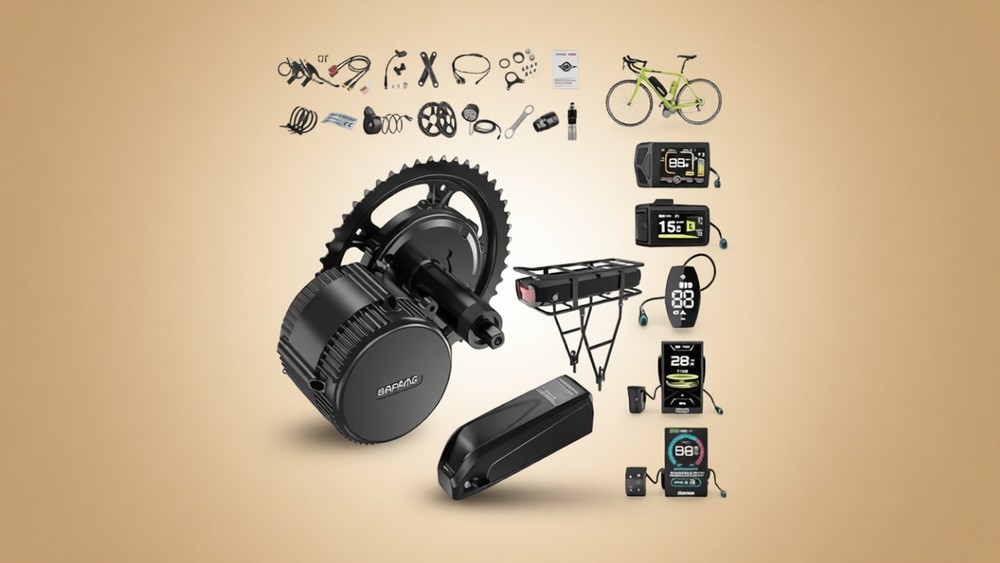
Not by default. The title lists the battery and display as optional, and one owner ordered a 500W build with a 48Ah battery pack.
Another owner received the wrong battery entirely and had it replaced quickly after telling the seller. If you order a bundle, check the pack against the invoice before you start the install, because the motor will not be the thing that goes wrong on day one.
Can you program this kit with the usual tuning tools?
Only if your unit speaks UART. The listing promises an open system with third-party firmware and tuning tools, but one owner received a CAN version and found it impossible to program, down to the startup behaviour. Another counted it as their first CAN-bus unit after three earlier installs.
The seller has bridged mixed setups with a bus cable before, so it is worth asking which protocol is in stock before you pay.
Will it fit my bike?
The window is JIS bottom brackets from 68 to 73mm long with an inner diameter of 33.5 to 36mm, a chain drive, and disc or V-brakes. Carbon frames and coaster brakes are out by the listing's own text. If your crankset bolts on with a different standard, budget for a bike shop visit like one owner did.
How long does installation really take?
The listing says 2 to 3 hours with basic tools, and one owner did call it simple with the colour-coded cables.
The most detailed account needed YouTube, Google, a fresh brake cable, a chain breaker and eventually a shop's help, and added rivnuts and an offset chainring along the way. A recent frame lands near the listing's estimate. An older one becomes a weekend with a parts run in the middle.
What warranty comes with it?
Thirty days for returns, 365 days for repair or replace, and lifetime technician guidance, per the spec table. The year of parts coverage is shorter than the motor's likely life, so the useful expectation is the seller's support, which has a good record in these reviews for swaps, post-window parts and unasked-for adapter cables. If it isn't the right fit, the conversion kit comparison table sorts every option we track.