Bafang sells this Polly pack on the same page as the 48-volt version we covered, and the two rungs look identical until you read them closely. The 52-volt rung carries more capacity for a modest bump in price, and its owner record is the better one: nine written texts, every one of them purchase-badged, and the most-helped text does something rare. It identifies the original equipment the pack matches.
That text also carries the warning this article leads with. The connector on the pack did not match the connector on the buyer's controller, and the fix took a swap and a voltage check before plugging in.
Two of the nine texts involve an adapter or a connector swap of some kind. If you are feeding a kit or a used bike, the plug decides everything.
The BAFANG 52V 20Ah Polly battery sells at 349.00, about 34 cents per watt-hour for the 1040 watt-hour rung. That's a hair under the per-watt-hour price of the 48-volt sibling we covered the same week, with 80 more watt-hours to ride on. The figure our table tracks for this listing renders in the specs box below, and our comparison table carries the live numbers.
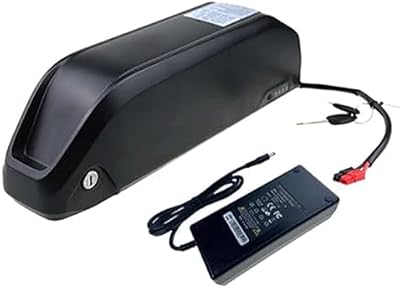
The Revv1 identification, and why it matters
The most-helped text in the record, twelve helpful votes, comes from a Ride1Up Revv1 owner. The claim is specific: this pack carries quite literally the same battery and cells from the same manufacturer as the motor and battery on the Revv1, and the only differences are the charger connector, which the owner says Ride1Up made proprietary, and the small hardware details.
The same owner swapped in a male connector because the pack shipped female, checked the voltage before plugging it into the controller, and reported doubled range with a small boost at the top end. Read that as a fitment procedure, not just a review. Match the connector, check polarity with a meter before the first connection, and only then power up.
A second text points the same direction from the kit world. One March 2025 owner has run the pack on a 1000-watt Bafang mid drive at 20 mph over hilly roads and has covered 30 miles on a ride, with an adapter cable between pack and controller. If you're building around a Bafang motor, our BBS-HD kit review covers the mid-drive side and its own record.
The 52-volt arithmetic, checked
Fifty-two volts times 20 amp-hours is 1040 watt-hours, and the price works out at about 34 cents per watt-hour. A 52-volt pack is a 14-cell layout, 14 cells at 4.2 volts being the 58.8-volt full-charge mark. Nothing on the page argues with that arithmetic.
The power claims split the same way they do on the 48-volt page, with one difference in the buyer's favor. The amperage row reads 20 amps, and 20 amps at 52 volts is a 1040-watt ceiling.
The bullet says the 52-volt pack suits 1000-watt motors, which sits just under the ceiling. That's honest. The ladder's 0-to-1600-watt label and the title's 1500-watt figure are aspirational, and a 1500-watt motor on this pack runs at about two-thirds of its rating.
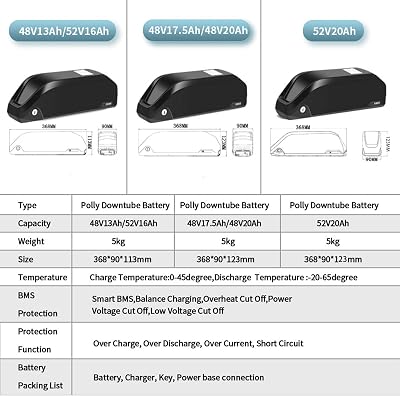
The weight repeats the family pattern. The details table says 11.02 pounds, the card says 5 kilograms, and 1040 watt-hours at that weight is about 0.21 kilowatt-hours per kilogram at pack level, the demanding end of what packs weigh.
The card then prints the same 5 kilograms for every rung in the family, which cannot hold across different capacities, so read the weight as this rung's figure and expect the real pack to sit a bit heavier.
One small listing wart is worth knowing before you cross-reference anything. The 48-volt page prints a model row that names the pack and its watt-hours. This page's model rows read just 20AH and 52V, and the watt-hour figure is gone.
The card, shared across the family, still lists this rung at 368 by 90 by 123 millimeters.
Two failures and a histogram with no middle
The variant histogram on this page reads 88 percent five stars and 12 percent one star, with nothing in between, over the pooled record of 19 ratings. The 48-volt page prints a different split over the same count. Each rung page draws its own histogram, so read the one on the page you're buying from.
Both one-star texts are captured and both are purchase-badged. One is a single line: the battery was a dud.
The other has more to teach. One owner has reported a pack that died a little over a month in, won't charge, a support message with no answer, and no return option. The listing prints no warranty row, so the practical lesson is the one that owner paid for: test the pack hard in the first weeks, while a return is still an easy ask.
Against that, seven of nine texts are five-star purchase-badged reports, three of them naming specific bikes, motors or mile counts. Two ratings cannot settle a reliability question either way, and a 19-rating pool is small. We say that plainly rather than pretend the histogram is decisive.
The fuel gauge, and the voltmeter that replaced it
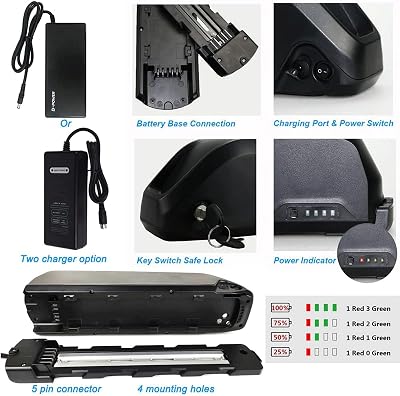
Two owners in nine describe the same fault: the remaining-capacity display doesn't read true. One September 2024 text has noted the gauge misreporting after rides. One February 2025 owner has worked out a workaround worth copying.
The screen shows output volts, and the owner has learned to recharge when the reading falls to around 47 or 48 volts.
That's the steadier instrument. Percentage gauges estimate state of charge, and the estimate drifts with load and age, while a voltage read is a measurement.
On a 14-cell pack the voltage floor also tells you when you're deep into the pack, which is exactly when a percentage gauge is least trustworthy. If your display offers both, trust the volts.
The range texts, decoded
The deepest range text describes minimal-assist riding: about 30 miles covered with 89 percent of the pack left. That works out at under 4 watt-hours per mile, which is what riding on the pedals with the motor barely helping looks like.
A November 2024 text has guessed 80 to 90 miles at moderate assist levels 3 to 4 on a Bafang BBSHD, which decodes to about 12 watt-hours per mile. Both are assist-mode figures.
Plan on the site-wide figure instead. At a realistic 20 to 25 watt-hours per mile, 1040 watt-hours carries you about 42 to 52 miles, and throttle-heavy riding sits at the bottom of that band. The pack's extra 80 watt-hours over the 48-volt sibling buys roughly 3 to 4 miles of honest range, not the doubling the assist-mode texts can suggest.
Frequently asked questions
Will a 52V pack run on a 48V bike?
One owner has done exactly that, on a used bike with an existing 48-volt setup, and has reported it working well. The bullet's own wording covers both voltages. The caveats stand anyway: your controller and charger both need to agree with the pack's voltage, and the connector match is the check that actually bites.
Does it include a charger?
The evidence leans yes. The title says charger, the family packing card names a charger, and one May 2026 owner has confirmed the pack performed and came with a good charger.
The details row lists a lock and nothing else, the same three-way split as the 48-volt page. The full decode is in the sibling article.
How far will it go on a charge?
About 42 to 52 miles at the 20 to 25 watt-hours per mile this site plans around. The owner texts that claim 30 miles at 89 percent or guess 80 to 90 describe light pedal assist, and the arithmetic behind both is in the range section above.
Who should buy this rung instead of the 48V one?
Riders whose controller already speaks 52 volts, and Ride1Up Revv1 owners matching their original pack, get the most out of this rung. If your system is 48 volts and happy, the 48-volt sibling costs less for almost the same per-watt-hour price. Either way, confirm the connector type on your controller before you order, because two of the nine owners had to adapt theirs.