The recorded spec box, three owner texts and a family of sibling rungs still on sale survive. Nobody captured the price before the listing went down, so this pack's value per watt-hour can't be computed by anyone now, and the honest move is to say so.
The sections below work through what the record holds: the connector question the 50-amp board raises, the charge math that survives checking, and the checks worth running on any 48V replacement before paying for it.
The rung the ladder left out
ZLSHELIBK's 48V 17.5Ah pack is gone from Amazon. The Amazon page for this ASIN returns Page Not Found as of November 1, 2026, and the API rejects the identifier, so the listing can't be bought or re-checked.
What follows is a rebuild from the recorded listing data, in the same way we handle every retired pack we cover, because people still own this battery and still search for information on it.
Here's the odd part. The listing's own variant list named six rungs of the family: 36V 10.6Ah, 48V 21.2Ah, 52V 21.2Ah, 52V 31.8Ah, 72V 15Ah and 72V 20Ah. The 17.5Ah capacity of this listing appears nowhere in that list.
The brand's own ladder left out the rung it was standing on, which reads like a title written for search engines rather than a rung the seller managed as part of a line.
The price is a second gap. No scrape, no data row and no previous article captured a price for this ASIN before the listing died. Value per watt-hour, the number our comparison table sorts by, is permanently unknowable for this pack.
What is known is the family's pricing habit: every surviving ZLSHELIBK rung sits between 0.29 and 0.36 per watt-hour, which puts the brand in the expensive third of the market even before this rung's own figure vanished.
What the recorded box holds
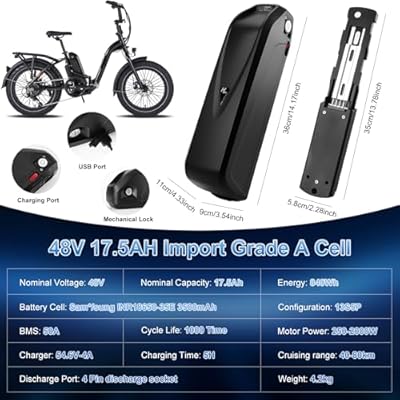
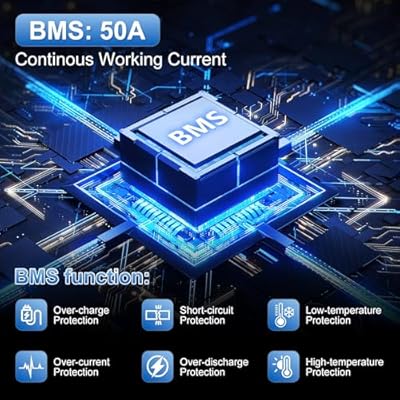
The recorded specs survive intact. 48V nominal at 17.5Ah works out to 840 watt-hours, and the multiplication closes exactly: 48 times 17.5 is 840. The discharge board was recorded at 50A continuous, with overcharge, over-discharge, overcurrent and short-circuit protection.
The case is the HL03 hailong style, which mounts to the downtube on a bracket. The charger was recorded at 54.6V and 4A. The warranty ran 24 months, and the manufacturer was recorded as Dongguan Batterysea Energy Co Ltd.
Three figures a replacement buyer actually needs were never recorded: the weight, the dimensions and the discharge connector type.
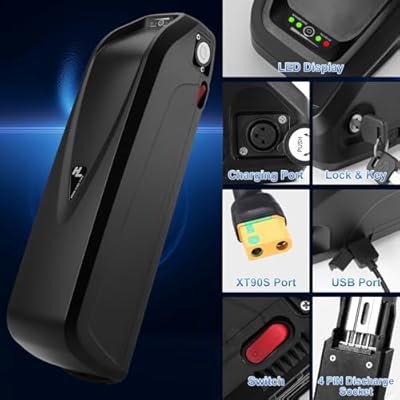
The old listing skipped all three, and no owner text fills them in. Many HL03 packs carry an XT60 or Anderson connector, but that's a family habit, not a fact about this pack. The record and the listing fail on the same gaps, which is worth knowing before anyone chases a used one of these.
The cell claim was Grade A imported cells with a 1000-plus cycle lifespan. The cell model itself was never stated, and that omission matters in the cycle-life math below.
The 50A board meets the connector's amp class
On paper the power side is comfortable. A 50A board on a 48V system delivers 2,400W continuous, and the claimed 2000W motor ceiling draws about 41.7A at full load. That leaves roughly 17 percent of headroom under the board, so a 2000W build sits inside the limit.
A 1000W motor draws about 21A and a 750W motor about 15.6A, both deep inside the figure.
The case tells a different story. The Hailong 01/02/03 case family uses standardized discharge connectors, and a parts seller documents their amp classes plainly: 4 blade contacts carry 20 to 25A, 5 golden round contacts carry 25 to 30A, and 6 round contacts carry 30 to 35A. Every standard pin count of the case this pack uses tops out below the 50A board behind it.
Unless the seller ran a non-standard or doubled-up discharge path, the connector, not the BMS, set the real ceiling on this pack. The connector type was never recorded, so the question can't be settled now. It's a check worth running on any high-amp hailong pack: read the pin count before you trust the board rating.
Charging and range on 840Wh
The charge estimate is the one number in the record that survives checking. At 4A, refilling 17.5Ah from empty needs at least 4.4 hours, and the recorded five-hour figure clears that floor with room for the charge taper. One owner has reported a full charge in 3 to 4 hours.
Four hours sits right at the floor, and three hours would need more than the charger's rated current, so treat that report as the edge of what the hardware allows rather than the norm. On the 2A chargers common in this price class, the same tank would need at least 8.75 hours, so the 4A brick was a genuine advantage.
Range scales from the em3ev anchor: their table gives a 960Wh 48V pack about 30 to 40 miles on throttle and 50 to 65 on low pedal assist, and 840Wh is 0.875 of that. That works out to about 26 to 35 miles on throttle alone and about 44 to 57 with gentle pedaling. Hills, headwinds and cold trim both figures down.
The old article's 25-to-40-mile guess at moderate assist lands inside the pedal-assist band, so that part of the record holds.
Buying a replacement instead
Since this listing is dead, the practical question is what to check on a replacement.
Three checks cover most of the risk. First, the charger label: a 48V pack is 13 cells in series and full at 54.6V, so the charger must read 54.6V output. A pack shipping with anything else is either mislabeled or a different chemistry.
Second, the connector pin count, read as an amp class using the 20-25, 25-30 and 30-35A bands above. Match it to your motor's real draw. Third, the bracket fit: HL03 cases share a footprint but frames vary in water-bottle-boss spacing, so measure the downtube before ordering.
The live alternatives in the same family carry those answers on their pages. The 48V 21.2Ah sibling sells at 299.99 for 1017.6Wh, about 0.29 per watt-hour, with UL2271 certification and the same 50A board and 4A charger. It carries 177Wh more than this pack did.
At the top of the family, the 52V 31.8Ah sibling runs an 80A board on 1653.6Wh. Both have live listings, which matters more than anything this retired rung can offer: their records can still grow, and this one is frozen.
Frequently Asked Questions
What charger did the ZLSHELIBK 48V 17.5Ah use?
A 54.6V 4A fast charger. That voltage is the mandatory match for a 13-series 48V lithium pack, and the label checks out. A full charge from empty took about five hours, with one owner reporting 3 to 4 hours at the edge of the charger's floor.
What motors was it rated for?
The listing claimed 250W to 2000W. The 50A board's 2,400W continuous ceiling covers the whole range on paper, with the 2000W top drawing about 41.7A and leaving 17 percent headroom. The connector amp class is the caveat, since the Hailong case's standard contacts carry 30 to 35A at most.
How long did the battery last?
Nobody knows, and nobody can now. The record froze at three ratings, none covering long-term cell aging. The 1000-plus cycle claim sits at the top of the 400-to-1,200 cycle band for lithium-ion chemistries, and it closes only if the cells were a long-cycle chemistry, which was never stated.
What form factor does it use?
The HL03 hailong case, mounted to the downtube on a bracket. The weight and dimensions were never recorded, so a cavity match against a specific frame can't be made from the record.
Is there any reason to hunt for a used one of these?
Very little. The pack's own value can't be computed, its specs can't be verified, and its warranty ended with the seller's listing. The live 21.2Ah sibling costs a known 0.29 per watt-hour with a certification behind it, which is a stronger position than anything this rung can offer a buyer now.
Compare every pack we track by price per watt-hour in the battery table, or browse the review archive for the rest of the family.