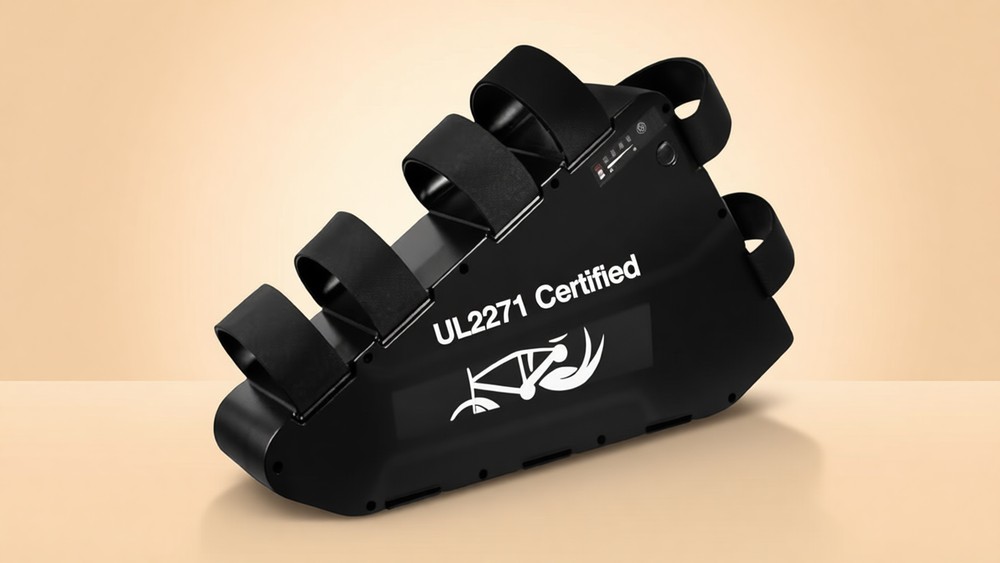
A triangle pack is the only way to carry 1654 watt-hours on a bicycle, and it only works if your frame is big enough to hide it. That single constraint decides more ZLSHELIBK purchases than any spec sheet does.
The 52V 31.8Ah pack claims an 80A BMS, motors up to 3000W, and a full charge in 8 hours. Its model string decodes cleanly into fourteen cell groups in series and six in parallel, which is the honest way to build 31.8Ah. Weight is the puzzle here: at the listed 16 pounds, the numbers strain what complete packs normally achieve, and one of the two figures may be generous.
What follows decodes the listing against itself, checks what fifteen buyers have actually reported, runs the range and charge arithmetic, and states plainly where the price lands among the packs we track.
The ZLSHELIBK 52V 31.8Ah is a big triangle pack with a genuinely big BMS. Eighty amps at 52 volts is about 4160W of continuous headroom, which covers the 3000W top of the motor claim with room to spare. The buyer record is smaller than the spec sheet: fifteen ratings, twelve written texts, and the most-endorsed one is a one-star.
At about 30 cents per watt-hour it sits in the pricier third of the packs we track, and the density arithmetic strains belief.
The model string tells the truth the bullets round off
ZLSHELIBK ships this pack with a model string, BGBTG2170/14S6P/53G, and that unglamorous string tells you more about what's inside than any of the eight bullets does.
Fourteen cells in series produce 58.8V at full charge and 50.4V nominal, which is where the 52V name comes from. Six groups in parallel at 5.3Ah each add up to the 31.8Ah on the title, and the 2170 marker points at 21700-size cells, the format most serious packs use now.
The 80A BMS sets the power ceiling, and the arithmetic is simple: eighty amps at 52 volts is about 4160W of continuous draw on a fresh pack. That's a lot of BMS for this price class.
What it doesn't buy you is proof, because nobody in the buyer record has reported running more than about 1000W, so the high-amp capability rests on arithmetic rather than on anyone's report.
Then there's the weight puzzle, and it's the number I'd check first. The spec table says 16 pounds. 1653.6Wh at 16 lb works out to about 228 watt hours per kilogram at pack level, and that's a figure complete packs don't reach: the cells alone run 160 to 300 watt hours per kilogram, and casing, BMS and wiring always drag the total down.
Either this pack is far lighter than complete packs get or one of the two numbers is generous.
The brand's smaller 52V 20Ah pack raised the same question when we ran its numbers. A luggage scale and a capacity meter on arrival settle it in an afternoon. Compare it against the rest of the field in our battery comparison table.
Fifteen ratings, and the criticism leads the helpful votes
The average is 4.4 from fifteen ratings, but the helpful votes tell a different story. Eighty-four percent of buyers gave five stars and twelve percent gave one star, with nothing at all at two or three, so the record splits into a happy camp and an angry one with nobody in between.
The most-endorsed text is the vulgar one-star from late May, at four helpful votes, and it says nothing about the battery beyond that the buyer is furious.
The next tier is more useful: an unverified one-star describes the pack getting hot while charging, two weeks of return attempts, the buyer told to pay for the return themselves and to call an overseas office for a label. Two five-stars sit at three votes each.
Every five-star text carries a confirmed order, and the only text without one is a one-star. What the mix supports is narrow: heat during charging and after-sales friction are in the record, while capacity failure isn't. Both one-stars complain about the seller's conduct, not about range or capacity, and no text disputes the Ah figure.

Range: the claim runs to 81 miles, the owners meter about 40
The bullet claims 31 to 81 miles. Hitting 81 miles from a 1653.6Wh pack takes about 20 watt-hours per mile, which only happens on the lightest pedal assist. At a 35 Wh-per-mile mixed pace, the same pack is about 47 miles.
The owners sit between those poles. One hunter rode 10.2 grass-trail miles and used 14 percent, which projects to about 73 miles at that pace. Two owners report about 40 miles on a charge.
One commuter lasted a full work week of 20-mile round trips on PAS 2, which implies very light assist the whole way.
You can run your own number by dividing the pack's watt-hours by your motor's draw per mile. Most full-throttle riding costs 50 watt-hours per mile or more, which is why nobody in the record has matched the 81-mile top of the claim.
Charging, cycles, and a cell name that is not a cell name
Thirty-one point eight amp-hours on the included 4A charger is 7.95 hours of bulk charging before the constant-voltage tail, so the listing's fully-charged-in-8-hours claim is optimistic from empty. From the partial charge a pack typically ships with, about five hours is realistic.
The thousand-cycle claim sits far above the 300 to 500 cycle norm that Battery University gives for consumer lithium-ion. And the bullet spells Samsungcells as one word without naming a cell model, which leaves the cell identity a claim even though the model string supports the format.
The IP65 rating covers jets of water from any direction, not submersion, and the bullet says as much when it warns against soaking the pack.

A pack this size makes one demand: a frame that fits it
This triangle measures 15.75 by 8.8 by 13.8 inches, weighs 16 pounds, and the listing names its own minimums: a 17-inch top tube, a 14-inch seat tube and a 20-inch down tube. Small frames are out, and it's worth measuring before you order rather than after.
At about 30 cents per watt-hour this pack sits in the pricier third of the 301 batteries we track, and our comparison table lets you check that position against everything else. It's a below-average value position, stated plainly.
So the decision this pack forces is narrow. It makes sense for a large-frame 52V build that will actually pull high amps, and the BMS math supports that. But no buyer has reported running more than about 1000W, so you'd be trusting the electronics under stress that nobody in the record has exercised.
Frequently asked questions
Can this pack run a 3000W motor?
The BMS math says yes: 80A at 52V is about 4160W continuous. But no owner has reported running more than about 1000W, so the top of that range is unproven by buyers.
Will it fit my bike frame?
Measure first. The listing requires at least a 17-inch top tube, a 14-inch seat tube and a 20-inch down tube.
Can I charge it overnight?
Yes, plan on most of a night. The bulk charge alone is about 8 hours on the 4A charger, plus a tail before it terminates.
Is it really waterproof?
IP65 means jets of water from any direction, not submersion, and the bullet warns against prolonged heavy rain itself.
What if I use it on a 48V bike?
Don't. A full charge is 58.8V, which is over the limit for a 48V system and can damage a controller rated for 48V only. If it isn't the right fit, the battery comparison table sorts every option we track.